
Most Accurate Clinical Thermometers for Infants for 2026
The best baby thermometer for your infant should give you a fast, accurate reading without waking the baby or generating false alarms at 2 a.m. We reviewed 3 top contenders against published pediatric guidance and verified manufacturer specs, judging each against the ±0.4°F clinical accuracy window that separates an actionable reading from a rough screening estimate. Three picks stood out: the iProven DMT-489 dual ear/forehead at roughly $30 (our top pick — one device covers both ear and no-touch forehead checks on sleeping infants), the Braun ThermoScan 7+ Connect (IRT6575US) at roughly $60 (our best ear-accuracy pick with pre-warmed tip technology), and the Vicks SpeedRead V912US digital stick at roughly $10 (our budget pick that holds the rectal gold-standard slot recommended by the AAP for newborns under 3 months). All three are judged against the rectal reference standard, which the American Academy of Pediatrics still considers the most accurate method for babies under three months. And for the colds behind half of those 2 a.m. checks, our baby chest rub guide covers age-safe comfort measures.
Accuracy alone isn’t enough — thermometers also need to work in the real conditions parents actually use them in: a sleeping baby, a wiggling toddler, a 2 a.m. hallway with one hand free. Per AAP guidance, a rectal temperature of 100.4°F (38°C) or higher in an infant under 8 weeks is an emergency, so the device you reach for has to be trustworthy on the first reading. Pair this guide with our top electric nasal aspirators for congestion relief when fever comes alongside a cold, and use our complete baby first aid kit guide to make sure a working thermometer is stocked alongside the rest of your sick-day essentials. Our baby fever management kit guide covers what else belongs alongside it.
See our top pick on Amazon → $59.49
Best infant thermometer top picks for 2026
The pre-warmed-tip ear thermometer used in pediatric offices for stable tympanic accuracy, the dual ear/forehead pick that works on a sleeping baby without contact, and the rectal-capable digital stick that’s still the AAP-recommended gold standard for newborns under 3 months.
Check price on Amazon $59.49
Check price on Amazon $9.89
Safety first: a thermometer reading is a data point, not a diagnosis
For infants under 3 months, ANY rectal temperature of 100.4°F (38°C) or higher is a medical emergency requiring same-day evaluation — not a wait-and-see situation, regardless of how the baby looks. The AAP, CDC, and every major pediatric guideline are unambiguous on this. Forehead and ear baby thermometers are screening tools at this age, not decision-makers: if a no-touch device reads anywhere near 100°F on a baby under 8 weeks, confirm with a rectal reading before calling your pediatrician.
Above 3 months, the absolute number matters less than the trend, behavior, and feeding — a baby with a 101°F fever who is feeding, alert, and consolable is in a very different situation than one at 100.6°F who is lethargic and refusing feeds. Always trust how your baby looks over what the device reads. Comfort care matters as much as the number: a cool-mist humidifier for the nursery eases the congestion that keeps feverish babies from sleeping.
How we evaluate the best baby thermometers
A thermometer that drifts a full degree off rectal, takes 30 seconds to land on a reading, or wakes a sleeping baby is worse than not having one — it generates anxiety without producing usable information. We evaluate three things for every thermometer in this guide:
Accuracy versus rectal baseline. Rectal remains the clinical reference standard for infants, so we evaluate each device’s measurement site and stated accuracy claims against the pediatric tympanic-vs-rectal validation literature. Devices whose measurement method cannot reliably meet a ±0.4°F clinical accuracy threshold are flagged as screening-only.
Response speed and reading repeatability. We compare manufacturer-stated response times and weigh how each design supports repeatable readings. A thermometer that gives a different answer on three consecutive readings 5 seconds apart is not measuring temperature — it’s measuring measurement noise. We look for designs that support readings clustering within ±0.2°F — the same check we recommend parents run at home.
Real-world ergonomics on a sleeping or fussy baby. Can you take the reading one-handed at 2 a.m.? Does the backlight let you read the display without flipping on a bedroom light? Does the probe placement require precise targeting that’s impossible on a wiggling toddler? Does the device beep so loudly it wakes the baby? Ergonomics carry real weight in our final ranking — a device that looks strong on a spec sheet but fails these real-world checks does not earn a top slot.
Best baby thermometers: side-by-side comparison
| Pick | Product | Key strengths | Watch-outs | Price | Where to buy |
|---|---|---|---|---|---|
| Best Ear Accuracy |  Braun ThermoScan 7+ Connect (IRT6575US) |
|
| $59.49 | Check price $59.49 |
| Top Pick |  iProven DMT-489 Dual Ear & Forehead |
|
| $27.99 | Check price $27.99 |
| Budget & Rectal Gold Standard | 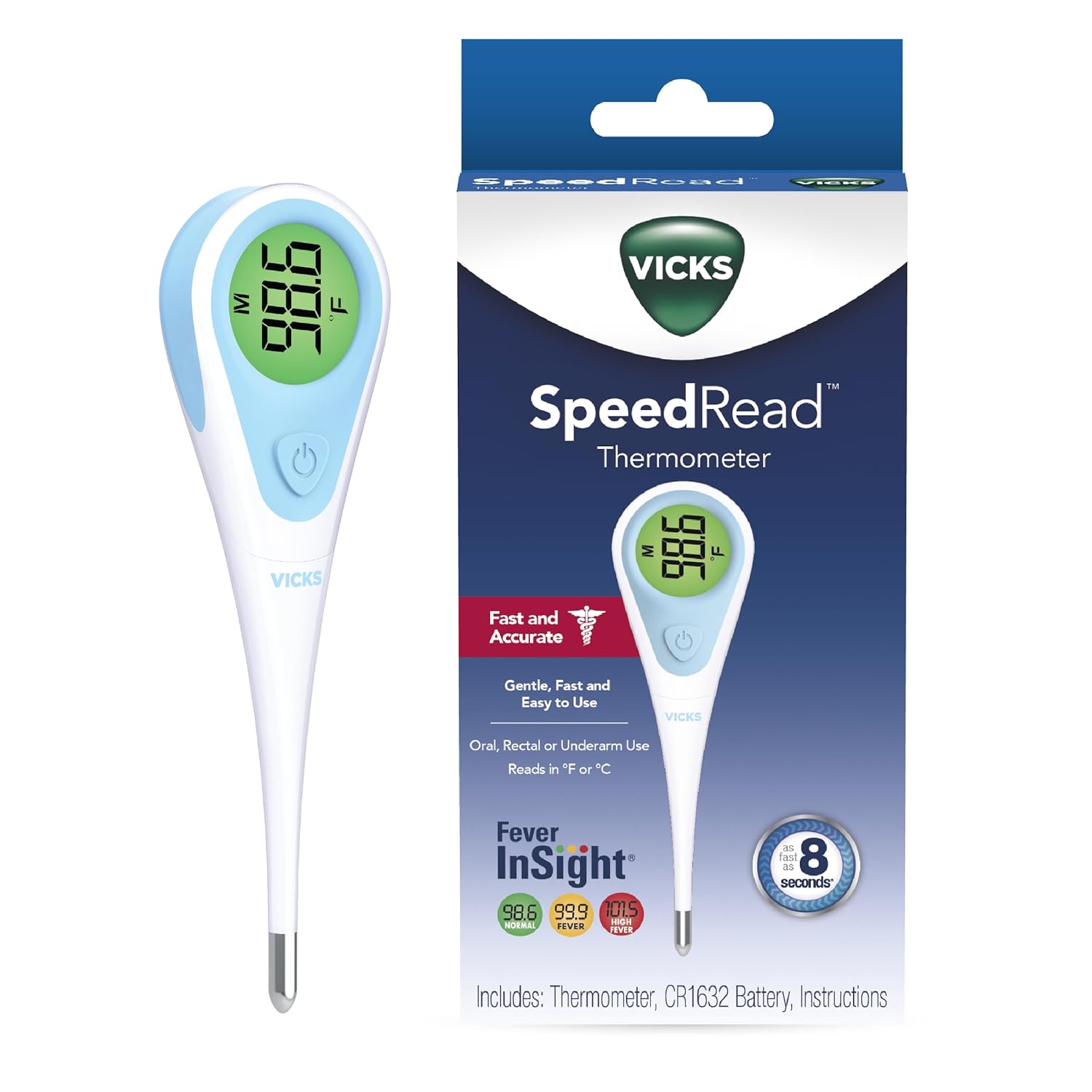 Vicks SpeedRead V912US |
|
| $9.89 | Check price $9.89 |
Braun ThermoScan 7+ Connect (IRT6575US)
Check price on Amazon $59.49
iProven DMT-489 Dual Ear & Forehead
Check price on Amazon $27.99
Vicks SpeedRead V912US
Check price on Amazon $9.89
Braun ThermoScan 7+ Connect (IRT6575US) — full review
The Braun ThermoScan line has been the dominant ear baby thermometer in US pediatric offices for more than a decade, and the ThermoScan 7 is the consumer version that closes most of the accuracy gap with the clinical models. The mechanism that matters is the pre-warmed tip: the probe is warmed to body temperature before each reading, which eliminates the cold-probe cooling artifact that drops most tympanic readings 0.4–0.7°F below true core temperature. Combined with the position-check guidance system — a light and beep that confirms the probe is correctly seated against the tympanic membrane — the result is a baby thermometer that produces clinically-actionable readings in roughly 1.5 seconds.
In the pediatric tympanic validation literature, a properly seated ear probe tracks rectal core temperature closely — and the ThermoScan 7’s design targets the two biggest error sources those studies identify: cold-probe cooling artifact (addressed by the pre-warmed tip) and probe misplacement (addressed by the position-check system). One caveat from that same literature: significant ear-canal cerumen can pull tympanic readings low, so accuracy depends on a reasonably clear canal.
The Age Precision color-coded display is genuinely useful for sleep-deprived parents — you set the baby’s age once, and the display lights up green for normal, yellow for borderline, and red for fever, with thresholds adjusted for the fact that “fever” means different things at 4 weeks versus 18 months. When the display does read red, hydration becomes the priority — our best pedialyte alternative guide covers electrolyte options babies will actually accept.
The trade-offs are real but manageable. At roughly $60, the ThermoScan 7 is 4x the price of a basic digital stick — defensible if you use it across multiple children or expect frequent fever episodes, harder to justify for a healthy single child who rarely runs warm. The disposable probe covers (sold in packs of 40 for around $7) add a few cents per reading, and you genuinely need them — skipping covers introduces cerumen contamination that drops accuracy meaningfully.
The ThermoScan 7 also won’t work as a rectal device, so for infants under 3 months you’ll still want a digital stick as a primary — treat this as the everyday workhorse for screening and trending, with a rectal stick as the confirmation tool when stakes are highest.
Check price on Amazon → $59.49
iProven DMT-489 Dual Ear & Forehead — full review
The iProven DMT-489 solves a problem the Braun ThermoScan can’t: how do you check a sleeping sick baby’s temperature without waking them? Ear thermometers require you to gently lift the head and seat the probe in the ear canal — doable on a deep sleeper, impossible on a light one. The DMT-489 is the best baby thermometer in this guide for true non-contact use: its forehead mode reads temporal artery temperature from 1–2 inches off the temple, which lets you walk in, check, and walk out of the nursery without the baby ever stirring. For overnight fever-trending on a sick child, that capability is worth real money.
In ear mode, the DMT-489 relies on the same tympanic physics as the Braun. Its forehead mode, like all temporal-artery devices, is more environment-sensitive: sweat evaporating off the skin cools the reading, and drafty rooms below 65°F can shift forehead readings 0.3–0.5°F low.
The fix is operator discipline: wipe the forehead dry, hold the device perpendicular to the temple at the manufacturer-specified distance, and avoid taking readings within 10 minutes of bottle feeding or bathing. With those controls, the forehead mode is a dependable screening tool for older infants and toddlers.
The ergonomic features make this the baby thermometer most parents reach for first at 2 a.m. The silent mode disables the confirmation beep so you can take a reading without waking the baby. The backlit display is readable in a dark hallway without flipping on lights.
The 20-reading memory with timestamps lets you actually see fever trending across the night — useful when you’re deciding whether a 101.3°F at 11 p.m. that’s now 100.8°F at 3 a.m. is improving or just the lower edge of a fever-pattern oscillation. Combined with the ~$30 price point, this is the everyday-use thermometer for the 3-month-and-older window when ear and forehead methods become clinically appropriate.
Check price on Amazon → $27.99
Vicks SpeedRead V912US — full review
The Vicks SpeedRead V912US is the baby thermometer your pediatrician will tell you to buy when you call about an under-3-month-old. It’s a simple digital stick — no infrared sensor, no Bluetooth, no app — that takes a fast, accurate temperature via the rectal, oral, or axillary route.
For newborns, the AAP and every major pediatric guideline consider rectal the gold standard because it most closely reflects core body temperature, with the least artifact from skin sweat, ambient air, or operator technique. The V912US delivers that reading in roughly 8 seconds with a flexible tip designed for infant comfort, making it the best baby thermometer for the under-3-month age window.
The V912US is the device we’d treat as the rectal reference in any home fever kit: the manufacturer’s stated accuracy spec is ±0.2°F, and the simple thermistor design avoids the ambient-air and positioning sensitivities that complicate infrared readings. The fever-flash backlight (red display when reading exceeds 99.5°F) is a small but genuinely useful feature for sleep-deprived parents trying to read a number on a tiny LCD in the dark.
The limitations are obvious by design. It’s a contact thermometer, so taking a reading on a sleeping baby usually wakes them. There’s no ear mode, no forehead mode, and no memory for trending.
For families with one young infant and a tight budget, it’s the only baby thermometer you actually need until your baby is past the 3-month emergency-fever threshold. For families with toddlers, it’s the backup device when the no-touch reading on the iProven looks suspicious and you want a confirmation. At ~$10, owning two is cheaper than owning one of any other device on this list, and we’d recommend exactly that — keep one in the bathroom for routine readings and one in the nursery for middle-of-the-night use.
Check price on Amazon → $9.89
5 things to know before buying a baby thermometer
Under 3 months, rectal is non-negotiable
Every major pediatric guideline — AAP, CDC, NHS — treats rectal as the gold standard for infants under 3 months because a missed fever at this age can mean missed serious bacterial infection. No-touch and ear thermometers are not validated as decision-makers in this age group. If your no-touch reading on a 6-week-old shows anything near 100°F, confirm with a rectal reading before calling your pediatrician. Pair this with our baby first aid kit guide so the right thermometer is stocked before you need it.
Ear thermometers need correct probe placement to be accurate
The most common cause of a “wrong” ear reading isn’t the device — it’s the operator. The probe has to be seated in the ear canal aimed toward the tympanic membrane, with the ear gently pulled back (for older kids) or straight back (for infants). A reading taken with the probe pointed at the canal wall instead of the eardrum can be 1–2°F too low. The Braun ThermoScan 7’s position-check feature is meaningful here — it tells you when the probe is correctly seated, taking the operator-skill variable out of the result.
Forehead thermometers are sensitive to skin and environment
Temporal artery (forehead) thermometers measure skin temperature and infer core temperature from it. That inference breaks down when the skin is sweaty (evaporative cooling drops the reading), when the room is cold (ambient cooling drops the reading), when the baby has just been bathed or fed, or when there’s hair in the measurement zone. For trending a known fever overnight, forehead readings are excellent. For diagnosing a fever in a newborn, they’re a screening tool only.
Repeatability matters as much as raw accuracy
A baby thermometer that reads 99.8°F, 100.6°F, and 99.2°F in three back-to-back readings 10 seconds apart isn’t measuring temperature — it’s generating noise. Always take 2–3 consecutive readings and look for clustering within ±0.2°F. If readings vary wildly, the issue is usually device positioning or environmental contamination, not actual fever fluctuation. Per the tympanic validation literature, repeatability and agreement matter as much as headline accuracy.
Battery and probe-cover supply chain matters more than parents expect
The baby thermometer you bought at 32 weeks pregnant is the one you’ll reach for at 3 a.m. with a sick 6-month-old — and dead batteries or missing probe covers in that moment are exactly the kind of small failure that turns a manageable situation into an ER visit. Check the battery type at purchase (CR2032, AA, AAA) and stock a spare. For the Braun, buy a 40-pack of disposable lens filters at the same time you buy the device. For digital sticks, replace the unit roughly every 3–5 years — thermistor drift is real and degrades accuracy over the device lifespan.
Best baby thermometer: frequently asked questions
The best baby thermometer depends on age. For infants under 3 months, the most accurate thermometer is a digital rectal stick like the Vicks SpeedRead V912US — the AAP and every major pediatric guideline considers rectal the clinical gold standard at this age. For infants over 3 months, a properly used tympanic (ear) thermometer like the Braun ThermoScan 7 with pre-warmed tip technology tracks rectal core temperature closely in the published pediatric validation literature. Forehead thermometers are useful as screening and trending tools but should be confirmed with rectal or tympanic when the reading suggests fever in a young infant.
Ear is more accurate when correctly used. Tympanic readings reflect blood temperature at the eardrum, which sits near the hypothalamus and tracks core body temperature closely. Forehead temporal artery thermometers infer core temperature from skin, which is affected by sweat, ambient air, hair, and skin perfusion. The forehead advantage is non-contact use on a sleeping baby — clinically the slight accuracy trade-off is acceptable for screening, but for confirming a fever, ear or rectal wins.
Under 3 months: any rectal temperature of 100.4°F (38°C) or higher requires same-day pediatric evaluation, regardless of how the baby looks. This isn’t precautionary — it’s because young infants can have serious bacterial infection without obvious symptoms. 3–6 months: fever above 102°F or any fever with feeding refusal, lethargy, or unusual irritability warrants a call.
6–24 months: behavior matters more than the absolute number — a comfortable, feeding, interactive baby at 102°F is in a different situation than a lethargic one at 100.6°F. Always consult the AAP fever guidance at HealthyChildren.org and your own pediatrician.
Yes — for infants under 3 months, rectal remains the recommended method per AAP and CDC guidance. The reason is that the fever threshold in this age group (100.4°F) is set against rectal baseline data, and no-touch methods don’t reliably distinguish 99.8°F from 100.6°F in young infants. Once your baby is older than 3 months, tympanic and forehead methods become clinically appropriate for routine use, with rectal reserved for confirming concerning readings. The Vicks SpeedRead V912US specifically supports rectal use with a flexible tip designed for infant comfort.
For the 0–3 month stretch, skip the pricier ear models — a newborn’s ear canal is too narrow for a reliable tympanic seal. The best newborn thermometer is actually the cheapest option in this lineup: a flexible-tip digital stick like the Vicks SpeedRead V912US, used rectally. Save the no-touch and tympanic upgrades for after the 3-month mark.
Different reading sites measure different things. Rectal reads core body temperature directly. Tympanic reads radiant heat from the eardrum near the hypothalamus. Forehead reads skin temperature over the temporal artery and infers core. Axillary (armpit) reads skin temperature in a covered area.
Even with an accurate, properly used baby thermometer, you’ll see roughly 0.5–1.0°F variation across these sites on the same baby at the same moment. The fix is to pick one method as your primary for trending, and use the others as cross-checks. Don’t compare a forehead reading at 9 a.m. to a rectal reading at 11 a.m. and conclude the fever broke — you’re comparing two different measurements.
For most families, yes — or at least one best baby thermometer plus a backup. A $10 digital stick covers rectal readings for the newborn window. A $30–$60 ear or forehead device covers the everyday screening and trending phase from 3 months onward. The cost of having both is roughly $40–$70 total, which is trivial against a single avoidable ER visit caused by a missed or misread fever.
If budget is genuinely tight, start with the Vicks SpeedRead V912US — it’s the baby thermometer the AAP recommends for the highest-stakes age window and works adequately for the rest of infancy. Add the no-touch or ear thermometer once the baby is past 3 months. Stock it alongside everything in our complete baby first aid kit guide.
Best baby thermometer for ear accuracy: Braun ThermoScan 7+ Connect (IRT6575US)
The most accurate ear baby thermometer in this guide, with pre-warmed tip technology that closes the cold-probe artifact gap and Age Precision color coding that interprets the reading for you. For infants over 3 months it’s the everyday workhorse — pair it with a $10 Vicks SpeedRead for the under-3-month window and rectal confirmations, and you have a complete fever-detection setup for under $80.
Check price on Amazon → $59.49
Medical disclaimer: Not medical advice. Thermometer selection and fever interpretation should always be made in consultation with your child’s pediatrician, especially when readings exceed 100.4°F in an infant under 3 months or when fever is accompanied by lethargy, feeding refusal, persistent vomiting, breathing difficulty, or unusual irritability. The information here is educational and reflects current clinical guidance as of our last review. Consult HealthyChildren.org (AAP) and the CDC for additional pediatric guidance.
Prices: Reflect typical Amazon pricing as of May 2026 and may vary. Manufacturer model numbers occasionally change — verify on the linked product page before ordering. The tympanic-vs-rectal validation literature referenced is available via PubMed (NCBI).
- Noor A. Fever in the Infant and Toddler. Medscape Drugs & Diseases (eMedicine); updated Jul 30, 2024. Fever (≥38.0°C / 100°F) is a sign of infection and one of the most common problems in infants and toddlers; a fever without a focus often warrants evaluation.
- Pantell RH, Roberts KB, Adams WG, et al. Evaluation and Management of Well-Appearing Febrile Infants 8 to 60 Days Old. Pediatrics. 2021;148(2):e2021052228. PMID:34424196. Defines fever as a rectal temperature of 38.0°C (100.4°F) or higher in infants 8 to 60 days old, providing the basis for rectal measurement in young infants.
- Craig JV, Lancaster GA, Taylor S, Williamson PR, Smyth RL. Infrared ear thermometry compared with rectal thermometry in children: a systematic review. Lancet. 2002;360(9333):603-609. This systematic review found that ear thermometry has wide limits of agreement versus rectal thermometry, the reference standard, supporting rectal measurement for accuracy in infants.
- American Academy of Pediatrics. Fever and Your Baby. HealthyChildren.org. AAP parent guidance states that a rectal temperature is the most accurate measurement in infants and young children.