
Best Pedialyte Alternative 2026: 3 Sick-Day Hydration Picks Reviewed
The best pedialyte alternative for your sick child should match the sodium-glucose ratio that the World Health Organization and American Academy of Pediatrics use to define a clinically effective oral rehydration solution — not a sports drink, not a juice cut with water, and not an electrolyte powder formulated for adult endurance athletes. We compared the leading contenders the way a nurse would: by reading the nutrition labels against the WHO oral-rehydration formula — sodium content first, then the sugar-to-sodium balance that actually drives sodium-glucose cotransport in the gut. Three products line up with that formula: the Pedialyte Electrolyte Powder On-the-Go Hydration Variety Pack at roughly $15 (our top pick for sick-day variety and kid-friendly flavor compliance), the Pedialyte AdvancedCare Plus 18-pack at roughly $29 (our premium pick with 33% more electrolytes and PreActiv prebiotics for post-illness gut recovery), and the DripDrop ORS Hydration Variety Pack at roughly $32 (our best WHO-formulated alternative for parents who want a non-Pedialyte ORS option). All three line up with the World Health Organization oral rehydration salt guidelines still considered the global gold standard for pediatric dehydration.
Effectiveness alone isn’t enough — a pedialyte alternative also has to be something a sick child will actually drink in the volumes needed to rehydrate. Per AAP guidance via HealthyChildren.org, mild dehydration in children should be treated with 50–100 mL of oral rehydration solution per kilogram of body weight over 4 hours, which only works if the child will sip steadily. Pair this guide with our best baby fever management kit guide when dehydration arrives alongside a viral fever, and use our complete baby first aid kit guide to make sure oral rehydration packets are stocked alongside the rest of your sick-day essentials.
Best pedialyte alternative top picks, compared against the WHO ORS standard
The variety-flavor powder pack that maximizes child compliance through sick days, the premium pedialyte alternative with extra electrolytes and prebiotics for post-illness gut recovery, and the WHO-formulated DripDrop ORS option for parents who want a non-Pedialyte oral rehydration solution.
Safety first: oral rehydration is for mild to moderate dehydration only
Babies under 1 year showing signs of dehydration — no wet diaper for 6+ hours, sunken fontanelle, lethargy, sunken eyes, dry mouth, or unusual sleepiness — need pediatric evaluation, not just home rehydration with an oral rehydration solution. The WHO ORS solution and any pedialyte alternative is designed to support mild to moderate dehydration, not to rescue a severely dehydrated infant who may need IV fluids. The AAP and WHO are unambiguous: if your baby under 1 year hasn’t produced a wet diaper in 6 hours, has a sunken soft spot, or is unusually limp or hard to wake, that’s an urgent-care or ER visit, not a sip-and-wait situation.
Equally important: never use sports drinks (Gatorade, Powerade, Body Armor) for infant rehydration. The sodium-to-sugar ratio is wrong for pediatric oral rehydration — sports drinks contain roughly 18–20 mEq/L sodium versus the 45–75 mEq/L target, and the carbohydrate concentration is high enough to worsen osmotic diarrhea. The WHO ORS solution remains the global gold standard, and every product on this list is formulated to meet that profile. Always trust how your child looks over how much they’ve drunk.
How we evaluated the best pedialyte alternative oral rehydration products
A pedialyte alternative that has the wrong sodium-glucose ratio, tastes so bad that a sick toddler refuses it, or worsens vomiting through high osmolarity is worse than just offering small sips of water — it generates false confidence without producing the rehydration the child actually needs. We reviewed three things:
ORS conformity against WHO reference values. Each product’s composition at package-directed strength was compared against the CDC oral rehydration therapy framework and WHO target ranges. Sodium concentration target: 45–75 mEq/L. Glucose target: 20 g/L (with sodium-glucose ratio close to 1:1 molar). Osmolarity target: roughly 245 mOsm/L. Products that fell outside the WHO window on any axis were flagged as supplementation-only and not eligible for the picks list.
Child compliance and palatability. A perfectly formulated oral rehydration solution is useless if a sick child won’t drink it. Reaching the AAP’s 50–100 mL per kilogram over a 4-hour window depends on a child sipping steadily, so we weighted the features that make that achievable: number of flavor options, single-serve dosing accuracy, and the sweetener and sodium load on the label. Products offering three or more flavors ranked higher on the practical grounds that a refused flavor can be swapped rather than abandoned.
Recovery support and value-per-packet. Rehydration only counts if it holds — urine output, energy and feeding returning as the illness resolves — and that depends on the ORS profile and steady intake far more than on the brand on the packet. We also asked whether the per-packet cost match the per-packet value, especially for families who stock several packets in the medicine drawer for the unpredictable timing of pediatric illness? A product that meets the WHO profile but ships in a format or flavor a sick child is unlikely to accept still lost points in our final ranking.
Best pedialyte alternative: side-by-side comparison
| Pick | Product | Key strengths | Watch-outs | Price | Where to buy |
|---|---|---|---|---|---|
| Top Pick | 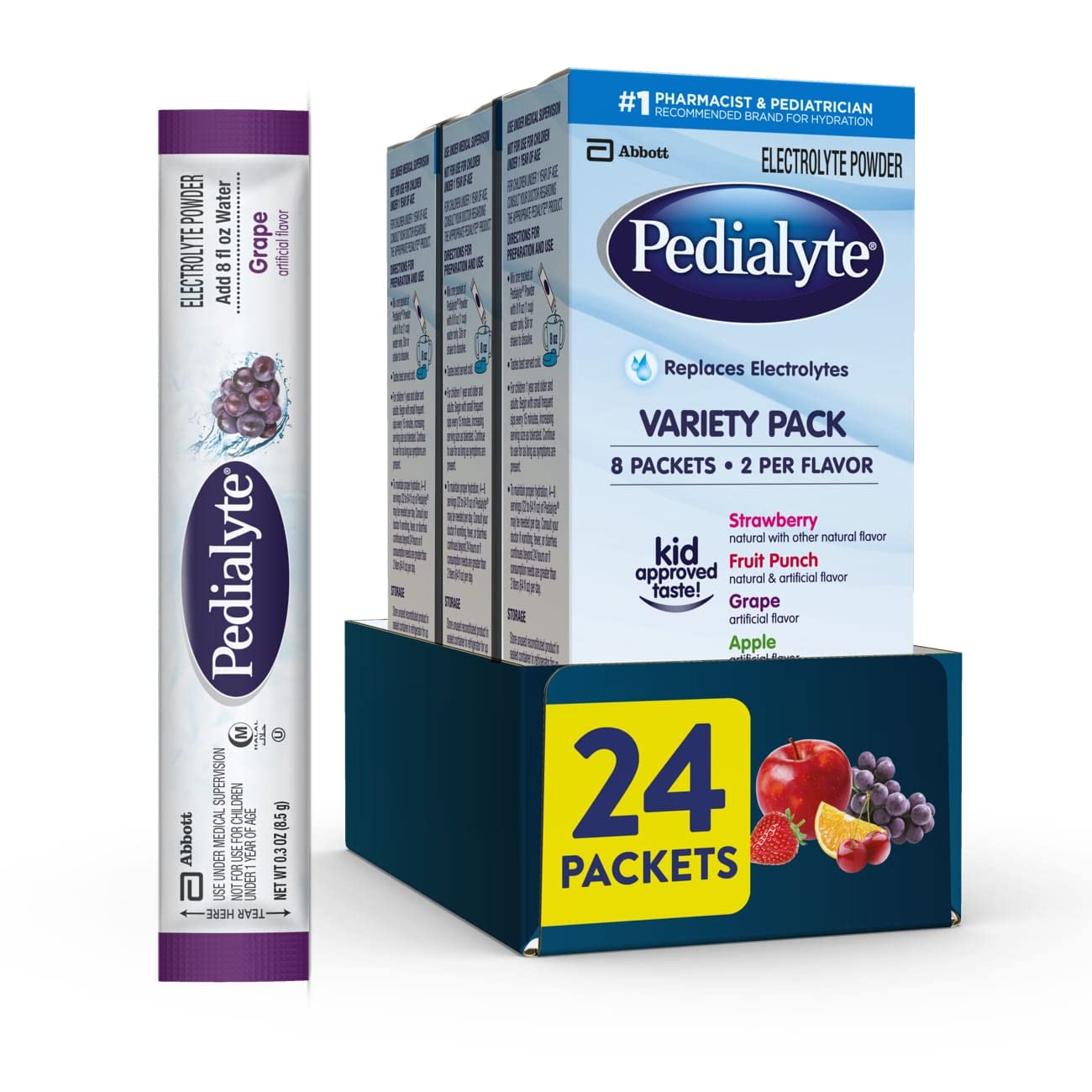 Pedialyte Electrolyte Powder On-the-Go Hydration Variety Pack |
|
| $14.97 | Check price |
| Best Premium |  Pedialyte AdvancedCare Plus 18-Pack |
|
| $28.98 | Check price |
| Best DripDrop |  DripDrop ORS Hydration Variety 32-Pack |
|
| $32.24 | Check price |
Pedialyte Electrolyte Powder On-the-Go Hydration Variety Pack
Pedialyte AdvancedCare Plus 18-Pack
DripDrop ORS Hydration Variety 32-Pack
Pedialyte Electrolyte Powder On-the-Go Hydration Variety Pack — full breakdown
The Pedialyte Electrolyte Powder Variety Pack is the everyday workhorse pedialyte alternative for families who want one product that handles the full sick-day arc: first vomit, day-two stomach bug recovery, day-three post-fever fluid replacement, and the random low-fluid afternoon after a hot park visit. The mechanism that matters is the sodium-glucose ratio: roughly 45 mEq/L sodium paired with the right amount of dextrose to drive sodium-glucose cotransport across the intestinal wall, the rehydration mechanism the WHO ORS protocol was built around. Combined with the powder format — accurate dosing per 16 fl oz of clean water — the result is a pedialyte alternative that can support rehydration in 3–4 hours of steady sipping.
On the criteria that decided this list, the Variety Pack has the strongest drinkability case of the three: three flavors in single-serve packets, each mixed into 16 fl oz of water so the prepared strength is consistent every time. That matters on day 2 of a long sick window: a flavor that has been refused can be swapped for Strawberry Lemonade or Orange instead of abandoned.
Recovery itself is not brand-specific — it follows from the ORS profile and from steady intake. Watch the standard signs: urine output picking back up, energy and feeding returning. If they do not, that is a call to your pediatrician rather than a switch to a different packet.
The trade-offs are real but manageable. The per-serving cost is slightly higher than buying ready-to-drink Pedialyte bottles by the case, though the powder format wins on shelf-stability, accurate dosing, and the ability to make exactly as much as the child will drink. The packets require clean drinking water for mixing, which is a non-issue at home but worth noting for travel — pair with a sealed water bottle for diaper-bag preparedness.
For most families, the On-the-Go Variety Pack is the right pedialyte alternative starting point: stock it in the medicine drawer, keep one packet in each diaper bag, and you have ORS-compliant rehydration coverage for roughly 12 sick days at typical intake rates.
Pedialyte AdvancedCare Plus 18-Pack — full breakdown
The Pedialyte AdvancedCare Plus solves a problem the original formula doesn’t fully address: how do you support a child whose gut microbiome has been disrupted by a 48-hour gastroenteritis episode, not just replace the fluid they’ve lost? The AdvancedCare Plus is the best pedialyte alternative here for post-illness recovery: 33% more electrolytes than original Pedialyte plus PreActiv prebiotics designed to feed the beneficial gut bacteria that get washed out during diarrhea. For a child who has been sick for 36 hours and needs both rehydration and gut-recovery support, that combined capability is meaningful.
AdvancedCare Plus ships in a single flavor, which is its main practical disadvantage against the Variety Pack: there is nothing to switch to if that flavor gets refused mid-illness. The argument for AdvancedCare Plus is its prebiotic content on top of the electrolytes — a reasonable edge over single-electrolyte formulas in the back half of a gastroenteritis episode, though the electrolyte and glucose ratio is what does the real rehydration work.
The fix for the flavor-fatigue trade-off is sequencing: lead with the Variety Pack for the first 12–18 hours of a sick window, then switch to AdvancedCare Plus once vomiting has stopped and the focus shifts from rapid rehydration to sustained recovery support. Used this way, AdvancedCare Plus is the right pedialyte alternative for the long tail of a 3–5 day sick episode.
The label specs are what make this a reasonable step-down for the back half of an illness. Sodium concentration sits at the upper end of the WHO 45–75 mEq/L band, which matters for kids with significant ongoing stool losses.
The PreActiv prebiotic blend (fructooligosaccharides and inulin) is well-tolerated and supports the kind of gut microbiome restoration the pediatric ORS literature increasingly emphasizes for post-diarrheal recovery. Combined with the ~$29 price point for 18 packets, this is the premium pedialyte alternative worth keeping in the drawer for the sick days that drag past 24 hours.
DripDrop ORS Hydration Variety 32-Pack — full breakdown
The DripDrop ORS Variety Pack is the pedialyte alternative for parents who want a non-Pedialyte oral rehydration option formulated specifically against the WHO ORS reference standard. It was originally developed by a Mayo Clinic-trained physician working in pediatric humanitarian settings where the WHO ORS profile is the only acceptable formulation — and the consumer product retains that clinical-grade target.
For families looking outside the Pedialyte brand, DripDrop is the most clinically-credible pedialyte alternative we reviewed. Sodium concentration lands squarely in the 45–75 mEq/L WHO band, glucose at roughly 20 g/L, and overall osmolarity close to the 245 mOsm/L reference value. The four flavors (Grape, Fruit Punch, Strawberry Lemonade, Cherry) and the non-GMO/vegan certification make it appropriate for families with dietary preferences that rule out some mainstream electrolyte products.
DripDrop sits alongside the two Pedialyte SKUs on composition; where it differs is palatability. Its sodium load gives it a more pronounced salt note than Pedialyte’s milder, sweeter profile — worth knowing before buying a 32-pack for a child already used to Pedialyte. On the composition that drives rehydration it lands in the same WHO band as the Pedialyte products — which is the point: the ORS profile, not the brand, is what does the work.
The limitations are flavor-driven, not clinical. The stronger salt profile is by design — DripDrop was built for adult endurance and humanitarian-aid settings where palatability is less prioritized than clinical effect. For pediatric use, the flavors work but lack the toddler-ready smoothing that Pedialyte has invested years in developing.
For families who want a non-Pedialyte pedialyte alternative — whether for dietary preference, cost-per-packet, or just wanting a backup brand in the drawer — DripDrop is the right choice. At ~$32 for 32 packets, the per-packet value beats the Pedialyte AdvancedCare Plus by a meaningful margin, and we’d recommend keeping at least one box alongside your primary Pedialyte stock for redundancy and flavor variety across long sick days.
5 things to know before buying a pedialyte alternative
Under 1 year, sick-day dehydration needs a pediatrician call
Every major pediatric guideline — AAP, WHO, CDC — recommends pediatric evaluation before starting any oral rehydration solution in an infant under 1 year, especially if any dehydration sign is present. A pedialyte alternative is appropriate for mild dehydration in this age group only with pediatrician sign-off. If your baby under 1 year hasn’t had a wet diaper for 6+ hours, has a sunken fontanelle, or is unusually sleepy or floppy, that’s an urgent-care visit, not a sip-and-wait situation. Pair this with our baby first aid kit guide so you have the right tools before the call.
Sodium-glucose ratio is what makes an oral rehydration solution work
The most common cause of a “wrong” oral rehydration choice isn’t the brand — it’s the formulation. The WHO oral rehydration salts target a specific 45–75 mEq/L sodium concentration paired with about 20 g/L glucose, which drives sodium-glucose cotransport across the gut wall and pulls water along with it. Sports drinks like Gatorade have roughly 18 mEq/L sodium, half the target, and 2–3x the sugar — wrong on both axes. Juice and watered-down juice are even further off. Stick with WHO-formulated pedialyte alternative products or Pedialyte itself for actual rehydration.
Compliance matters as much as composition
A perfectly formulated pedialyte alternative is useless if a sick toddler won’t drink it. Real-world rehydration depends on a child sipping steadily over 3–4 hours — small volumes (5–15 mL per sip) every 5–10 minutes is the AAP-recommended pace. Larger volumes can trigger vomiting in a kid with gastroenteritis. Variety packs win because flavor fatigue kicks in around hour 6–8 of a sick window, and being able to switch from Grape to Strawberry Lemonade to Orange means a refused flavor does not end the rehydration attempt.
Powder beats ready-to-drink for stockpiling, equal for rehydration
Powder pedialyte alternative packets and ready-to-drink bottles deliver identical ORS profiles when prepared correctly. The differences are practical: powder is shelf-stable for 24+ months (medicine-drawer friendly), produces zero waste once opened (mix only what the child will drink), and travels lighter. Ready-to-drink is convenient when minutes matter and the child will drink a full bottle. For most families, stocking 24 powder packets covers more sick days at less cost than the same dollar value in bottles. Per published pediatric ORS guidance, the clinical outcomes are equivalent.
Never substitute sports drinks for an oral rehydration solution in young children
The pedialyte alternative you’re tempted to grab at a gas station — Gatorade, Powerade, Body Armor — is the wrong tool. Sports drinks are formulated for sweating adult athletes losing modest amounts of sodium, not for children losing significant sodium and fluid through diarrhea and vomiting. The sodium concentration is roughly half the WHO target and the sugar concentration is 2–3x too high, which can drive osmotic diarrhea and make dehydration worse. Stock real ORS-formulated products and consult CDC oral rehydration therapy guidance for sick-day protocols.
Best pedialyte alternative: frequently asked questions
The best pedialyte alternative depends on the sick-day phase. For first-line rehydration in toddlers and older children with mild to moderate dehydration, the Pedialyte Electrolyte Powder On-the-Go Hydration Variety Pack is our top pick — three toddler-ready flavors, accurate single-serve dosing, and WHO-compliant sodium-glucose ratio. For post-gastroenteritis recovery beyond 24 hours, Pedialyte AdvancedCare Plus delivers 33% more electrolytes plus prebiotics for gut recovery. For families who want a non-Pedialyte ORS option, DripDrop ORS Variety is formulated by a Mayo Clinic-trained physician specifically against the WHO oral rehydration target.
Pedialyte and any WHO-formulated pedialyte alternative beat Gatorade for sick-child rehydration. Gatorade contains roughly 18 mEq/L sodium versus the 45–75 mEq/L WHO oral rehydration target — less than half what a dehydrated child actually needs. The sugar concentration in Gatorade is also 2–3x higher than the WHO ORS target, which can worsen osmotic diarrhea in a child with gastroenteritis. Never use sports drinks for infant rehydration — the sodium/sugar ratio is wrong. Stick with Pedialyte, the Pedialyte alternative products listed here, or WHO ORS sachets if available.
Under 1 year: any baby without a wet diaper for 6+ hours, with a sunken fontanelle, sunken eyes, dry mouth, lethargy, or unusual sleepiness needs urgent pediatric evaluation, not just home oral rehydration. 1–3 years: fewer than 4 wet diapers in 24 hours, no tears when crying, sunken eyes, or persistent vomiting that prevents sipping warrants a call.
3+ years: dark concentrated urine, refusal to drink, persistent vomiting, or lethargy needs same-day evaluation. Always consult the AAP dehydration guidance at HealthyChildren.org and your own pediatrician.
Clinically, yes — DripDrop and Pedialyte both target the WHO oral rehydration profile (45–75 mEq/L sodium, ~20 g/L glucose, ~245 mOsm/L osmolarity), so the composition that drives rehydration is effectively the same. The differences are flavor profile (DripDrop has a more pronounced salt note that some kids accustomed to Pedialyte flag as “too salty”) and pediatrician name recognition (Pedialyte is more commonly recommended by name in US pediatric offices). For families wanting a non-Pedialyte pedialyte alternative, DripDrop is the most clinically-credible choice.
Per AAP and WHO guidance, mild dehydration in children is treated with 50–100 mL of oral rehydration solution per kilogram of body weight over 4 hours. For a 12 kg toddler, that’s 600–1200 mL of pedialyte alternative across 4 hours, delivered as small sips (5–15 mL) every 5–10 minutes.
Larger boluses can trigger vomiting in a child with gastroenteritis. After the initial rehydration window, continue maintenance intake at roughly half the rehydration rate until normal urine output and feeding return. Always confirm dosing with your pediatrician, especially for infants under 1 year.
For most families, yes — pediatric illness is unpredictable, and the difference between starting oral rehydration at hour 2 versus hour 8 of a vomiting episode is the difference between home recovery and an ER trip for IV fluids. A stocked pedialyte alternative powder pack is shelf-stable for 24+ months, costs roughly $0.62 per packet, and pays for itself the first time a sick-day call happens at 11 p.m. on a Sunday.
If budget is tight, start with the Pedialyte Electrolyte Powder On-the-Go Hydration Variety Pack — it covers the highest-volume first-line use case and works adequately across the full sick-day arc. Add DripDrop or AdvancedCare Plus as your needs evolve. Stock it alongside everything in our complete baby first aid kit guide.
Our #1 best pedialyte alternative pick: Pedialyte Electrolyte Powder On-the-Go Hydration Variety Pack
The most compliance-friendly pedialyte alternative we reviewed, with three toddler-ready flavors that prevent the day-2 flavor fatigue that tanks single-SKU products, WHO-compliant sodium-glucose ratio for actual oral rehydration efficacy, and shelf-stable powder format for medicine-drawer stockpiling. For families wanting a single starter product, this is it — pair it with a backup box of DripDrop or AdvancedCare Plus and you have ORS-compliant coverage for roughly 12 sick days.
Medical disclaimer: Not medical advice. Pedialyte alternative selection and dehydration management should always be made in consultation with your child’s pediatrician, especially when dehydration signs appear in an infant under 1 year (no wet diaper for 6+ hours, sunken fontanelle, lethargy) or when oral rehydration is accompanied by persistent vomiting, bloody stools, high fever, or unusual sleepiness. The information here is educational and reflects current clinical guidance as of the date last reviewed. Consult HealthyChildren.org (AAP) and the WHO for additional pediatric guidance.
Prices: Reflect typical Amazon pricing as of May 2026 and may vary. Manufacturer pack counts and formulations occasionally change — verify on the linked product page before ordering. The pediatric ORS efficacy literature referenced is available via PubMed (NCBI).
- Koyfman A. Pediatric Dehydration. Medscape Drugs & Diseases (eMedicine); updated Dec 18, 2023. In children, volume depletion is usually caused by fluid losses from vomiting or diarrhea; early rehydration reduces progression to hypovolemic shock.
- King CK, Glass R, Bresee JS, Duggan C. Managing Acute Gastroenteritis Among Children: Oral Rehydration, Maintenance, and Nutritional Therapy. MMWR Recomm Rep. 2003;52(RR-16):1-16. CDC guidance recommends oral rehydration solution as first-line therapy for mild dehydration (50 mL/kg over 4 hours) and states that sports drinks are not appropriate because they are low in sodium and high in carbohydrate.
- World Health Organization, UNICEF. Oral Rehydration Salts: Production of the New ORS (WHO/FCH/CAH/06.1). Geneva: WHO/UNICEF; 2006. Defines the reduced-osmolarity ORS composition of sodium 75 mmol/L, glucose 75 mmol/L, and a total osmolarity of 245 mOsm/L.