
Best Baby Fever Management Kit 2026: 3 Sick-Day Essentials Reviewed
The best baby fever management kit isn’t a single product — it’s a small, organized set of tools your household can reach for at 2 a.m. when an infant spikes a temperature and the nose-and-cough symptoms inevitably arrive a day later. We reviewed the three sick-day essentials we’d actually want sitting in a nursery medicine drawer right now: the NoseFrida SnotSucker Original at roughly $15 (our top pick for safe, physician-designed nasal clearance), a NoseFrida + 24 filter bundle at roughly $20 (our best-value option for cold-season households), and a Kids Cough Syrup daytime/nighttime combo 4-pack at roughly $26 (our pick for cough and mucus relief in children ages 2–12 only, never under). Together, these three products form the core of a best baby fever management kit that prioritizes the things parents can actually do safely at home, paired with a clear escalation protocol from the American Academy of Pediatrics.
Fever in babies is rarely the actual problem — it’s the body’s response to an underlying infection, and the management decisions that matter most are whether to escalate to a pediatrician and how to keep the baby comfortable, fed, and breathing well while their immune system does its work. Per AAP infant fever guidance, a rectal temperature of 100.4°F (38°C) or higher in an infant under 3 months is a medical emergency that requires same-day evaluation, full stop. Pair this best baby fever management kit guide with our best baby thermometers review so you have an accurate rectal-capable device on hand, our best baby chest rub picks for soothing cold-season congestion, and our best Pedialyte alternative guide for keeping a feverish baby hydrated.
Best baby fever management kit top picks for 2026
A physician-designed nasal aspirator that safely clears the congestion fever rarely arrives without, a long-cold-season bundle that puts 24 spare filters in your drawer before you need them, and an age-appropriate cough syrup combo for the 2-and-up siblings who pick up every daycare bug.
Check price on Amazon $14.44
Check price on Amazon $19.99
Check price on Amazon $25.94
Safety first: a best baby fever management kit does not replace a pediatrician call
For infants under 3 months, ANY rectal temperature of 100.4°F (38°C) or higher is a medical emergency — call your pediatrician immediately or go to the emergency department, regardless of how the baby looks. No nasal aspirator, cough syrup, or fever-comfort product in this best baby fever management kit substitutes for that call. The AAP, CDC, and every major pediatric guideline are unambiguous on this. Confirm any concerning no-touch reading with a rectal reading before deciding what to do next, and never wait-and-see on a febrile newborn.
Per the FDA pediatric cough and cold warning, do NOT give over-the-counter cough and cold medicines to children under 4 years old — serious side effects including death have been reported in young children. The cough syrup in this best baby fever management kit is for ages 2–12 per the label (with the FDA’s under-4 warning still applying as the operative pediatric guidance), and under no circumstances should it be given to infants. For acetaminophen dosing in older babies and toddlers, follow the AAP weight-based antipyretic dosing guidance and your pediatrician’s specific guidance — never dose by age alone.
How we review the best baby fever management kit
A best baby fever management kit lives or dies on the 2 a.m. test: can a sleep-deprived parent grab the right tool, use it correctly the first time, and know when to escalate to the pediatrician? We evaluated three things for every product in this guide:
Nasal clearance design and filter hygiene. We reviewed each aspirator against pediatrician-recommended practice for infant nasal clearance: suction a parent can modulate breath-by-breath, a single-use hygiene-filter barrier between the mucus chamber and mouthpiece, and construction that sanitizes easily between uses per manufacturer care instructions. We also compared filter supply between the 4-filter and 24-filter packs, because an empty filter pack mid-sick-day is a real failure mode. A nasal aspirator that doesn’t actually clear the mucus blocking a feverish baby’s feeding isn’t part of a best baby fever management kit — it’s clutter in the drawer.
Cough relief label compliance in the age-appropriate window. The daytime/nighttime cough combo is labeled for children ages 2 and older. Per the operative FDA pediatric cough and cold warning, it should never be given to any child under 4 years old, and we flag that boundary repeatedly in this best baby fever management kit guide because it matters.
Real-world drawer ergonomics for a complete best baby fever management kit. Can you find every piece of the kit in the dark? Is the NoseFrida hygiene filter pack still sealed and clean six weeks into cold season? Is the cough syrup dosing cup intact and the label readable? Every piece of a best baby fever management kit needs to survive being thrown in a medicine drawer for six months and then grabbed at 3 a.m. with one hand. Products that look good on a spec sheet but fail drawer ergonomics do not earn a recommendation here.
Best baby fever management kit: side-by-side comparison
| Pick | Product | Key strengths | Watch-outs | Price | Where to buy |
|---|---|---|---|---|---|
| Top Nasal Clearance | 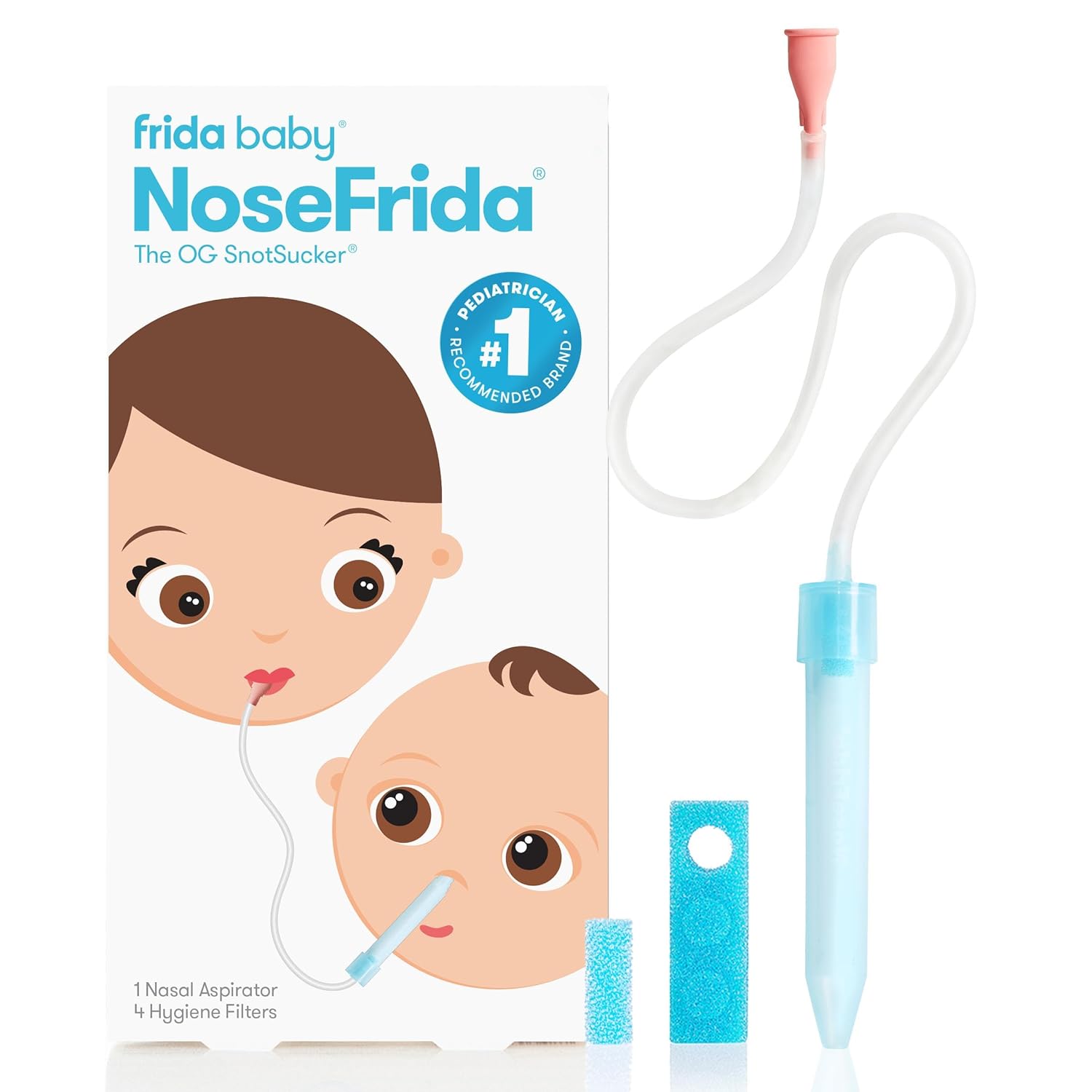 NoseFrida SnotSucker Original + 4 Hygiene Filters |
|
| $14.44 | Check price $14.44 |
| Best Value Bundle |  NoseFrida SnotSucker + 24 Extra Hygiene Filters |
|
| $19.99 | Check price $19.99 |
| Best Cough Relief — Ages 2–12 Only |  Kids Cough Syrup Daytime + Nighttime Combo (Ages 2–12, 4-Pack) |
|
| $25.94 | Check price $25.94 |
NoseFrida SnotSucker Original + 4 Hygiene Filters
Check price on Amazon $14.44
NoseFrida SnotSucker + 24 Extra Hygiene Filters
Check price on Amazon $19.99
Kids Cough Syrup Daytime + Nighttime Combo (Ages 2–12, 4-Pack)
Check price on Amazon $25.94
NoseFrida SnotSucker Original — full review
The NoseFrida SnotSucker is the single most-used product in any best baby fever management kit we’d actually build, because fever in babies almost always travels with congestion and a stuffy infant nose disrupts feeding, sleep, and comfort more than the fever itself. The aspirator’s design is what sets it apart: a parent applies suction with their own breath through a long tube, with a single hygiene filter sitting between the mucus chamber and the mouthpiece. That filter — a small foam disc — is designed to keep aerosolized mucus from reaching the parent while still letting the parent precisely modulate suction strength by inhaling harder or softer.
That breath-control mechanism is why pediatricians consistently recommend the NoseFrida over rigid bulb syringes for the best baby fever management kit use case. Bulb syringes apply a fixed, often excessive suction that can traumatize the delicate nasal mucosa of an infant and even cause minor bleeds — defeating the purpose of clearing the nose for easier breathing. The NoseFrida lets a parent start gentle, increase only as needed, and stop instantly when the baby tolerates it.
The hygiene filter system is what makes the device practical for a real best baby fever management kit. Each filter is single-use and disposable, and the original pack ships with 4 — enough for one bad cold or roughly a week of moderate congestion. Reusing filters is explicitly not recommended because saturated foam loses its barrier function, which is exactly when you don’t want mucus migrating up the tube.
The aspirator body is top-rack dishwasher safe per the manufacturer, which makes sanitizing between cold-season uses straightforward. The clear plastic chamber lets parents see how much mucus has been cleared per session, which both confirms the session worked and signals when it’s time to stop.
The trade-offs are real but minor in the context of a best baby fever management kit. Some parents need 1–2 sessions to get comfortable with the breath-suction mechanism — the first attempt feels unfamiliar, but the hygiene filter is designed to block aerosolized contact, and by session three most parents are comfortable. The 4-filter starter pack is also lean for a busy daycare household, which is exactly why the 24-filter bundle exists as an upgrade path.
Check price on Amazon → $14.44
NoseFrida SnotSucker + 24 Hygiene Filters — full review
The 24-filter bundle is the version of the NoseFrida we’d recommend for any household building a best baby fever management kit that needs to last a full winter cold season. The aspirator body is identical to the original — same physician-designed geometry, same breath-controlled suction mechanism, same dishwasher-safe construction. What changes is the filter supply, and that change matters more than the modest $5 price step-up suggests.
The hygiene filters are single-use and not meant to be reused, so a household working through a full cold season can easily outrun the 4 filters the original pack supplies. Re-ordering filters mid-cold-season is exactly the kind of operational friction that defeats a best baby fever management kit, because the moment you need a clean filter is almost never the moment Amazon delivers one.
The 24-filter pack pre-empts that failure mode entirely. Stored sealed and away from kitchen humidity, the spare filters keep their barrier function until you need them.
The per-filter cost in the 24-pack works out lower than buying refill packs separately at retail. For a single-child household with mild cold seasons, that math doesn’t quite tip in favor of the bundle. For multi-child households, daycare-exposed households, or any family building a best baby fever management kit they want to stop thinking about until they need it, the 24-pack is the obvious choice.
One operational note: store the spare filters in a sealed bag or original packaging in a cool, dry drawer. Foam filters left loose in a humid bathroom can absorb ambient moisture that compromises their barrier function. Keep them in the same drawer as the rest of your best baby fever management kit and they’ll be ready when you need them at 2 a.m.
Check price on Amazon → $19.99
Kids Cough Syrup Daytime + Nighttime Combo — full review
Before any product detail, the single most important fact about this piece of the best baby fever management kit: per the FDA pediatric cough and cold warning, over-the-counter cough and cold medicines should NOT be given to children under 4 years old. Serious side effects, including death, have been reported in young children. The cough syrup combo we recommend here is labeled for ages 2–12, but the FDA’s under-4 guidance remains the operative pediatric safety boundary, and you should always consult your pediatrician before giving any cough or cold medication to any child.
With that hard boundary stated, the household reality is that older siblings ages 4–12 bring home daycare and school bugs that infect the entire household — and managing their cough and keeping them comfortable can make the whole household’s sick stretch easier to get through. The daytime/nighttime combo is designed exactly for that workflow. The daytime formulation manages cough without sedation, letting a 5-year-old stay reasonably functional during the day. The nighttime formulation adds a mild sedative component to support sleep, which is when meaningful cough recovery actually happens.
The grape flavor is there to improve dosing compliance in resistant preschoolers, which matters because a cough syrup the child refuses to take is no cough syrup at all.
The mucus relief component (an expectorant) helps thin secretions so that the cough becomes productive — clearing mucus rather than just suppressing the reflex. That’s clinically the right approach for most pediatric coughs, because the cough itself is doing useful work and the goal is to make it more effective, not silence it.
The 4-pack format is appropriate for a best baby fever management kit because winter cold seasons typically include 3–5 sick episodes per child, and re-ordering mid-season is operational friction. Store the bottles in a cool, dark medicine drawer (not a humid bathroom), keep the dosing cups intact and visible, and verify expiration dates at the start of each cold season. Never extrapolate adult cough syrup dosing to children, never combine multiple cough/cold products without pediatrician approval, and never use this product in any child under 4 years old.
Check price on Amazon → $25.94
5 things to know before buying a best baby fever management kit
Under 3 months, fever is an emergency — not a kit problem
No best baby fever management kit substitutes for a pediatrician call when an infant under 3 months has a rectal temperature of 100.4°F (38°C) or higher. The kit is for comfort, hydration, and congestion management — not for delaying medical evaluation in a febrile newborn. Confirm any suspicious no-touch reading with a rectal reading on our best baby thermometers picks, then call your pediatrician immediately.
Nasal clearance is usually more impactful than fever reduction
The single most useful intervention in a best baby fever management kit is clearing a stuffy nose so the baby can feed and breathe. Babies are obligate nose-breathers in early months — a blocked nose disrupts feeding, sleep, and comfort more than the fever itself often does. A physician-designed aspirator like the NoseFrida earns its place in the kit by enabling the sick-day feeding that otherwise wouldn’t happen.
Cough and cold medicines are NOT for children under 4
The FDA explicitly warns against over-the-counter cough and cold medicines in children under 4 years old. Serious side effects, including death, have been reported. No piece of any best baby fever management kit for an infant or toddler should include a cough or cold medication unless your pediatrician has specifically prescribed one. For older siblings ages 4 and up, a labeled pediatric cough syrup combo is appropriate with pediatrician sign-off.
Hydration and comfort beat aggressive fever-reduction tactics
The goal of a best baby fever management kit isn’t to drive temperature to 98.6°F — it’s to keep the baby comfortable, hydrated, and breathing well while their immune system works. Acetaminophen at correct weight-based pediatric dosing (per AAP dosing guidance and your pediatrician’s specific guidance) is appropriate for comfort, not for chasing a number. Combine with hydration support from our best Pedialyte alternative guide and gentle chest soothing from our best baby chest rub picks.
Stock the kit before cold season, not during
The best baby fever management kit you assemble at 32 weeks pregnant is the one you’ll reach for at 3 a.m. with a sick 6-month-old — and missing pieces in that moment are exactly the kind of small failure that escalates a manageable situation into an avoidable ER trip. Check hygiene-filter supply, dosing-cup integrity, medication expiration dates, and battery status on your thermometer at the start of each cold season. The 24-filter NoseFrida bundle is specifically built for this preempt-don’t-react workflow.
Best baby fever management kit: frequently asked questions
A complete best baby fever management kit includes: a rectal-capable digital thermometer (gold standard for under 3 months), a physician-designed nasal aspirator like the NoseFrida SnotSucker for clearing congestion that fever almost always travels with, saline drops, infant-appropriate acetaminophen at correct weight-based dosing (per pediatrician guidance), a hydration support like Pedialyte or an approved alternative, and a clear escalation protocol identifying when to call the pediatrician. For older siblings ages 4–12, an age-appropriate cough syrup combo can be added with explicit pediatrician sign-off. Crucially, no cough or cold medication should be in the kit for any child under 4 years old per FDA warning.
Under 3 months: any rectal temperature of 100.4°F (38°C) or higher is a medical emergency requiring same-day pediatric evaluation, regardless of how the baby looks — call your pediatrician immediately. 3–6 months: fever above 102°F, or any fever with feeding refusal, lethargy, persistent vomiting, breathing difficulty, or unusual irritability warrants a call. 6–24 months: behavior matters more than the absolute number — a comfortable, feeding, interactive baby at 102°F is in a different situation than a lethargic one at 100.6°F. Always consult the AAP fever guidance at HealthyChildren.org and your own pediatrician.
Yes — the NoseFrida is, per its maker, physician-designed and is widely recommended by US pediatricians for infants from birth, including newborns. The hygiene filter system is designed to keep mucus from reaching the parent’s mouth, and the breath-controlled suction lets the parent modulate strength gently and stop the moment the baby is uncomfortable. It’s substantially gentler than rigid bulb syringes, which apply fixed suction that can traumatize delicate nasal mucosa. Use saline drops first to loosen mucus, then 1–2 short suction sessions per nostril, and stop if the baby becomes distressed.
No — per the FDA pediatric cough and cold warning, over-the-counter cough and cold medicines should NOT be given to children under 4 years old. Serious side effects, including death, have been reported. The cough syrup in this best baby fever management kit is for the 4+ sibling age range only (label states 2–12, FDA’s under-4 warning is the operative pediatric safety guidance), and never for infants or toddlers under 4. For congestion management in young babies, use the NoseFrida with saline drops; for comfort, use weight-based acetaminophen per pediatrician guidance. Always consult your pediatrician before any pediatric medication.
Hydration is one of the most important pieces of a best baby fever management kit because fever increases insensible water loss. For breastfed infants under 6 months, offer the breast more frequently — small, frequent feeds are easier on a sick baby than large ones. For formula-fed infants, offer smaller, more frequent bottles. For babies 6 months and older, an oral rehydration solution like Pedialyte or an approved alternative (see our best Pedialyte alternative guide) replaces both fluid and electrolytes. Watch for dehydration signs: fewer than 4 wet diapers in 24 hours, dry mouth, sunken fontanelle, or unusual lethargy — any of these warrants a pediatrician call.
For an infant under 3 months with any documented fever, follow your pediatrician’s specific guidance — typically this involves clinical evaluation rather than home temperature trending. For babies 3 months and older managing a known viral illness, checking temperature every 4–6 hours during the day and once overnight is generally sufficient. Use a reliable thermometer (see our best baby thermometers review), record the reading and time, and watch the trend rather than obsessing over any single number.
Within your best baby fever management kit, pair temperature tracking with hydration tracking (wet diapers per day), feeding tracking (volume and frequency), and behavior tracking (alert and consolable, or lethargic and refusing). Any worsening trend across those four metrics is the signal to call the pediatrician, regardless of the absolute temperature reading.
Our #1 best baby fever management kit pick: NoseFrida SnotSucker + 24 Filter Bundle
The single product that earns its place in every best baby fever management kit we’d actually assemble: a physician-designed nasal aspirator that safely clears the congestion fever travels with, bundled with enough hygiene filters to last a full winter cold season. Pair it with a reliable rectal-capable thermometer, hydration support, and a clear pediatrician-call escalation rule, and you have a complete sick-day setup for under $40.
Check price on Amazon → $19.99
Medical disclaimer: Not medical advice. Pediatric fever management and product selection should always be made in consultation with your child’s pediatrician, especially when readings exceed 100.4°F in an infant under 3 months or when fever is accompanied by lethargy, feeding refusal, persistent vomiting, breathing difficulty, or unusual irritability. Per the FDA, do not give over-the-counter cough and cold medicines to children under 4 years old. Consult HealthyChildren.org (AAP) and the CDC for additional pediatric fever guidance.
Prices: Reflect typical Amazon pricing as of May 2026 and may vary. Manufacturer formulations and pack contents occasionally change — verify on the linked product page before ordering. The pediatric acetaminophen dosing literature referenced is available via PubMed (NCBI).
- Noor A. Fever in the Infant and Toddler. Medscape Drugs & Diseases (eMedicine); updated Jul 30, 2024. Fever (≥38.0°C / 100°F) is a sign of infection and one of the most common problems in infants and toddlers; a fever without a focus often warrants evaluation.
- Koyfman A. Pediatric Dehydration. Medscape Drugs & Diseases (eMedicine); updated Dec 18, 2023. In children, volume depletion is usually caused by fluid losses from vomiting or diarrhea; early rehydration reduces progression to hypovolemic shock.
- Maraqa NF. Bronchiolitis. Medscape Drugs & Diseases (eMedicine); updated Oct 16, 2025. Bronchiolitis is an acute viral inflammatory injury of the small airways with severe symptoms mostly in young infants, whose narrow airways are easily obstructed by mucus and edema.
- Pantell RH, Roberts KB, Adams WG, et al.; AAP Subcommittee on Febrile Infants. Evaluation and Management of Well-Appearing Febrile Infants 8 to 60 Days Old. Pediatrics. 2021;148(2):e2021052228. Clinical practice guideline for well-appearing febrile infants 8-60 days old, defining fever as a temperature of 38.0°C (100.4°F) or higher.
- Sullivan JE, Farrar HC; AAP Section on Clinical Pharmacology and Therapeutics, Committee on Drugs. Fever and Antipyretic Use in Children. Pediatrics. 2011;127(3):580-587. Antipyretic therapy aims to improve a febrile child’s comfort rather than normalize body temperature, with dosing based on weight.