
Best Cool Mist Humidifier for Nursery 2026: 3 Mold-Resistant Picks
The best cool mist humidifier for nursery use has to do three things at once: deliver consistent moisture through dry winter nights, run quietly enough not to wake a light sleeper, and resist the mold and bacterial growth that turns most humidifiers into airborne contamination factories within a week of normal use. We looked at the cool mist humidifiers families actually buy and judged them on the axis that decides whether one stays in service: how hard it is to keep clean. A humidifier that needs full disassembly and a bottle brush every few days will not get cleaned, and an uncleaned tank is a mold and bacteria reservoir sitting a few feet from your baby’s face — which is why every humidifier manual tells you to empty, rinse, and dry the tank daily. Three cool mist humidifiers came through with the combination of consistent output, low noise floor, and tractable hygiene that earned them a place in this guide: the Crane Drop Ultrasonic at $37.49 (the nursery classic that has anchored American nurseries since 2009), the Honeywell HCM350B Germ-Free with UV-C at $76.42 (our premium pick for any baby where waterborne bacterial exposure is a real concern), and the Levoit Classic 160 top-fill at $39.99 (our easy-clean pick that genuinely makes the difference between a working humidifier and a mold factory). All three are cool mist humidifiers — never warm mist — for reasons we explain in detail below, anchored by safety guidance from the American Academy of Pediatrics.
The right cool mist humidifier for the nursery solves the dry-air problem that drives a lot of winter wakeups: cracked lips, bloody noses, persistent congestion, and the scratchy cough that wakes a sleeping baby at 3 a.m. Per EPA indoor air quality guidance, indoor humidity between 30% and 50% reduces the survival of respiratory viruses, lowers static-charge irritation, and supports mucous-membrane function — exactly the conditions a sick or healthy baby’s airway needs to do its job. Pair this guide with our best HEPA air purifier for baby to handle particulate and allergen load, and read our cool mist vs warm mist humidifier breakdown if you’re still deciding which category fits your nursery setup.
Best cool mist humidifier for nursery: top picks
The 1-gallon ultrasonic that has anchored nurseries since 2009, the UV-C germ-free premium pick that Honeywell rates to kill up to 99.9% of waterborne pathogens before they nebulize, and the top-fill cool mist humidifier with the widest tank mouth in the category for fingers-inside scrubbing.
Check price on Amazon $76.42
Check price on Amazon $39.99
Safety first: cool mist only, and absolutely no essential oils in a baby’s humidifier
NEVER use a warm-mist humidifier in a nursery if your child can reach it. Warm-mist units boil water inside the tank, and tipped or pulled units cause thousands of ER visits per year for steam and boiling-water burns according to CPSC injury data — most of them in children under 5. A cool mist humidifier eliminates the burn-risk variable entirely, which is why every cool mist humidifier on this list is built around an ultrasonic or evaporative cool mist mechanism rather than a heating element. If you are choosing between cool mist and warm mist for any room a baby can reach, the answer is always cool mist.
NEVER add essential oils to a baby’s cool mist humidifier. Aerosolized essential oils — even ones marketed as “kid-safe” — can cause neurological symptoms (drowsiness, ataxia), respiratory distress, and chemical pneumonitis in infants and young toddlers when inhaled at the concentrations produced by humidifier nebulization. The AAP humidifier safety advisory is unambiguous: a cool mist humidifier in a nursery runs water only.
How we evaluated the best cool mist humidifier for nursery use
A cool mist humidifier that grows visible biofilm in 5 days, hums at 45 dB on its lowest setting, or requires a degree in mechanical engineering to disassemble for cleaning is not a nursery humidifier — it’s a problem disguised as a solution.
Hygiene by design. We compared what each unit does about the tank being the hygiene risk: whether the plastic is antimicrobial-treated, whether a UV-C stage treats the water before it leaves the unit, whether parts are dishwasher-safe, and whether an adult hand physically fits inside the tank to scrub it. The best cool mist humidifier for nursery use is the one whose design makes the required cleaning routine survivable — because no parent actually cleans a humidifier daily, and the manufacturers who pretend otherwise are lying about the use case.
Noise floor at crib level. We compared each manufacturer’s published noise rating on the lowest and highest mist settings, and the mechanism behind it — a fanless ultrasonic unit and a fan-driven evaporative unit are not in the same class. The threshold for nursery-acceptable cool mist humidifier noise is below 35 dB on the low setting — quieter than a whisper, below the level generally considered disruptive to infant sleep. Ultrasonic units tend to win this dimension over evaporative units with internal fans.
Cleaning friction. A cool mist humidifier that’s hard to clean does not get cleaned.
Tank-fill ergonomics. Nearly every humidifier spill happens during the fill step, and most cool mist humidifier designs make this step worse than it needs to be. We compared what each design asks of you at the sink and on the walk back to the nursery. Top-fill designs win this category decisively; bottom-fill designs require flipping the tank upside down and screwing on a cap with one hand while balancing a sloshing 1-gallon weight with the other.
Best cool mist humidifier for nursery: side-by-side comparison
| Pick | Product | Key strengths | Watch-outs | Price | Where to buy |
|---|---|---|---|---|---|
| Nursery Classic | 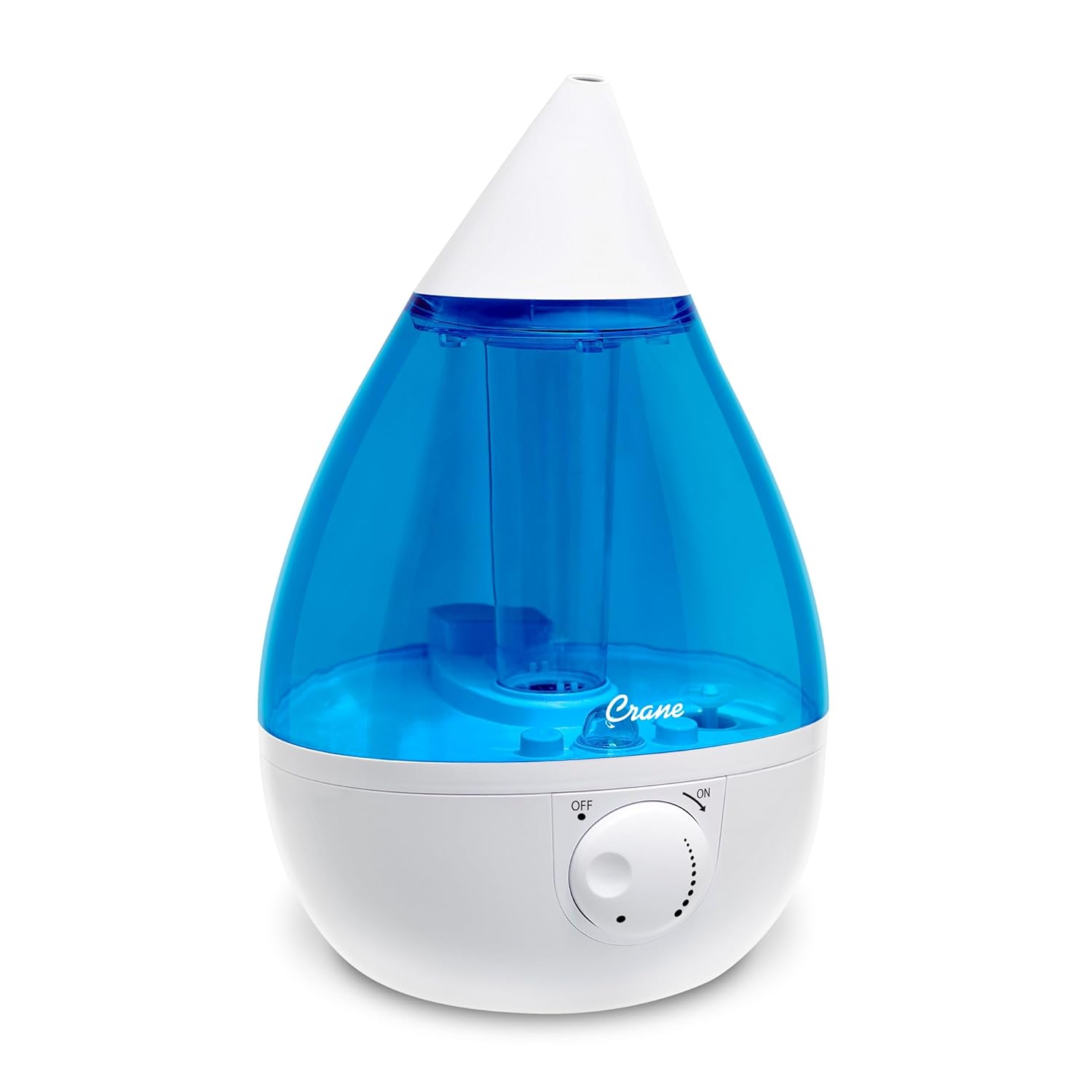 Crane Drop Ultrasonic Cool Mist Humidifier |
|
| $37.49 | Check price |
| Best UV / Germ-Free | 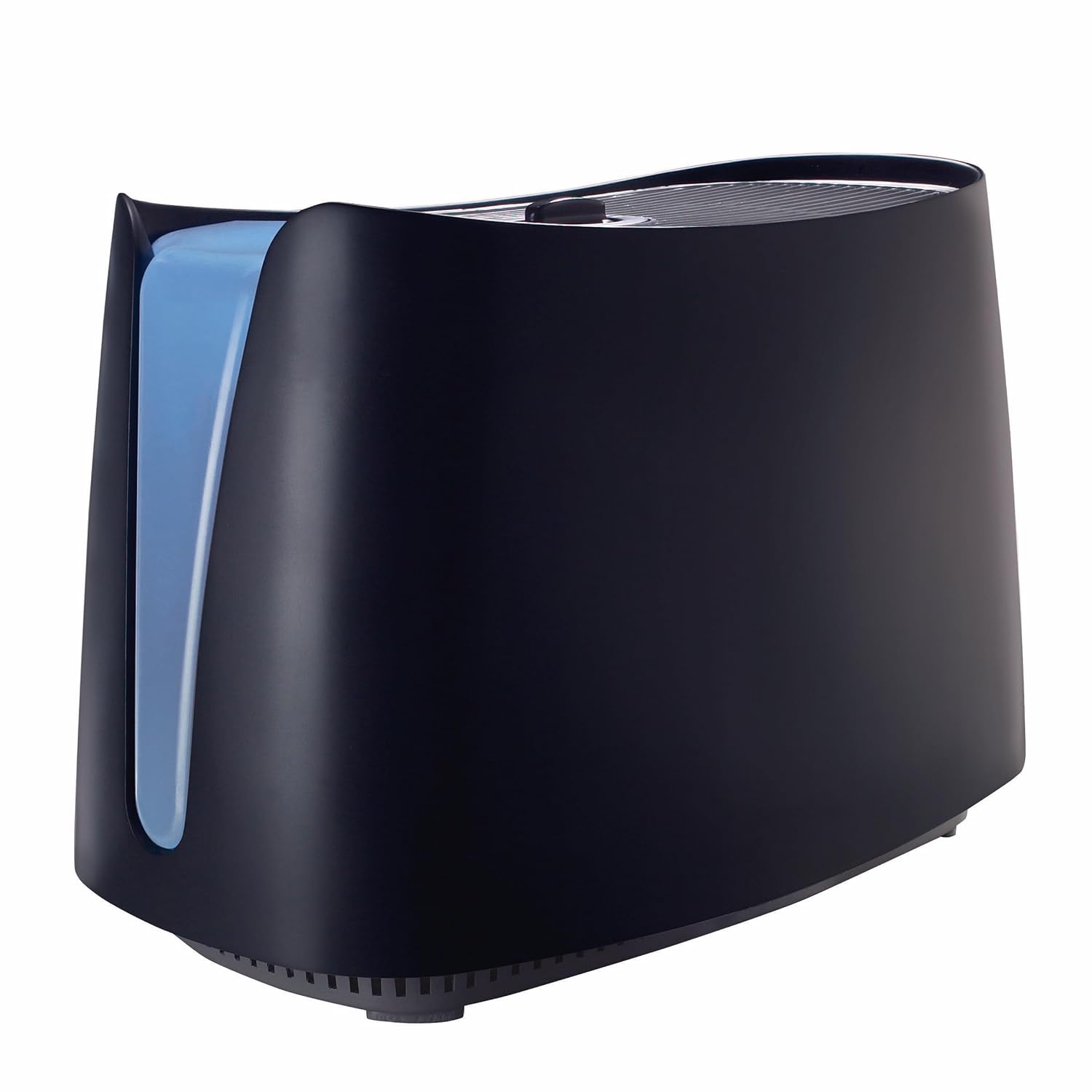 Honeywell HCM350B Germ-Free Cool Moisture |
|
| $76.42 | Check price $76.42 |
| Best Easy-Clean |  Levoit Classic 160 Top-Fill Ultrasonic |
|
| $39.99 | Check price $39.99 |
Crane Drop Ultrasonic Cool Mist Humidifier
Honeywell HCM350B Germ-Free Cool Moisture
Check price on Amazon $76.42
Levoit Classic 160 Top-Fill Ultrasonic
Check price on Amazon $39.99
Crane Drop Ultrasonic Cool Mist Humidifier — full breakdown
The Crane Drop is the cool mist humidifier most parents end up with when they start asking what to put in the nursery. It’s been a staple since 2009 not because of clever marketing, but because the combination of ultrasonic mist generation, a 1-gallon tank, and a price point under $50 is the right trio of features for most families — and the design has been refined across more than a decade of iteration.
The ultrasonic mechanism matters specifically because it eliminates the heating element. A cool mist humidifier built around piezoelectric vibration generates microscopic water droplets at room temperature, which means there is no boiling water inside the tank, no burn risk from a tipped unit, and no thermal load added to a nursery that needs to stay in the safe-sleep temperature band. Per CPSC injury data, warm-mist humidifiers are a documented cause of pediatric scald-burn ER visits each year — almost all of which are entirely prevented by switching to a cool mist humidifier like the Crane.
The Crane Drop is an ultrasonic unit with no fan, which is why it runs quiet enough on low to sit near a crib without disrupting sleep. The 1-gallon tank is rated for a full 24 hours of continuous mist on low and roughly 11 hours on high, which means a single evening fill comfortably covers an overnight sleep cycle plus a full daytime nap window. The mist plume direction can be rotated 360 degrees, useful for aiming output away from cribs and toward the room volume rather than at the baby directly.
The hygiene story is a mixed bag, and we want to be honest about it. The tank uses Crane’s Clean Control antimicrobial material, which Crane says slows mold growth on tank walls between cleanings — a mitigation, not a substitute for the cleaning routine. But the bottom-fill design means cleaning still requires unscrewing a base cap, inverting the tank, and reaching inside through a relatively narrow opening, which is the dimension on which the Levoit beats it.
If you use municipal tap water with measurable hardness, the ultrasonic mist will also deposit a thin white mineral dust on nearby surfaces over a few days — distilled or filtered water solves this entirely, but it’s a real ongoing cost to factor in. For the right family — one comfortable with a once-weekly vinegar descale and willing to spring for distilled water in hard-water markets — the Crane Drop is the best cool mist humidifier for nursery use we reviewed at any price under $60.
Honeywell HCM350B Germ-Free Cool Moisture — full breakdown
The Honeywell HCM350B is the cool mist humidifier built around the one thing every other humidifier ignores: the water tank itself is the primary hygiene risk in the device. The HCM350B addresses this with an integrated UV-C light that exposes water passing through the wicking pathway to germicidal ultraviolet, which Honeywell rates to kill 99.9% of mold spores, bacteria, and viruses before that water is converted to airborne moisture. For any family where a baby is immune-compromised, has chronic lung disease, or is being released from NICU into a home humidifier setup, the HCM350B is the only cool mist humidifier on our shortlist we’d flag as worth discussing with your pediatrician.
The mechanism is evaporative rather than ultrasonic — water is wicked through an antimicrobial-treated filter and evaporated into the air by an internal fan, rather than being mechanically vibrated into a visible mist. The two practical consequences are: zero white mineral dust deposited on nearby surfaces (because the minerals stay behind in the wick), and a higher noise floor than the ultrasonic picks. The fan is the trade-off: an evaporative unit is audibly louder on low than the ultrasonic picks, and if you need the nursery close to silent, one of those is the better choice.
The HCM350B is the one here with a UV chamber and a dishwasher-safe tank, which is what actually keeps a humidifier from turning into a bacterial aerosol. Neither the Crane nor the Levoit has any in-tank treatment stage; both depend entirely on the owner’s cleaning discipline. The Honeywell is the only one of the three that treats the water itself. For parents specifically worried about Legionella, Pseudomonas, or mold spore aerosolization — risks that are real but often overstated in non-clinical settings — the UV-C pathway is the only one of these three picks that treats the water at the source.
The trade-offs are honest. At $76.42, the HCM350B is roughly 75% more expensive than the Crane Drop. The wicking filter needs replacement every 1–3 months at roughly $15 per filter, adding $60–180 per year to the cost of ownership. The fan-driven evaporative design is audibly louder than ultrasonic cool mist humidifier alternatives, which matters in a small nursery where the unit is within 6 feet of the crib.
The dishwasher-safe tank and base are a genuinely meaningful design choice, though — most humidifiers can’t be cleaned the way you’d clean a baby bottle, and the HCM350B can. If budget allows and the family situation justifies the UV-C investment, this is the best cool mist humidifier for nursery use in the premium tier.
Check price on Amazon → $76.42
Levoit Classic 160 Top-Fill Ultrasonic — full breakdown
The Levoit Classic 160 is the cool mist humidifier that took the right lesson from the last decade of humidifier complaints: the cleaning routine is the actual product. Every cool mist humidifier looks identical on day one — but by week three, the only differentiator is whether the parent has been able to maintain the unit, and that comes down to two design choices the Levoit gets right.
First: the top-fill design. Instead of inverting a 1-gallon tank over a bathroom sink and screwing a cap on while water splashes everywhere, you simply lift a lid and pour water in from the top. The fill is a lid-off, pour-in motion you can do with one hand free, and there’s no spill ritual. For a parent who’s already exhausted, this single design choice may be the difference between a humidifier that gets refilled nightly and one that doesn’t.
Second: the tank mouth. The opening into the Levoit’s tank is the widest in the category — an adult hand fits inside up to the wrist, which means scrubbing every interior surface with a brush is physically possible. Compare this to most cool mist humidifier tanks, where the opening is a 1.5-inch threaded port that no human hand fits through, making “cleaning” a euphemism for swirling some vinegar around and hoping. The Levoit is the rare cool mist humidifier you can actually clean.
The Levoit is the quietest of the humidifiers here on its low setting. The 2.5L tank is rated for roughly 24 hours of continuous cool mist on low, and the unit has an auto shut-off for when the tank runs dry. The mist outlet is rotatable, and the body is compact enough to sit on a low nursery shelf without dominating the room visually.
The compromises are minor. The 2.5L tank is smaller than the Crane’s 3.8 liters, which translates to more frequent refills in particularly dry climates where the humidifier is running on high. As an ultrasonic cool mist humidifier, the Levoit will also deposit mineral dust if you fill it with hard tap water — distilled or filtered water solves this. There’s no UV-C sterilization, so the unit relies on the user’s cleaning discipline rather than an in-tank mitigation, which is exactly why the easy-clean design matters so much.
Check price on Amazon → $39.99
5 things to know before buying a cool mist humidifier for the nursery
Cool mist only — never warm mist in a nursery
Warm-mist humidifiers boil water to produce steam, which means a tipped or pulled unit can scald a child. Per CPSC injury data, warm-mist humidifiers are a documented cause of pediatric scald-burn ER visits each year. A cool mist humidifier built around ultrasonic vibration or evaporative wicking generates moisture at room temperature, eliminating the burn-risk variable entirely. The marginal “germ-killing” benefit warm-mist humidifiers are sometimes marketed around does not exist in real-world use — and even if it did, it would not justify the burn risk. Cool mist humidifier, always.
The cleaning routine is the actual product
Every cool mist humidifier on the market grows mold and bacteria if it isn’t cleaned. The question isn’t whether your humidifier will grow biofilm — it’s whether the design makes cleaning easy enough that you’ll actually do it. Look for top-fill designs (no flip-and-spill ritual at the sink), wide tank mouths (an adult hand has to fit inside to scrub), and dishwasher-safe components. A cool mist humidifier you can’t clean in under 10 minutes is a cool mist humidifier you won’t clean — and an uncleaned humidifier is a respiratory irritant, not a comfort device.
Ultrasonic vs evaporative is a real trade-off
Ultrasonic cool mist humidifier models (Crane Drop, Levoit Classic 160) are quieter and produce a visible cool mist, but they aerosolize whatever is in the water — including dissolved minerals, which deposit as white dust on nearby furniture if you use hard tap water. Evaporative cool mist humidifier models (Honeywell HCM350B) use a wicking filter and an internal fan, are slightly louder, produce invisible moisture, and trap minerals in the filter rather than aerosolizing them. Per EPA indoor air quality guidance, the mineral-dust issue is real but mostly cosmetic — distilled water solves it for ultrasonic units.
Humidity target is 30–50% — measure it
The right humidity range for a nursery is 30–50% relative humidity. Below 30% you get cracked lips, bloody noses, static, and increased respiratory virus transmission. Above 50% you get dust mite proliferation, mold growth on cool surfaces, and condensation on windows. A $10 hygrometer placed on the changing table tells you whether your cool mist humidifier is actually doing its job — and tells you to turn the humidifier down or off when you cross into the 50%+ range. Running a cool mist humidifier without a hygrometer is flying blind.
Distilled water solves more problems than it creates
Using distilled water in your cool mist humidifier prevents three problems at once: mineral-dust deposition on furniture, mineral scale buildup inside the unit that shortens its lifespan, and one of the substrates that supports certain biofilm-forming bacteria. The cost is real — roughly $1.50/gallon and a recurring grocery-list item — but for ultrasonic cool mist humidifier models in hard-water markets, distilled water turns a maintenance-heavy device into a low-friction one. Tap water is fine in soft-water markets and on evaporative units where minerals stay in the wick.
Best cool mist humidifier for nursery: frequently asked questions
Daily empty-and-rinse, weekly descale, monthly deep clean. Every day: empty any remaining water, rinse the tank and base with fresh water, and dry both with a clean towel before refilling — this is the single highest-leverage habit for keeping a cool mist humidifier safe. Every 7 days: run a 50/50 white vinegar solution through the unit for 30 minutes, then scrub the interior with a soft brush and rinse thoroughly. Monthly: replace any wicking filters, soak removable parts in vinegar for 1 hour, and inspect every interior surface for biofilm. Skipping these steps doesn’t just shorten the device’s life — it turns the cool mist humidifier into a respiratory irritant.
Distilled water is best for ultrasonic cool mist humidifier models (Crane Drop, Levoit Classic 160), because it prevents the white mineral dust that ultrasonic mist aerosolizes. Tap water is acceptable in soft-water markets and on evaporative cool mist humidifier models (Honeywell HCM350B), where minerals stay trapped in the wicking filter rather than being aerosolized into the room. Per EPA indoor air guidance, the practical difference is mostly cosmetic — the mineral dust isn’t a health risk at typical exposure levels — but distilled water also extends the lifespan of the humidifier and reduces the cleaning load.
Yes. A $10 hygrometer placed within 3 feet of the crib tells you whether the cool mist humidifier is hitting the 30–50% relative humidity target or overshooting into the range where mold and dust mites proliferate. Many cool mist humidifier models include onboard humidity sensors, but those sensors sit inches from the unit’s own mist output and consistently under-read the actual room humidity. An independent hygrometer placed elsewhere in the nursery is the only way to know the real ambient humidity — and it’s the only way to know when to turn the cool mist humidifier off.
30–50% relative humidity is the recommended range for a nursery per AAP and EPA guidance. Below 30%, dry-air symptoms appear: cracked lips, bloody noses, scratchy throats, increased respiratory virus survival in the air. Above 50%, indoor humidity favors dust mite proliferation, mold growth on cool surfaces (windows, exterior walls), and feels physically uncomfortable. Aim for 40–45% as a target sweet spot, and use the cool mist humidifier output to keep the reading there — not to maximize visible mist, which is an unreliable proxy for actual humidity.
Usually yes, but with discipline. A cool mist humidifier running on low for a full 8–10 hour sleep cycle is exactly the use case these units are designed for — and at low output in a 150-square-foot room, the humidity typically stays within the 30–50% target band without overshooting. The exceptions: very humid summer nights when ambient humidity is already above 50% (turn the humidifier off), and any night when condensation appears on the nursery windows in the morning (you’re running too high or too long).
The other discipline question is hygiene: a cool mist humidifier running all night for 7 nights between cleanings is the standard hygiene risk profile. Daily empty-and-rinse plus weekly descale is non-negotiable if the unit is running every night.
Replace any cool mist humidifier showing one of three failure modes. First: visible biofilm or staining inside the tank that doesn’t come out with a vinegar soak and full scrub — once mold establishes in microscopic surface pores, you cannot fully eliminate it from a plastic tank, and the device will reseed biofilm faster between cleanings. Second: degraded output — when a unit that used to maintain 45% humidity overnight is now struggling to hit 35%, the ultrasonic element or wicking filter is failing. Third: musty smell from the mist plume, which is mold aerosolization in progress and means stop using the unit immediately.
In normal use with weekly cleaning, expect 2–4 years of useful life from a cool mist humidifier in this price tier. Pair the new unit with our best HEPA air purifier for baby for a complete nursery air-quality setup.
Our top cool mist humidifier for nursery: Crane Drop Ultrasonic
The nursery classic, with a 1-gallon tank that runs a full overnight cycle, a fanless ultrasonic mechanism that doesn’t whir beside the crib, and an antimicrobial tank material Crane says slows biofilm formation between cleanings. Pair it with a $10 hygrometer to keep humidity in the 30–50% safe band and a gallon jug of distilled water if you’re in a hard-water market, and you have a complete nursery humidifier setup for under $60.
Medical disclaimer: Not medical advice. Humidifier selection and use should always be guided by your child’s pediatrician, especially for infants with chronic lung disease, immune compromise, NICU-discharge respiratory management, or active respiratory infection. Never add essential oils, medications, or vapor additives to a cool mist humidifier used in a nursery. The information here is educational and reflects current clinical guidance as of publication. Consult HealthyChildren.org (AAP) and the CPSC for additional pediatric safety guidance.
Prices: Reflect typical Amazon pricing as of May 2026 and may vary. Manufacturer model numbers occasionally change — verify on the linked product page before ordering. EPA indoor air quality recommendations for relative humidity referenced are available at epa.gov.
- Baradaran A. Thermal Burns. Medscape Drugs & Diseases (eMedicine); updated Oct 23, 2023. Scald burns from hot liquids and steam are a common thermal-injury mechanism, and young children’s thin skin is burned by briefer, cooler exposures than adults.
- American Academy of Pediatrics. Cough & Cold: Symptom Relief. HealthyChildren.org. Accessed July 19, 2026. The AAP recommends cool-mist rather than warm-mist humidifiers for children because hot water and steam pose a burn and scald risk.
- Arundel AV, Sterling EM, Biggin JH, Sterling TD. Indirect health effects of relative humidity in indoor environments. Environ Health Perspect. 1986;65:351-361. Survival of airborne bacteria and viruses and the incidence of respiratory infections are minimized when indoor relative humidity is kept around 40-60%.