
Bamboo diapers review: worth the premium cost? (2026)
Bamboo diapers cost two to three times more than mainstream disposables — and the marketing makes big promises about sensitivity, sustainability, and softness. But when you read the fine print, “bamboo diapers” rarely means 100% bamboo. Most are plant-based blends with bamboo viscose or sustainably-sourced wood pulp. We reviewed the leading bamboo and eco-disposable diapers across leak-protection ratings, ingredient transparency, certifications, and real cost-per-diaper to answer the question every eco-conscious parent asks: is the premium actually worth it?
Our top 3 bamboo and eco diapers ranked
Short on time? Here are the three eco-disposable diapers worth the premium — and the one that actually justifies its top-tier price.
Why trust Pediatric Picks?
We evaluated bamboo and eco diapers across seven criteria: ingredient transparency (what percentage is actually plant-based vs. petroleum-based polymers), third-party certifications (Nordic Swan ecolabel, FSC, OEKO-TEX, EWG Verified), manufacturer absorbency and overnight leak-protection ratings, fit and skin-contact materials, presence or absence of fragrance, chlorine, latex, and parabens — cross-referenced with the EWG Skin Deep database — biodegradability claims, and true cost-per-diaper at typical case prices.
These are research-driven reviews by a critical-care RN: each brand’s certification records, full ingredient disclosures, and manufacturer absorbency ratings were verified against the published standards and databases above rather than taken from marketing copy at face value.
The truth about “bamboo” diapers
Here’s what diaper companies don’t put on the front of the package: very few “bamboo diapers” sold in the US are made primarily from bamboo. Most use bamboo viscose (a chemically processed bamboo fiber) for the soft inner liner, while the absorbent core is fluff pulp from sustainably-sourced wood — not bamboo. Some brands marketed as “bamboo” actually use FSC-certified wood pulp with no bamboo at all, and rely on the marketing halo of the bamboo association.
This isn’t necessarily bad — FSC-certified wood pulp is a legitimate sustainable material. But it does mean parents paying premium prices for “bamboo” should understand what they’re actually getting. The three picks below represent three honest tiers: a brand that uses real plant-based materials throughout (DYPER), a brand with the strongest third-party eco certifications regardless of bamboo content (Bambo Nature), and the most accessible plant-based option that delivers most of the benefits at half the price (Honest).
Bamboo diapers: side-by-side comparison
| Pick | Product | Key strengths | Watch-outs | Price | Where to buy |
|---|---|---|---|---|---|
| Premium Pick | 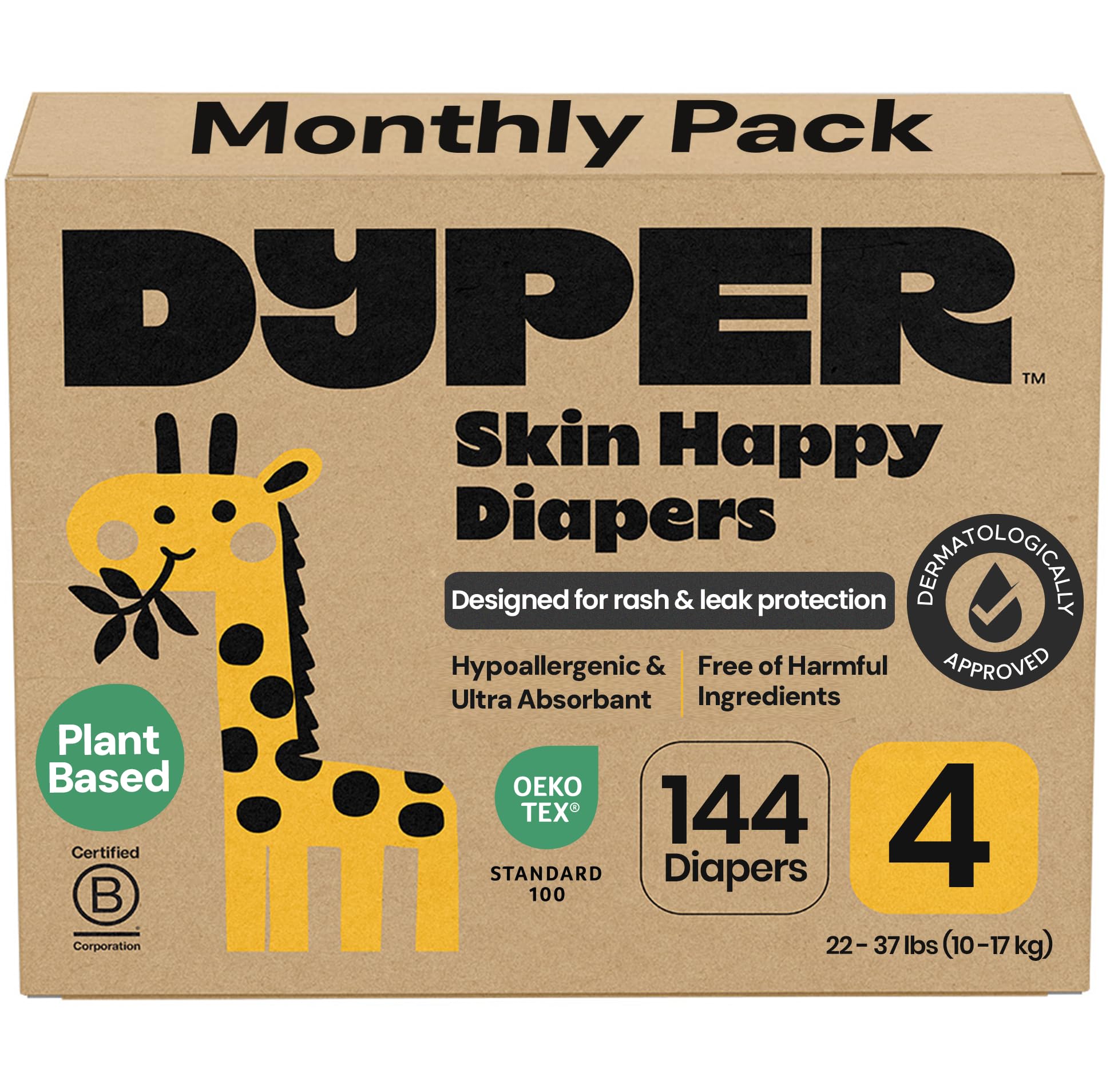 DYPER Plant-Based |
|
| $116.99 / 144ct (Size 4) | Check price $116.99 |
| Best Eco-Certified |  Bambo Nature |
|
| ~$79.02 / case (Size 1) | Check price |
| Best Value |  Honest Company Comfort Dry |
|
| $26.99 / 72ct (Newborn) | Check price $26.99 |
DYPER Plant-Based
Check price on Amazon $116.99
Bambo Nature
Honest Company Comfort Dry
Check price on Amazon $26.99
DYPER Plant-Based — full review
DYPER built its reputation as the bamboo viscose diaper subscription brand. The current Amazon listings emphasize “plant-based” rather than pure bamboo, but the formula remains the most ingredient-conscious of the mainstream eco options. The company explicitly excludes chlorine, latex, alcohol, fragrances, parabens, and phthalates — a more restrictive ingredient policy than most competitors. For families committed to minimizing chemical exposure, DYPER is the closest approximation of a “clean” disposable diaper available on Amazon.
On paper, DYPER’s specs line up with premium mainstream brands, including a manufacturer-rated 12-hour leak protection claim for overnight wear. The PH-sensitive wetness indicator is a thoughtful touch, especially for newborn changes when you can’t always tell visually whether a change is needed. The diapers fit true to size with stretchy side panels that move with active babies.
The case for DYPER comes down to ingredient transparency and the company’s REDYPER composting program (available to subscription customers). The case against is price: at roughly $0.81 per diaper for a one-off Amazon purchase, you’ll pay $30–$45 more per month than mainstream eco brands. The subscription model brings the price down significantly. If you want the cleanest plant-based formula available without going to specialty retailers, and you’re willing to pay for it, DYPER is the answer.
Check price on Amazon → $116.99
Bambo Nature — full review
Bambo Nature is a Danish diaper brand that’s been quietly leading European eco-disposables for more than 35 years. Despite the misleading name (it’s “Bambo” not “Bamboo”), this brand earned its place in any honest bamboo diaper review because it carries the strongest third-party environmental certifications of any diaper available in the US. The Nordic Swan ecolabel is the most rigorous European eco certification — manufacturers must prove sustainable sourcing, low-emission production, and biodegradable packaging across the entire product lifecycle. Most “bamboo” diapers sold in the US carry no such certification.
The diapers themselves use FSC-certified wood pulp as the absorbent core, not bamboo. The brand has been transparent about this for years. The gentle materials and totally chlorine-free processing may make it a reasonable option for babies with diagnosed eczema or contact dermatitis. The wetness indicator and flexible waistband match the convenience features of mainstream brands.
The factory has been running on 100% wind power since 2008, and Bambo Nature was the first baby diaper brand to receive certain environmental designations in Europe. For families whose primary concern is verified sustainability rather than the bamboo brand specifically, Bambo Nature offers stronger third-party validation than any “bamboo-marketed” competitor at a more accessible price than DYPER.
Honest Company Comfort Dry — full review
The Honest Company isn’t a true bamboo diaper, but it earns inclusion in this review because it solves a real problem: most bamboo diapers cost too much for everyday use. Honest’s Comfort Dry diapers use a plant-based inner liner — the part that actually touches baby’s skin — while keeping the price accessible. At roughly $0.37 per diaper, Honest costs less than half of DYPER and 20% less than Bambo Nature, while still delivering the manufacturer’s hypoallergenic, fragrance-free formula.
Performance is where Honest really earns its place. The 5-point leak protection system is genuinely effective — comfy fit leg cuffs catch leaks during diaper changes, the wetness indicator is clearly visible, and the diapers feature umbilical cutouts for newborns and double poo pockets for sizes 1–2. Many parents report reliable leak protection from Honest that holds up well against premium-priced brands. Their fragrance-free, hypoallergenic-labeled formulation — consistent with general American Academy of Pediatrics guidance to minimize irritants on infant skin — makes them a gentler option for many babies with sensitive skin.
The honest critique of Honest: the “plant-based” label applies primarily to the inner liner, not the entire diaper. The absorbent core uses standard sodium polyacrylate technology, and the outer waterproof layer is petroleum-based plastic like every mainstream disposable. If you want full plant-based composition, you need DYPER or a specialty brand. If you want the eco-conscious benefits where they matter most (skin contact and ingredient transparency) at half the premium price, Honest is the smart middle path.
Check price on Amazon → $26.99
Is the bamboo diaper premium actually worth it?
Average babies use ~6,000 diapers from birth to potty training. Here’s what the premium actually costs over that lifetime — and when it’s worth paying:
The math: bamboo vs. mainstream
At $0.20/diaper for mainstream Pampers or Huggies, a baby’s lifetime diaper cost is ~$1,200. At $0.37/diaper (Honest), the cost rises to ~$2,220 — a $1,020 premium. At $0.47/diaper (Bambo Nature), it’s ~$2,820 — a $1,620 premium. At $0.81/diaper (DYPER), it’s ~$4,860 — a $3,660 premium over the 2.5–3 year diapering window.
When the premium IS worth it
If your baby has diagnosed eczema, contact dermatitis, or recurring rashes that mainstream diapers trigger, a premium eco diaper that avoids a common irritant may be worth the added cost compared with repeated dermatologist visits and barrier creams. Babies with confirmed sensitivities should test Bambo Nature or DYPER specifically — both have strong reputations for sensitive skin.
When the premium ISN’T worth it
If your baby has no skin sensitivity, no rash history, and no specific medical reason to switch, the premium is largely an environmental and values-based purchase. There’s nothing wrong with that — but mainstream diapers like Pampers Pure or Huggies Special Delivery offer some of the same hypoallergenic benefits at lower cost. The bamboo brand premium is hardest to justify on pure performance grounds.
The smart middle ground
Many families use Honest Company day diapers (lower cost, plant-based liner where skin contact matters) and switch to a premium overnight diaper like Bambo Nature for the longest stretches. This hybrid approach captures the eco-conscious benefits where they matter most — extended skin contact during sleep — without paying premium prices for every change.
Frequently asked questions
Almost never. Most “bamboo diapers” use bamboo viscose for the soft inner liner that touches baby’s skin, while the absorbent core uses fluff pulp (often from FSC-certified sustainable wood) and the outer waterproof layer is petroleum-based plastic. The phrase “made with bamboo” or “plant-based” is more accurate. True 100% bamboo diapers don’t exist as disposables because bamboo alone can’t provide the waterproof outer layer required for leak protection.
Generally yes — but for reasons beyond bamboo itself. Eco-disposable diapers like Bambo Nature, DYPER, and Honest are typically chlorine-free, fragrance-free, and lotion-free, which removes the most common irritants found in mainstream disposables. The bamboo viscose liner is also softer than synthetic non-woven fabrics. For babies with diagnosed eczema or contact dermatitis, many parents find eco-disposables gentler than mainstream brands, though responses vary — check with your pediatrician about persistent skin reactions.
Mostly no. Most “bamboo diapers” sold on Amazon are not home-compostable due to the plastic outer layer and synthetic absorbent core. Some brands like DYPER offer industrial composting programs (REDYPER) for paid subscribers, but the diaper itself doesn’t break down in a backyard compost bin. The most accurate environmental claim for these brands is “more sustainable” rather than “biodegradable.”
Not necessarily. Premium mainstream diapers like Pampers Swaddlers and Huggies Little Snugglers offer comparable leak protection to bamboo and eco diapers. The absorbent technology (sodium polyacrylate) is similar across most disposables. The bamboo advantage is primarily in skin contact and ingredient transparency, not absorbency. Don’t switch to bamboo expecting fewer leaks — switch for ingredient reasons.
Yes. “Nappies” is just the British and Australian word for diapers, so everything here applies whether you call them bamboo diapers or bamboo nappies. Brands like Bambo Nature and DYPER sell internationally, and the ingredient and certification differences we compared don’t change with the name.
Our top eco-certified pick: Bambo Nature
The strongest third-party environmental certifications, gentle, low-irritant materials, and a more accessible price than full-bamboo subscription brands.
Prices and availability: Prices shown reflect typical Amazon pricing as of April 2026 and may vary by size and pack count. Click any product link for the current price.
Medical disclaimer: Content is for informational and educational purposes only. It does not constitute medical advice or replace professional pediatric consultations.
- Silverberg NB. Pediatric Contact Dermatitis. Medscape Drugs & Diseases (eMedicine); updated Mar 19, 2026. Contact dermatitis affects at least a quarter of children; irritant injury damages the protective upper epidermis, and skin protection with emollients is advised.
- Zabawski EJ. Irritant Contact Dermatitis. Medscape Drugs & Diseases (eMedicine); updated Aug 11, 2025. Nonallergic skin inflammation caused by direct chemical damage to the epidermis, including cumulative irritation from soaps and repeated exposure.