
Types of Cloth Diapers: AIOs, Pockets & Covers (RN Guide)
Walk into a cloth diaper conversation and you’ll hear terms like AIOs, pockets, covers, prefolds, fitteds, hybrids, and AI2s — each describing a different system with distinct advantages and trade-offs. If you’re considering cloth diapers but feel overwhelmed by the vocabulary, this guide decodes the different kinds of cloth diapers so you can choose the right system for your family’s budget, lifestyle, and tolerance for laundry. Understanding the difference between cloth diaper AIOs, pockets, and covers is the first step toward building a stash that actually works for you.
For most families, pocket diapers are the best all-around choice among the three cloth systems — customizable absorbency, a 4–6 hour dry time, and a full-stash cost of $300–$400, with the ALVABABY 6-pack (~$30) as the cheapest way to test them. All-in-ones (AIOs) are the easiest for daycare and grandparents but cost the most ($450–$600 per stash) and take 12–24 hours to dry. Covers with prefolds are the most economical option ($150–$200 for a full stash) but have the steepest learning curve. Many experienced families mix systems: AIOs for outings, pockets at home, and covers with hemp inserts overnight.
Best starter pick for each cloth diaper type
A budget pocket set to start, and the essential wet bag accessories every cloth family needs.
Why trust Pediatric Picks?
We evaluated cloth diaper systems across five criteria: ease of use (how many steps stand between a clean diaper and a fastened one), absorbency capacity (published fill weights, fiber type, and layer count compared), drying time (construction compared — separated inserts dry far faster than sewn-in layers), durability (materials, construction, and each manufacturer’s published wash guidance compared), and total cost of ownership for a full stash from birth to potty training. We also weighted daycare handoffs heavily, where whoever changes the diaper may never have used cloth before — the fewer steps between a clean diaper and a fastened one, the better a system survives being handed to someone else.
Recommended products: side-by-side comparison
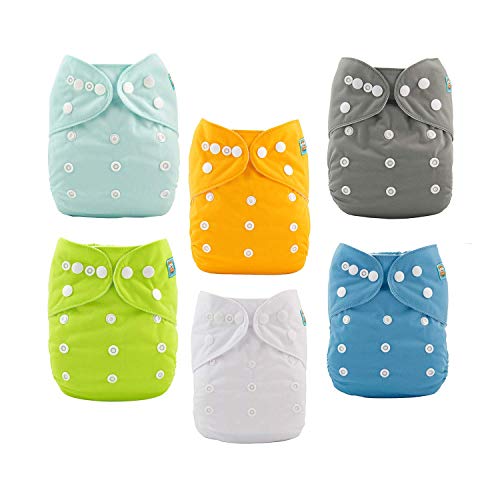
ALVABABY 6-Pack Pocket Diapers
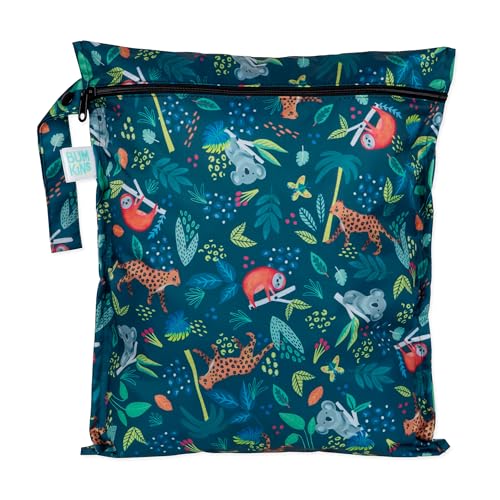
Bumkins Waterproof Wet Bag

Bumkins Wet/Dry Bag
The three main types of cloth diapers
Every modern cloth diaper system falls into one of three categories: all-in-ones (AIOs), pocket diapers, or covers with inserts. Understanding how cloth diaper AIOs, pockets, and covers differ — in terms of convenience, cost, drying time, and absorbency customization — is essential before you invest in a stash of 20–24 diapers.
AIOs vs. pockets vs. covers at a glance
| All-in-ones (AIOs) | Pocket diapers | Covers + inserts | |
|---|---|---|---|
| Convenience | Highest — used exactly like a disposable | High — 10–15 min of stuffing per wash load | Moderate — folding technique to learn |
| Dry time | 12–24 hrs | 4–6 hrs | 2–4 hrs |
| Full-stash cost | $450–$600 | $300–$400 | $150–$200 |
| Stash size | 24–30 diapers | 20–24 diapers | 6–8 covers + 24–30 inserts |
| Daycare-friendly? | Yes — staff use them like disposables | Sometimes, if pre-stuffed | Rarely accepted |
| Best for | Multiple caregivers, maximum simplicity | Best balance of cost, customization, and drying speed | Tightest budgets, willing to learn folds |
All-in-one cloth diapers: the closest to disposable
Among cloth diaper AIOs, pockets, and covers, AIOs are the simplest to use. The absorbent layers are sewn directly into the waterproof shell — there’s nothing to stuff, fold, or assemble. You put it on like a disposable diaper, use it, remove it, and toss the whole thing in the wash. This makes AIOs the easiest cloth diaper for partners, grandparents, babysitters, and daycare providers who aren’t familiar with cloth diapering systems.
The trade-off is drying time. Because the absorbent layers are sewn into the shell, air and heat can’t reach them as easily during washing and drying. AIOs typically take 12–24 hours to air dry, compared to 4–6 hours for separated pocket inserts. This means you need more AIOs in your rotation (24–30 for full-time use with every-other-day washing) to ensure you never run out while diapers are drying. The per-diaper cost of premium AIOs ($18–$25 each) makes them the most expensive cloth diaper system to build a complete stash.
Best for: families with multiple caregivers who need maximum simplicity, parents new to cloth who want the easiest possible transition from disposables, and daycare situations where staff won’t stuff or fold diapers. Among cloth diaper AIOs, pockets, and covers, AIOs have the highest convenience and the highest upfront cost.
Pocket cloth diapers: the customizable workhorse
Pocket diapers are the most popular type among cloth diaper AIOs, pockets, and covers — and for good reason. A pocket diaper has a waterproof outer shell with a moisture-wicking inner liner and an opening (the “pocket”) where you stuff absorbent inserts. The insert does the absorbing; the shell does the waterproofing; the liner keeps baby’s skin feeling dry. After use, you pull the insert out, wash everything, and re-stuff once dry.
The key advantage of pockets is customizable absorbency. For daytime, one standard microfiber insert is usually sufficient. For naps, double up with two inserts. For overnight, use a hemp or bamboo insert for maximum capacity — our guide to the best overnight cloth diaper inserts for heavy wetters compares hemp and bamboo options. This flexibility means the same diaper shell works for every situation — you just change what you put inside it. The ALVABABY 6-Pack with 12 inserts $29.89 is the most popular starter set for pocket diapers, offering six shells and twelve microfiber inserts at a budget-friendly price that lets you test cloth diapering without a major investment.
The trade-off is prep time. After every wash load, you need to stuff inserts back into shells before they’re ready to use. This takes 10–15 minutes per load (roughly 20–24 diapers). Some parents find this meditative; others find it tedious. Pocket diapers also dry faster than AIOs because the inserts separate completely from the shell during washing. Among cloth diaper AIOs, pockets, and covers, pockets offer the best balance of cost, customization, and drying speed.
Cover systems: the most economical cloth diaper option
Cover systems are the original cloth diaper approach — a waterproof cover worn over an absorbent insert (prefold, flat, or fitted diaper). Unlike pockets where the insert goes inside the shell, covers sit over the absorbent layer. This means you can reuse the same cover for multiple diaper changes if it hasn’t been soiled — just swap the wet insert for a dry one and re-cover. One cover can last 3–4 changes before it needs washing.
This reusability makes covers the most economical system among cloth diaper AIOs, pockets, and covers. You need far fewer covers than pockets or AIOs — typically 6–8 covers plus 24–30 inserts for full-time cloth diapering. The inserts (especially prefolds) are the cheapest absorbent option available, often under $2 each. A complete cover-based stash can be built for $150–$200, compared to $300–$400 for pockets and $450–$600 for AIOs. According to EPA waste data, disposable diapers represent a significant portion of municipal solid waste — cloth diapering in any form reduces that contribution.
The trade-off is the learning curve. Folding prefolds or flats requires technique that takes a few days to master. Covers also require more attention during changes — you’re handling two pieces instead of one. For this reason, covers are less popular with daycare providers and secondary caregivers. Among cloth diaper AIOs, pockets, and covers, the cover system wins on cost and loses on convenience.
Which type of cloth diapers should you choose?
Choose AIOs if convenience is your top priority
You want cloth diapering to be as close to disposable as possible. You have partners, grandparents, or daycare staff who need to use them. You’re willing to pay more upfront and own more diapers to account for longer drying times. Among cloth diaper AIOs, pockets, and covers, AIOs require the least education for caregivers.
Choose pockets if you want the best all-around system
You want customizable absorbency for different situations (day, nap, overnight). You don’t mind 10–15 minutes of stuffing after each wash. You want faster drying than AIOs at a lower cost. The ALVABABY 6-Pack $29.89 is the ideal way to test pockets before committing to a full stash.
Choose covers if budget is your top priority
You want the lowest possible cost for full-time cloth diapering. You’re willing to learn prefold folding technique. You have easy access to laundry (you’ll wash inserts more frequently than shells). Among cloth diaper AIOs, pockets, and covers, the cover system can save you $200–$400 versus other options.
Choose a mix if you want flexibility
Many experienced cloth diaper families use a mixed stash: AIOs for daycare and outings (maximum convenience), pockets for home daytime use (customizable), and covers with hemp inserts for overnight (maximum absorbency). There’s no rule that says you must pick one type from cloth diaper AIOs, pockets, and covers — mixing systems gives you the best of each.
Essential accessories for cloth diapers
Wet bags: non-negotiable for cloth diapering
You need at least 2–3 waterproof wet bags $11.95 — one for the diaper pail at home, one for the diaper bag, and one spare. A Bumkins Wet/Dry bag $19.95 with two compartments separates clean and soiled diapers in the diaper bag. Wet bags go in the wash with your diapers — they’re part of the laundry cycle. Our waterproof wet bag comparison for daycare and travel covers more sizes and options.
Diaper sprayer: makes solid removal easy
A toilet-mounted sprayer rinses solids off cloth diapers before they go in the wash pail. Not strictly necessary (you can dunk and swish), but it makes the least pleasant part of cloth diapering significantly more pleasant. Essential once baby starts solids and stool becomes firmer.
Cloth-safe detergent: protects absorbency
Standard detergents with fabric softeners, optical brighteners, or heavy fragrances can coat cloth diaper fibers and reduce absorbency over time. Use a cloth-diaper-safe detergent — most cloth diaper communities recommend plant-based, free-and-clear formulas. Regardless of which cloth diaper AIOs, pockets, and covers you choose, the right detergent keeps them performing. Once your stash arrives, follow a proven cloth diaper wash and strip routine to keep inserts absorbing like new.
How many diapers do you need?
For full-time cloth diapering with every-other-day washing: 20–24 diapers for pockets or AIOs, or 6–8 covers plus 24–30 inserts for cover systems. For part-time cloth (cloth at home, disposable at daycare): 12–15 diapers or 4–5 covers plus 15 inserts. Start with a smaller trial set before building a full stash.
Frequently asked questions
Disposable diapers cost $1,500–$2,500 per child from birth to potty training. A full stash of cloth diapers (including accessories, detergent, and water/energy for washing) costs $400–$800 total — a savings of $700–$1,700 per child. If you reuse cloth diapers for a second child, the savings double because the diapers are already purchased. Among cloth diaper AIOs, pockets, and covers, the cover system saves the most, and AIOs save the least (but still significantly less than disposables).
Not inherently. Diaper rash is caused by prolonged moisture contact with skin, which happens with both cloth and disposable diapers if they’re not changed frequently enough. Cloth diapers need to be changed every 2–3 hours (versus 3–4 hours for disposables) because they don’t contain the super-absorbent polymer that locks moisture away. With proper change frequency, cloth diapers don’t cause more rash — some parents report less rash due to fewer chemicals against skin. The AAP’s diaper rash guidance confirms that frequent changes — not diaper type — are the primary factor in rash prevention.
Many daycares accept cloth diapers, but policies vary. AIOs are the most daycare-friendly among cloth diaper AIOs, pockets, and covers because they require zero assembly — staff use them exactly like disposables. Some daycares accept pre-stuffed pockets. Covers with prefolds are rarely accepted because they require folding technique. Always check with your specific daycare before investing in a cloth system for daycare use.
Absolutely — and many families do. Common approaches: cloth at home, disposables at daycare; cloth during the day, disposables overnight; or cloth most days with disposable backup for travel and busy days. Part-time use of cloth diapers still saves money and reduces waste. You don’t have to be all-or-nothing with cloth diaper AIOs, pockets, and covers. Even using one cloth diaper per day saves 365 disposables per year.
For full-time cloth diapering with every-other-day washing: 20–24 diapers for pockets or AIOs, or 6–8 covers plus 24–30 inserts for cover systems. For part-time cloth (cloth at home, disposables at daycare): 12–15 diapers or 4–5 covers plus 15 inserts. Don’t buy a full stash on day one — start with a small trial set like a 6-pack, confirm the system works for your family, then build up.
Maximum absorbency: either a pocket diaper stuffed with a hemp or bamboo insert, or a cover over hemp inserts. Standard microfiber inserts compress over time and are usually not enough for 10–12 hour stretches. See our roundup of the best overnight cloth diaper inserts for heavy wetters for specific hemp and bamboo picks.
Use a cloth-diaper-safe detergent — no fabric softeners, optical brighteners, or heavy fragrances, which coat the fibers and reduce absorbency over time. Wet bags go in the same wash load as the diapers. For the full step-by-step routine, including how to strip diapers that have lost absorbency, follow our cloth diaper wash and strip routine.
All cloth diapers work the same basic way — a waterproof outer layer holds moisture in while an absorbent inner layer soaks it up, then the whole thing gets washed and reused instead of thrown away. The three types differ in how those two layers connect: an all-in-one (AIO) sews the absorbent layers directly into the shell, a pocket diaper has a separate insert you stuff into an opening, and a cover system layers a waterproof cover over a separate absorbent prefold or fitted diaper that you swap out.
An all-in-two (AI2) sits between a pocket diaper and a cover system: like a cover, the waterproof shell snaps or lays over a separate absorbent insert instead of having everything sewn in; unlike a pocket, the insert lays on top of (or snaps into) the shell rather than being stuffed inside it. That means one shell can often be reused across 2–3 changes with just a fresh insert swapped in, and the insert dries faster than a sewn-in AIO because it is not trapped inside a waterproof layer. AI2s are not one of the three main categories covered above because most stashes are built around AIOs, pockets, or covers — but if you see the term while shopping, this is where it fits.
For a first pocket-diaper stash, ALVABABY is a widely used budget starter brand — the ALVABABY 6-Pack $29.89 above is a common first purchase. For overnight hemp inserts, Mama Koala and EcoAble are established names in that category (see our overnight cloth diaper insert picks). For wet bags, Bumkins is a reliable, widely available brand. There is no single “best” cloth diaper brand for every family — the right brand depends on which system (AIO, pocket, or cover) fits your routine.
Start your cloth diaper journey
ALVABABY 6-Pack — 6 pocket diapers + 12 inserts for the most affordable way to test cloth diapering.
Check price on Amazon → $29.89Medical disclaimer: Content is for informational and educational purposes only. It does not constitute medical advice or replace professional pediatric consultations.
- Agrawal R. Diaper Dermatitis (Diaper Rash). Medscape Drugs & Diseases (eMedicine); updated Jun 30, 2025. Irritant diaper dermatitis from overhydration, maceration and prolonged urine/feces contact; Candida commonly complicates the rash after 48–72 hours and with antibiotic use.
- Dib R. Diaper Rash. Medscape Drugs & Diseases (eMedicine); updated Jul 31, 2024. Classifies diaper-area rashes — irritant contact dermatitis, intertrigo, candidal diaper dermatitis and others — and their overlap in the diaper region.