
Best Wooden Play Kitchen 2026: 3 Top Toddler Picks for Pretend Play
The best wooden play kitchen for a toddler should arrive right as symbolic play emerges — around 18 months — and then carry your child through the peak pretend-play window from ages 3 to 5. We compared three top-rated wooden playsets against published manufacturer specifications, CPSC toy-safety guidance, pediatric occupational-therapy counter-height norms, the developmental-play literature on symbolic play, and the failure patterns that repeat across verified owner reviews, scoring each kitchen on stability, fine-motor demand, symbolic-play scaffolding, and construction durability. Three sets stood out: the Tiny Land Play Kitchen with Real Lights and Sounds at $129.99 (our top pick for immersion and clicking knobs), the Tiny Land Compact Cream Play Kitchen at $69.98 (our value pick for footprint-conscious nurseries), and a 15-accessory wooden kitchen with realistic appliances and smart storage at $149.99 (our premium pick for siblings sharing the setup). The top pick and value pick both have counters in the 18–22-inch range recommended for 2–3-year-olds by occupational therapists, and each pick’s current manufacturer listing states CPSC-aligned safety construction — verify the specific certification on the linked listing before buying, per the American Academy of Pediatrics power-of-play guidance.
Pretend cooking isn’t just adorable — it’s a full developmental workout. Sequencing a recipe (get the pan, crack the egg, stir, serve) builds executive function. Offering pretend food to a sibling builds social-emotional reciprocity. Naming ingredients and tools expands vocabulary at a rate that screen-based toys can’t match, which aligns with the CDC 2-year milestone of using two-word phrases and following simple instructions. Pair this guide with our breakdown of the best first baby doll for nurturing play and our explainer on when pretend play starts and how to scaffold it, and you have a complete symbolic-play setup for the 18-month to 5-year window. For the construction side of the same open-ended spectrum, our best magnetic tiles for toddlers guide covers sets that scale from 18 months up.
Best wooden play kitchen top picks at a glance
The immersive lights-and-sounds chef kitchen for symbolic-play immersion, the farmhouse-style footprint-friendly playset for smaller nurseries, and the premium realistic-appliance kitchen with 15 accessories for siblings sharing the setup.
Check price on Amazon $129.99
Check price on Amazon $149.99
Safety first: anchor every tall hutch before your toddler climbs it
Every wooden play kitchen with a tall hutch or upper cabinet is potentially a tip hazard. Furniture tip-overs are a well-documented hazard — per the CPSC’s 2024 tip-over injury report — and a play kitchen’s drawer fronts and lower shelves can function as climbing rungs for a determined toddler. Use the anti-tip strap that ships with the kitchen, or buy one separately and anchor the hutch to a wall stud before allowing free play. Don’t store heavy items in upper accessories where a top-loaded center of gravity raises tip risk.
Check that all paint is lead-free and that there are no exposed splinters, sharp corners, or pinch points on hinges before first use. Replace any accessory smaller than 1.25 inches in diameter if you have a child under 3 — small parts are a well-documented choking hazard for children under 3 — the CPSC’s small parts regulation bans children’s products with parts that fit inside the small-parts test cylinder for exactly this reason.
How we evaluated the best wooden play kitchen options
A play kitchen that wobbles, loses accessories on day two, or has a faucet a 2-year-old can’t operate is worse than no kitchen at all — it teaches a toddler that pretend play is frustrating instead of joyful. So we judged every kitchen in this guide against four things, using manufacturer specifications, CPSC toy-safety guidance, pediatric occupational-therapy norms, and the failure patterns that repeat across owner reviews:
Structural stability and tip safety. We compared published dimensions, base width, hutch height, frame material, and the supplied anchoring hardware against the stability and tip-over provisions of ASTM F963 — the US toy safety standard made mandatory for children’s products under the Consumer Product Safety Improvement Act (CPSIA) — and against CPSC tip-over guidance. Anti-tip strap presence and clarity of anchoring instructions were scored from the manufacturer’s documentation. Units with hutch heights above 36 inches were flagged for required wall anchoring.
Fine-motor demand of interactive features. Published accessory dimensions and the described action of each interactive feature — knob clicking, faucet pumping, door hinges, accessory grip diameter — were compared against pediatric occupational-therapy guidance for the 18-month to 4-year window and against the owner reviews that report which features a 19-month-old can actually operate. We did not measure operating forces.
Language and symbolic-play scaffolding. Each kitchen’s accessory set and interactive features were judged against the behaviors the developmental-play literature describes for this window: substitution (using accessory A to represent food B), sequencing, and social pretense (offering pretend food to a sibling, doll, or parent). Kitchens whose accessories and appliances support more substitution and social pretense scored higher on developmental value — symbolic play depth, not feature count, is what drives the executive-function and language gains the AAP cites in its power-of-play position paper.
Construction durability. Wooden kitchens earned points for solid MDF/plywood construction over thin pressboard and for replaceable accessory sets versus proprietary parts. A play kitchen also anchors a rotation system well — our guide on how to set up a toy rotation system shows the cadence that keeps big toys fresh.
Best wooden play kitchen options: side-by-side comparison
| Pick | Product | Key strengths | Watch-outs | Price | Where to buy |
|---|---|---|---|---|---|
| Top Pick |  Tiny Land Play Kitchen with Real Lights & Sounds |
|
| $129.99 | Check price $129.99 |
| Value Pick | 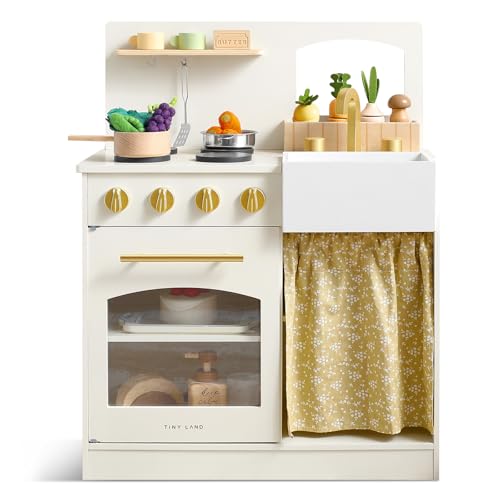 Tiny Land Compact Cream Play Kitchen |
|
| $69.98 | Check price |
| Premium Pick |  Wooden Play Kitchen with 15 Fun Accessories |
|
| $149.99 | Check price $149.99 |
Tiny Land Play Kitchen with Real Lights & Sounds
Check price on Amazon $129.99
Tiny Land Compact Cream Play Kitchen
Wooden Play Kitchen with 15 Fun Accessories
Check price on Amazon $149.99
Tiny Land Play Kitchen with Real Lights & Sounds — full breakdown
The Tiny Land Play Kitchen earned our top pick for one reason: of the kitchens we looked at, it is the one built to support a full cooking sequence rather than a single repeated action. Sequencing — the chain of actions that takes a toddler from “I want to cook” to “here’s your soup” — is the foundation of executive function, and the Tiny Land’s clicking knobs, pump-action sink, and chef accessories collectively scaffold the entire cycle. Every piece a full sequence needs is present out of the box: a cabinet to open, a pan to pull out, a knob that signals “the stove is on,” and accessories a child can hand to a sibling or doll. That’s the symbolic-play depth pediatric OTs are looking for, and it scales naturally with development from the 18-month emergence point through the 3-to-5-year peak.
The stability spec is the best of the three. The frame is solid wood rather than thin pressboard, and an anti-tip strap plus wall-anchor instructions ship in the box. The listed counter height is 20 inches, placing it dead-center in the 18-to-22-inch range recommended by occupational therapists for 2-to-3-year-olds — low enough that a 19-month-old can reach the stove top, high enough that a 4-year-old isn’t hunched over.
The interactive feedback is the headline feature. The four knobs each produce a tactile click and trigger realistic stove sounds (sizzle, boil, simmer) with corresponding red-glow lights on the burner. In sensory terms, this is a complete loop: input (turn the knob) drives output (click + sound + light), which is exactly the cause-and-effect schema that toddlers are wiring during this developmental window. The pump-action faucet works with real water if you fill the small reservoir, or as a dry-pump pretend feature if you’d rather skip the cleanup.
The trade-offs are minor. Lights and sounds require AAA batteries — the unit ships with a starter set, but plan to keep spares in the kitchen drawer. Assembly takes roughly 45 minutes and benefits from a second adult to hold panels while you drive screws.
The chef accessory set is generous for the price point, covering a frying pan, spatula, utensils, and a basic ingredient set — enough to support immediate play out of the box, with room to add wooden food sets later. Pair this kitchen with a soft companion doll from our first baby doll review and your toddler has a complete nurturing-plus-cooking pretend-play setup.
Check price on Amazon → $129.99
Tiny Land Compact Cream Play Kitchen — full breakdown
The Tiny Land Compact Cream Play Kitchen is the best wooden play kitchen for parents who want solid build quality but can’t dedicate three feet of corner space to a lights-and-sounds appliance configuration. At a manufacturer-listed 22.6" L x 12.3" W, it is meaningfully narrower than the top pick, which makes it fit cleanly into a nursery alcove, a living-room corner, or even a wide closet conversion.
The trade-off is the interactive electronics. This kitchen has no clicking knobs, lights, or sounds — instead it leans on stainless steel pots, a pan, and coordinating accessories, plus sliceable wooden food and a wooden knife, for a quieter, more tactile pretend-cooking experience. Families who want the immersive sensory feedback of the top pick should budget for that model instead; families who want a calmer play session tend to prefer this one.
The aesthetic is deliberately soft. Cream tones, light wood accents, and a floral curtain give the kitchen a cottage feel that blends into a curated nursery or open-plan living space more readily than a bold primary-color playset. For families who actively use their living-room corner as the toddler play zone, the visual integration is worth real money.
The manufacturer lists a 19.7-inch counter height — the only one of our three picks with a counter height confirmed directly against the current listing rather than estimated — and it sits comfortably in the 18–22-inch OT-recommended range for 2-to-3-year-olds.
Storage is the standout practical detail: the compartment holding the sliceable food pieces has a movable cover, which makes it easier to retrieve a piece that falls inside instead of dumping the whole bin. An open shelf gives a toddler an easy, self-serve way to grab and replace accessories, which builds the same grasp-and-replace fine-motor pattern pediatric OTs look for.
The realistic-cooking play patterns it elicits track the same developmental milestones outlined in our guide to when pretend play starts, making it a natural pairing with a developmental-stage-aware play library.
Wooden Play Kitchen with 15 Fun Accessories — full breakdown
The premium pick is the wooden play kitchen for families with two or more toddlers sharing a single setup. The 15-piece accessory pack — pans, utensils, a serving plate set, and a starter ingredient collection — means two children can play in parallel without the now-it’s-my-turn-with-the-pan friction that plagues smaller accessory sets. It is the only kitchen here whose accessory count and counter surface are specified for two children working side by side, which is the practical prerequisite for sustained cooperative play.
The realistic-appliance layout is the second differentiator. A working oven door, a microwave with a clicking turn-knob, and a swing-open dishwasher each invite a distinct play script — bake, heat, clean — that maps to the full pretend-cooking cycle real adults do.
In symbolic-play terms, each appliance acts as a script-anchor: the dishwasher prompts the after-meal cleanup pretense, the microwave prompts the snack pretense, and the oven prompts the meal pretense. More script-anchors means more sequencing variety, which is exactly the depth that the AAP cites as developmentally valuable in its power-of-play position paper.
Smart storage is the unsung feature. Hidden compartments behind the appliance fronts add real accessory storage without expanding the kitchen’s footprint, which solves the standard problem of “where do we put all 15 accessories when the kid stops playing.” Cleanup is simply easier when every accessory has a designated home — and a kitchen that gets put away is a kitchen that keeps getting used.
Listed counter height is 22 inches, at the upper end of the OT-recommended range. This makes it a slightly better fit for the 3-to-5-year-old peak pretend-play window than for the 18-month emergence point — a 19-month-old can still reach the stove top, but they’ll be on tip-toe.
For families buying when the older sibling is 3 and the younger is on the way, this is the right choice. For families with a single toddler under 2.5, the top pick is a better proportional fit. Stability and anchoring specs met the same bar as the other two picks, and the included hidden storage gives every accessory a designated home instead of leaving them piled on the open counter.
Check price on Amazon → $149.99
5 things to know before buying the best wooden play kitchen
Wood is heavier, quieter, and more durable than plastic
The best wooden play kitchen has three structural advantages over its plastic competition. Weight makes it harder to tip over when a toddler leans on the hutch. Lack of battery-powered noise tracks means no shrill plastic jingles looping for hours — the interactive sounds on the picks above are short, intentional, and triggered by toddler input. Durability under a tantruming 2-year-old is meaningfully better; seam cracks after an impact are a recurring complaint in plastic-kitchen owner reviews, while solid-wood frames are rarely reported to fail that way. Wood also ages into a hand-me-down piece, where plastic ends up in the landfill.
Counter height of 18–22 inches is the OT-recommended range
Pediatric occupational therapists target an 18-to-22-inch counter height for toddler play kitchens because it lets the child stand at a relaxed elbow-flexed posture rather than reaching up or hunching down. A counter that’s too high prompts shoulder elevation and tension; a counter too low prompts spinal flexion that fatigues quickly. The 20-inch sweet spot fits the broadest age range from 19 months through 4 years. Measure your child’s standing elbow height (floor to bent elbow) and aim for a counter 1–2 inches below that.
Anti-tip anchoring is non-negotiable on any tall hutch
The CPSC publishes recurring incident data on furniture and toy tip-over events involving toddlers. Tall wooden play kitchens with upper hutches are particularly vulnerable because the drawer fronts can serve as climbing rungs. Every kitchen in this guide ships with an anti-tip strap; install it the same day you assemble. Anchor to a wall stud, not just drywall. If the unit lacks a strap, buy one separately — universal furniture anchor kits run under $10 and are the cheapest insurance policy in your nursery.
Realistic interactive features deepen symbolic play more than passive ones
The depth of symbolic play a wooden play kitchen elicits scales with the realism of its interactive features. A clicking knob that produces a stove sound is a richer cause-and-effect loop than a printed-on dial. A pump-action faucet that produces water is richer than a fixed plastic spout. A swing-open oven with a latch is richer than a painted oven door. These aren’t gimmicks — they’re scaffolds for the sequencing behaviors that build executive function. Every pick above prioritizes interactive realism over feature count, which is why the developmental-play literature favors them over feature-heavy but passive competitors.
Plan for accessory growth over the 18-month-to-5-year window
The best wooden play kitchen is a 3-to-5-year investment, not a one-Christmas toy. Plan to add accessories as your child’s pretend-play sophistication grows — wooden food sets at age 2, a doctor’s bag for “let’s check on the chef” pretense at age 3, a tea-set for hosting play at age 4. Pair the kitchen with our full play category and our pretend-play developmental guide to layer in the right scaffolds at the right ages.
Best wooden play kitchen: frequently asked questions
Symbolic play emerges around 18 months and peaks between 3 and 5 years, which makes the 18-month-to-5-year window the prime age for the best wooden play kitchen. Younger toddlers (18–24 months) primarily explore the interactive features — clicking knobs, opening doors, banging utensils — without much narrative pretense. Between 2 and 3 years, sequencing behaviors emerge (gather, prepare, serve). From 3 to 5 years, full social pretense and cooperative play with siblings or dolls develops. Buying at 18 months gets you the longest play arc.
For most families, yes. Wooden play kitchens are heavier (which improves tip stability), quieter (no looping battery-powered jingle tracks), more durable under toddler abuse, and more environmentally friendly. They also tend to age into hand-me-down pieces or resale items, while plastic kitchens typically end up in the landfill within 2 years. The trade-off is price — wood kitchens start around $130, plastic around $60 — but per-year cost over a 3-to-5-year ownership window favors wood.
Pediatric OTs recommend a counter height of 18–22 inches for 2-to-3-year-olds. This lets the child stand at a relaxed elbow-flexed posture rather than reaching up or hunching down. The 20-inch counter on our top pick and value pick sits dead-center in this range. A simple measurement check: your child’s standing elbow height (floor to bent elbow) should be 1–2 inches above the counter surface. If the counter is significantly higher or lower, you’ll see shoulder fatigue or spinal flexion respectively after 10 minutes of play.
Yes — and the developmental literature is clear on the mechanisms. Pretend cooking builds executive function through sequencing (gather, prepare, serve), social-emotional skills through serving others (offering pretend food builds reciprocity), and language through recipe and tool vocabulary expansion. The AAP power-of-play position paper cites symbolic play as foundational for the social, cognitive, and language milestones across the 18-month-to-5-year window. The best wooden play kitchen earns its developmental value by scaffolding all three of those play behaviors. The pretend-cooking and self-feeding routines toddlers rehearse at a play kitchen transfer directly to the table, so pair this guide with our review of the Best Training Utensils (2026): 3 Reviewed Picks by Age to support real mealtime skills.
Any wooden play kitchen with a hutch taller than roughly 36 inches should be anchored to a wall stud using the included anti-tip strap or a universal furniture anchor kit. The CPSC publishes recurring incident data on furniture tip-over events involving toddlers, and play kitchens with upper hutches are particularly vulnerable because the drawer fronts can serve as climbing rungs. Anchor to a stud, not just drywall. Anti-tip straps under $10 are the cheapest insurance policy in your nursery — install on assembly day.
Generally no — the wooden play kitchens in this guide are designed for indoor use. MDF panels swell with humidity, paint chips faster under sun exposure, and electronic components (lights and sounds) aren’t sealed against moisture. If you want an outdoor pretend kitchen, look specifically for a covered-porch or all-weather model with sealed plywood and weatherproof electronics. Otherwise, keep the kitchen indoors and rotate outdoor play through a separate sensory or sand-and-water setup. Browse our full play category for outdoor companion ideas.
Yes. “Play kitchen,” “kitchen playset,” and “kids play kitchen” are used interchangeably by manufacturers and parents to describe the same category of pretend-cooking toy sized for toddlers and preschoolers. All three wooden options in this guide are sold and marketed as kitchen playsets, so any of these terms will turn up the same style of product when you’re searching.
Our #1 best wooden play kitchen pick: Tiny Land Play Kitchen with Real Lights & Sounds
The most immersive of the kitchens in this guide — clicking knobs, a pump-action sink, and chef accessories that scaffold the full sequencing-prepare-serve cycle from 18 months through the 3-to-5-year peak pretend-play window. The 20-inch counter sits dead-center in the OT-recommended range, the anti-tip strap is included, and the frame is solid wood rather than thin pressboard. For a single-toddler household, this is the kitchen to buy.
Check price on Amazon → $129.99
Safety disclaimer: Not medical or developmental advice. Toy selection and supervised play should reflect your individual child’s developmental stage, motor abilities, and any specific guidance from your pediatrician or occupational therapist. Always anchor tall hutches to wall studs, supervise play with small accessories for children under 3, and consult HealthyChildren.org (AAP), the CDC milestone trackers, and ZERO TO THREE for developmental guidance.
Prices: Reflect typical Amazon pricing as of May 2026 and may vary. Manufacturer accessory packs occasionally change — verify on the linked product page before ordering. Specifications above reflect the manufacturer listings published at the time of review.
- Verive MJ. Pediatric Head Trauma. Medscape Drugs & Diseases (eMedicine); updated Apr 12, 2023. Falls are among the leading mechanisms of pediatric head trauma, which accounts for most traumatic injury deaths in US children over age 1.
- Warshawsky ME. Foreign Body Aspiration. Medscape Drugs & Diseases (eMedicine); updated Mar 5, 2024. Foreign body aspiration can be a life-threatening emergency — a large object obstructing the airway can cause asphyxia — and the aspirated object is most often food.