
When Pretend Play Starts: 2026 Guide + 3 First Pretend Play Sets
When pretend play starts is one of the most reliable developmental questions a parent can ask, because the answer maps to a five-stage symbolic play timeline that pediatricians and speech-language pathologists have been tracking since Piaget’s original 1962 work. Functional play (using a spoon on yourself) shows up around 12 to 15 months. Self-pretend (feeding a doll a pretend bottle) emerges around 18 months. Other-pretend (having the doll feed another doll) lands near 24 months. Object substitution (a banana becomes a phone) clicks into place around 30 months. True role-play with reciprocal characters (mom feeds baby, doctor checks patient) appears between 36 and 48 months. Each stage builds on the last, and pediatric researchers consider pretend play one of several meaningful early predictors of later language, executive function, and kindergarten readiness. The three pretend play sets we recommend below were chosen to match those exact developmental rungs: the Learning Resources Farmer’s Market Color Sorting Set $24.97 as the top pick for 18 to 36 months, the LeapFrog Yum-2-3 Toaster $15.38 as a value pick for 18 to 30 months, and the Melissa & Doug Spray, Squirt & Squeegee Cleaning Set $18.89 as a budget pick that ignites role-play imitation from 24 months on.
Pretend play is not optional enrichment. The American Academy of Pediatrics Power of Play clinical report (2018) formally prescribes unstructured pretend play as a developmental intervention, and the CDC 24-month milestone checklist is one of the tools a pediatrician uses to screen social-emotional and language development at the 2-year well visit. The published PubMed literature on pretend play and toddler language links earlier object-substitution ability to stronger later language and narrative skills, though the exact timeline and effect size vary across studies. Read this guide alongside our best wooden play kitchen review and first baby doll guide so the toys arrive at the right developmental moment instead of months too early.
When pretend play starts: 3 first pretend play sets to match the milestone
The grocery-sorting set that bridges functional play and object substitution from 18 months on, the toddler-friendly toaster that ignites self-pretend feeding scripts, and the cleaning set that turns mom-and-dad imitation into role-play language at the 24-month mark.
Check price on Amazon $24.97
Check price on Amazon $15.38
Check price on Amazon $18.89
Skip screen-based pretend apps — passive simulation is not the same as active play
App-store “pretend cooking” and “pretend doctor” titles look superficially like the kitchen-play and doctor-kit scripts that drive symbolic play development, but the AAP Power of Play report is explicit: the developmental gains come from active, child-led, open-ended manipulation of physical objects, not from watching a screen respond to taps. A toddler tapping a virtual carrot into a virtual pot is rehearsing a pre-scripted sequence written by an adult, not generating their own symbolic narrative. The same toddler stacking real wooden carrots in a real wooden pot is doing the work that builds language, executive function, and theory of mind.
If your toddler is not yet pretending by 24 months, the answer is not a screen-based app — it is more floor time with a parent modeling simple self-pretend (“Mmm, mommy is drinking the juice!”), and a conversation with your pediatrician at the 2-year well visit. The CDC milestone checklist exists precisely so that delayed symbolic play is caught and supported early.
How we matched pretend play toys to the right developmental stage
A pretend play set that lands six months too early sits in the bin until the child has aged into it, and a set that lands six months too late triggers frustration because the symbolic scripts are already more sophisticated than the toy can support. We sorted each candidate against the symbolic play stage it most directly invites, then scored four axes inside that stage.
Developmental match against the Piaget-based symbolic play timeline. The 5-stage timeline (functional play, self-pretend, other-pretend, object substitution, role-play) is the framework speech-language pathologists use clinically to assess pretend play development. We mapped each toy to the earliest stage it invites and the latest stage it still supports. A toy with a wide stage range (18 to 36 months) scored higher than one locked to a narrow window, because pretend play is intrinsically scaffolded by older siblings and parents.
Language elicitation density. Toys offering more distinct objects, actions, and roles for a parent to label, request, and narrate scored higher on this axis. Per the PubMed literature on pretend play and toddler language, language density during pretend predicts later expressive vocabulary independent of total play time.
Durability and dishwasher tolerance. Pretend food gets mouthed, dropped, thrown, and (often) shoved into actual snack cups. Pieces had to survive a year of toddler handling without splintering, peeling paint, or leaching dyes. Pieces small enough to be choking hazards under the CPSC small-parts standard were disqualified for the under-3 age band regardless of other strengths.
Active vs passive design. No toy made the list if its primary engagement loop is “press button, watch lights and sounds happen.” The point of pretend play is that the child generates the script. Light-and-sound feedback is acceptable as a confirmation cue (the LeapFrog toaster’s pop-up animation), but never as the main event.
When pretend play starts: side-by-side pretend play set comparison
| Pick | Product | Key strengths | Watch-outs | Price | Where to buy |
|---|---|---|---|---|---|
| Top Pick |  Learning Resources Farmer's Market Color Sorting Set |
|
| $24.97 | Check price $24.97 |
| Value Pick | 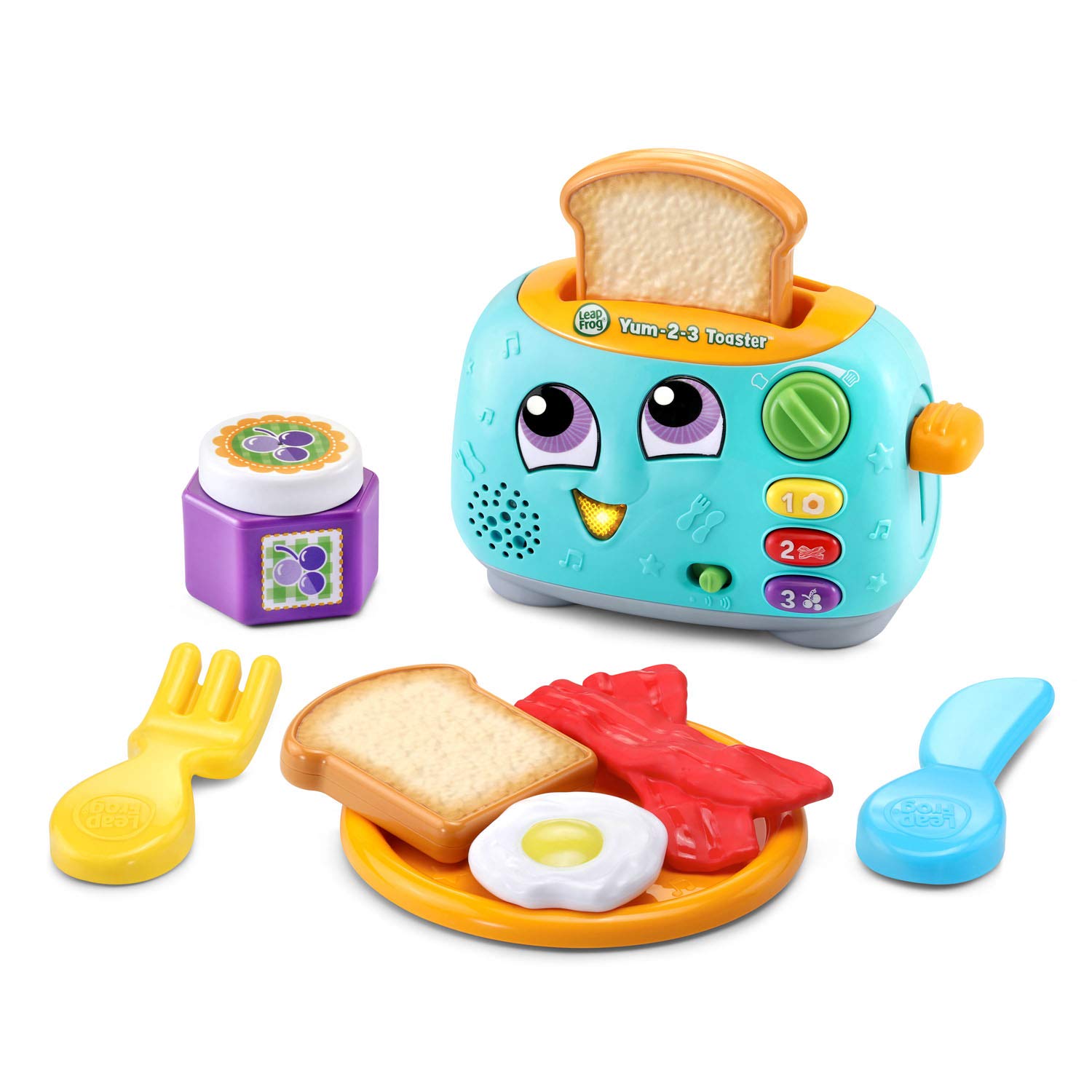 LeapFrog Yum-2-3 Toaster |
|
| $15.38 | Check price $15.38 |
| Budget Pick |  Melissa & Doug Spray, Squirt & Squeegee Cleaning Set |
|
| $18.89 | Check price $18.89 |
Learning Resources Farmer’s Market Color Sorting Set
Check price on Amazon $24.97
LeapFrog Yum-2-3 Toaster
Check price on Amazon $15.38
Melissa & Doug Spray, Squirt & Squeegee Cleaning Set
Check price on Amazon $18.89
Learning Resources Farmer’s Market Color Sorting Set — full evaluation
The Farmer’s Market set is the rare pretend toy that scales across three of the five symbolic play stages, which is why we rate it the single most useful first pretend purchase for the 18-to-36-month window. At 18 months the set lives in the functional-play and self-pretend zones — the toddler sorts apples into the red basket because that is satisfying, and then picks up a single apple and pretends to eat it. By 24 months the same set has shifted into other-pretend, with the toddler handing apples to the doll, the parent, or the dog. By 30 months the colored produce becomes the substrate for object substitution — the pear becomes a phone, the carrot becomes a magic wand — and by 36 months the basket itself becomes a grocery store cash register in a reciprocal storekeeper-customer role-play.
What makes the set work developmentally is that it is genuinely open-ended. There is no scripted narrative baked in. The five baskets and chunky produce pieces do not tell the child what to do with them. They simply provide enough variety (five colors, multiple produce types, stackable baskets) to support whatever symbolic stage the child has currently reached. That is the opposite of what battery-operated single-script pretend toys do, and it is why the set scores highest of the three picks on our language-elicitation axis — there is simply more here to name, request, and narrate than a single-script toy offers.
The build quality matches the developmental design. The produce pieces are oversized chunky molded plastic that comfortably pass the CPSC small-parts standard for under-3 use, the baskets nest for storage, and the included tongs (which become a top-tier fine-motor exercise around 30 months when the child can actually use them) add a layer of OT-relevant grip practice without being precious about it.
The trade-off is sprawl. Twenty-five pieces is a lot when the bin tips over, and you will end up storing the set in a clear shoebox tote rather than its original packaging. The price — about $32 — is also higher than single-function pretend toys at this stage, though the multi-year developmental range makes the per-month cost lower than narrower toys that get retired by 24 months. For families committing to one good pretend purchase, this is it.
Check price on Amazon → $24.97
LeapFrog Yum-2-3 Toaster — full evaluation
The LeapFrog Yum-2-3 Toaster is the best $19 you can spend on a child sitting right at the 18-month self-pretend threshold. The mechanism is simple: the toddler pushes the two chunky toast pieces into the toaster, presses the lever, waits, and the toast pops up with a brief light cue. That sequence — insert, action, wait, retrieve — is exactly the cause-and-effect scaffold that introduces toddlers to the idea that an object can stand in for another object (toast pieces become real toast, then become real food being fed to a doll).
Where this set sits in the symbolic play timeline is precisely the self-pretend stage. The child pretends to eat the toast themselves first, which is the diagnostic move pediatric SLPs look for at 18 months. By 24 months the same toy shifts naturally into other-pretend — the toast goes into the doll’s mouth, the parent’s mouth, the stuffed bear’s mouth. That progression is the reason this toaster pairs so cleanly with a play kitchen and a first baby doll: each piece scaffolds the next stage.
The light-and-sound feedback is the design choice we scrutinized hardest. Our active-vs-passive rule disqualifies toys whose primary engagement is watching scripted electronic output. The Yum-2-3 passes because the audio cue is brief, child-initiated, and confirmatory — the toddler pushes the lever, the toaster pops — rather than a continuous demand for attention. The optional song and counting features do edge toward passive, but they are easy to switch off — and switching them off is what most parents end up doing.
Limitations are honest. Two toast pieces is less variety than a multi-food set, so there are fewer distinct pretend moves for a toddler to narrate — which means less language elicitation per session than the Farmer’s Market top pick. The toy also has a narrower symbolic stage range — useful from 18 to roughly 30 months, after which a child has graduated past the toaster script. As a first dedicated pretend purchase for an 18-month-old at a sub-$20 price, however, it is a clean entry point into symbolic play. Pair it with our best wooden play kitchen review to extend the kitchen-script lifespan well into the role-play years.
Check price on Amazon → $15.38
Melissa & Doug Spray, Squirt & Squeegee Cleaning Set — full evaluation
The Melissa & Doug Spray, Squirt & Squeegee set is a stealth developmental tool dressed up as a $19 cleaning kit. At 24 months, when the other-pretend stage is solidifying and reciprocal role-play is just emerging, what toddlers want above all else is to do what mom and dad do. The strongest pretend-play scripts at this age are not abstract make-believe — they are direct parent imitation. A toddler watching a parent spray and wipe the kitchen counter, then handed a child-sized spray bottle of their own, will absorb hours of parallel-play scripting that is functionally indistinguishable from cooperative role-play.
The set delivers six real-moving-parts tools: a spray bottle that actually pumps water, a working squeegee, a scrub brush, a dust pan, a broom, and a cloth. Real function is the trick. A pretend spray bottle that does not spray reads as a prop, and toddlers move on. A spray bottle that actually mists water is genuinely magical at 24 months and triggers extended role-play. On our language-elicitation axis it invites the highest concentration of action verbs (spray, wipe, sweep, clean, scrub) of any toy on this list — verbs are the developmentally critical word class for toddler language because they unlock the subject-verb-object sentence frame that 30-month-old kids start producing.
This set is also the cleanest fit for the role-play stage that emerges between 30 and 36 months. By 30 months toddlers begin staging reciprocal scripts — “I clean, you clean too” — and the multi-tool kit supports parent-child parallel cleaning naturally. The wooden construction holds up, the paint is non-toxic, and the storage caddy keeps the set from sprawling.
The two genuine downsides are the working water spray (supervise on hardwood and around electronics) and the toddler-sized handles, which limit the set’s useful life beyond about 42 months when the child outgrows the grip scale. For a sub-$20 pretend toy that pulls action verbs out of a toddler and serves as the bridge to true role-play, those limitations are well worth the price.
Check price on Amazon → $18.89
The 5-stage symbolic play timeline: when pretend play starts and how it grows
Stage 1 — Functional play (12 to 15 months)
The earliest stage of pretend play is functional play, where the toddler uses an object the way it is designed to be used but without yet adding symbolic meaning. The child puts a spoon to their own mouth, holds a phone to their own ear, or runs a brush through their own hair. There is no doll, no narrative, no substitution — just the recognition that this object goes with this action. Functional play is the foundation everything else builds on, and a delay here is the first thing a pediatric SLP wants to know about. Per the CDC milestone guidance, functional play should be visible by the 15-month well visit.
Stage 2 — Self-pretend (around 18 months)
At roughly 18 months, the toddler extends functional play into the first true symbolic act: they pretend the cup has milk in it, or pretend to eat from an empty toy plate, with themselves as the actor. The LeapFrog Yum-2-3 toaster lives squarely in this stage — the toddler “eats” the toast they just popped up. Self-pretend is the moment pretend play officially starts in the SLP clinical sense, and it is what the 18-month well visit screens for. The marker: the child engages in an action as if a property exists (food in the cup) that is not actually there. That gap between reality and action is the symbol.
Stage 3 — Other-pretend (around 24 months)
By the second birthday, the toddler shifts the symbolic action away from themselves and onto another entity — usually a doll, stuffed animal, or parent. The toast goes into the doll’s mouth, not just the child’s. The Farmer’s Market Set top pick is built for this stage: the toddler hands apples to the parent or the bear and “sells” produce. This other-pretend behavior is a developmental precursor to the more elaborate role-play the CDC’s 4-year milestone checklist describes as “pretends to be something else, like a teacher or superhero” — the 24-month checklist itself focuses on earlier social-emotional markers like noticing when others are hurt or upset. If your child is not yet pretending at 24 months, bring it up at the 2-year well visit. It is the most reliable early indicator of language and social-cognition trajectory.
Stage 4 — Object substitution (around 30 months)
Around 30 months, toddlers begin using one object to represent a completely different object — a banana becomes a phone, a block becomes a car, a wooden carrot becomes a hammer. Object substitution is the developmental leap from concrete to abstract symbolic thought, and researchers consider it one of the more meaningful pretend-play predictors of kindergarten readiness in the literature. The Melissa & Doug cleaning set scaffolds this transition because the child can use the squeegee as a paintbrush, the spray bottle as a watering can, or the broom as a guitar.
Stage 5 — Reciprocal role-play (36 months and beyond)
By 3 years, pretend play matures into reciprocal role-play with assigned characters — mom and baby, doctor and patient, customer and storekeeper. The child can negotiate roles (“you be the doctor, I’ll be the patient”) and sustain a multi-step pretend narrative across 10 or 15 minutes. This is the stage that the AAP Power of Play report identifies as critical for self-regulation and executive function. Role-play is what unlocks the social-emotional skills children need for preschool: turn-taking, perspective-taking, language flexibility. Read our first baby doll guide for the role-play scaffolding doll that fits this window.
When pretend play starts: frequently asked questions
Pretend play starts in a recognizable form at around 18 months, when toddlers begin self-pretend — bringing an empty cup to their own mouth as if drinking, or pretending to eat from a toy plate. Functional play (using a spoon on yourself, putting a phone to your ear) appears earlier, around 12 to 15 months, and is the foundation that pretend play builds on. By 24 months, most toddlers extend pretend to others (feeding the doll, hugging the bear), and by 30 to 36 months they begin true object substitution and reciprocal role-play. If you are not seeing self-pretend by the 18-month well visit or other-pretend by the 24-month well visit, bring it up with your pediatrician.
The standard symbolic play timeline used by pediatric SLPs and developmental psychologists has five stages. Stage 1 is functional play (12–15 months) — using an object on yourself the way it is designed. Stage 2 is self-pretend (18 months) — pretending an action with yourself as the actor and an imagined object. Stage 3 is other-pretend (24 months) — doing the pretend action to a doll or stuffed animal. Stage 4 is object substitution (30 months) — using one object to stand for another. Stage 5 is reciprocal role-play (36 months and beyond) — assigned roles, sustained narratives, and turn-taking dialogue.
Pretend play and language develop on the same underlying symbolic-thought timeline, which is why pediatric SLPs treat them as paired indicators. The cognitive operation that lets a child use a banana to stand for a phone is the same operation that lets a child use the word “milk” to stand for actual milk — both require holding a symbol in mind that is detached from physical reality.
The published PubMed research on pretend play and toddler language links earlier object-substitution ability to stronger later language and narrative skills, though the exact timeline, effect size, and covariates studied vary across the literature. Floor-time pretend play with a parent narrating is one of the highest-yield language interventions available.
No. The AAP Power of Play clinical report and the broader child-development literature consistently identify active, child-led, open-ended play with physical objects as the format that drives the developmental gains. Screen-based pretend play apps look superficially similar — tap the carrot, drop it in the pot, see the cooking animation — but the child is rehearsing a pre-scripted adult-designed sequence, not generating their own symbolic narrative. The cognitive work that builds language, executive function, and theory of mind is the work of generation, not consumption. Use physical pretend toys for the developmental return, and reserve screen time for the narrower entertainment purpose it actually serves.
A 24-month-old who is not yet showing other-pretend (feeding the doll, hugging the bear, putting the toy phone to a doll’s ear) warrants a conversation with your pediatrician at the 2-year well visit. Symbolic play is one of four social-emotional milestones the CDC checklist screens at this age, and a delay here is one of the earlier signals SLPs use to flag children for further developmental evaluation. The fix in mild cases is usually more parent-led pretend modeling on the floor — narrating short scripts (“Mommy is drinking the juice, mmm yummy”) and inviting imitation. More persistent delays may merit a referral to an early-intervention SLP, which is a covered service in every US state for children under 3.
The biggest lever is parent modeling on the floor. Sit down with your toddler and demonstrate short symbolic scripts — pretend to drink from a cup, pretend to feed the doll, pretend to talk on a banana phone — with exaggerated facial expressions and simple narration. Toddlers learn pretend by watching it, then imitating it. Provide a small rotation of open-ended pretend toys (food, dolls, a play kitchen, tools, dress-up cloths) and minimize battery-operated single-script toys that do the symbolic work for the child.
Keep play sessions short and child-led — 10 to 15 minutes of focused floor play with a present parent beats 60 minutes of solo screen time, every time. Stock the right developmental fit with our wooden play kitchen review and full play category.
Our top pick for when pretend play starts: Learning Resources Farmer’s Market Set
The single most useful first pretend purchase for the 18-to-36-month window. The Farmer’s Market set scales across three symbolic play stages (self-pretend, other-pretend, and object substitution), and its naming-and-requesting script — pick, weigh, pay, bag — gives a toddler more to talk about than a single-purpose toy does. It pairs cleanly with a play kitchen, a first baby doll, and the cleaning set above to scaffold a complete pretend-play ecosystem from 18 months to preschool.
Check price on Amazon → $24.97
Medical disclaimer: Not medical advice. Concerns about pretend play development, language delay, or developmental milestones should always be discussed with your child’s pediatrician, especially if a toddler is not showing self-pretend by 18 months or other-pretend by 24 months. The information here is educational and reflects current clinical guidance as of publication. Consult HealthyChildren.org (AAP) and the CDC Learn the Signs. Act Early. program for additional guidance.
Prices: Reflect typical Amazon pricing as of May 2026 and may vary. Set contents and exact piece counts occasionally change — verify on the linked product page before ordering. The pretend-play-and-language research referenced is available via PubMed (NCBI).