
Best Baby Activity Center 2026: 3 Hip-Healthy Stationary Picks
The best baby activity center for hip development is a stationary one — not a sit-in walker. Pediatric hip specialists have long emphasized that a baby’s hips and knees need room to fall into a naturally bent, slightly spread position — sometimes called the “frog-leg” or M-position — rather than being held straight down with the thighs pressed together, because sustained straight-legs-together positioning (not the bent-and-spread posture) is the pattern linked to a higher risk of hip dysplasia (International Hip Dysplasia Institute, hip-healthy positioning guidance). That guidance is established for swaddling and babywearing; neither IHDI nor the AAP has published guidance specific to stationary activity centers. Pediatric-rehab and orthopedic sources that do address this product category, including Children’s Rehabilitation Institute TeletonUSA and Nebraska Medicine’s orthopaedics team, apply the same principle here — cautioning against seat designs that hold a baby’s legs straight down and pressed tightly together, and favoring designs that let the hips settle into their natural, slightly bent and spread position We compared 3 stationary contenders against that general hip-healthy positioning principle and against the pediatric-rehab guidance that addresses activity centers specifically the Skip Hop Explore & More 3-Stage at $149.99 (our top pick for grow-with-me longevity from 4 months through pulling-to-stand), the Skip Hop Discoverosity Montessori 3-Stage at $184.99 (our premium pick that converts to a true play table for open-ended floor play), and the Time Followers 6-in-1 Montessori-inspired center at $139.99 (our value pick with 4-stage transformation from infant seat to toddler table). All three were compared on manufacturer-published recommended-use limits and convertibility to non-containment play — none of the three manufacturers publish a seat-opening or hip-position specification, so no pick below should be read as a certified “IHDI hip-safe” pass; see our buying guide for what to check yourself.
Hip safety isn’t the only reason pediatricians push stationary activity centers over walkers. The American Academy of Pediatrics formally opposes the sale of baby walkers in the United States because of the injury rate (more than 230,000 walker-related ER visits treated in U.S. emergency departments over a 25-year surveillance period (1990-2014)), and because walkers actually delay rather than accelerate gross motor milestones. A stationary activity center solves both problems: no mobility means no stair falls, and the upright weight-bearing builds the leg strength that supports independent walking later. Pair this guide with our best activity tables for toddlers for the post-12-month transition, and read our container baby syndrome prevention guide to understand why even hip-safe activity centers still need strict 15–20 minute daily limits.
See our top pick on Amazon → $149.99
Best baby activity center top picks after our hip-positioning review
The 3-stage stationary center with the broadest age range, the Montessori-inspired premium pick that converts to a true play table for open-ended floor play, and the 4-stage value pick that extends usability from 6 months through the toddler years. None of the three publish a specific hip-position spec, so see our buying guide below for the hip-positioning principle to check for yourself.
Check price on Amazon $149.99
Check price on Amazon $184.99
Check price on Amazon $139.99
Safety first: stationary activity centers are not walkers, but they still have hard use limits
The American Academy of Pediatrics has called for a ban on the sale of mobile baby walkers in the United States since 2018 because of the injury rate (stair falls, burns, drowning, head trauma) and the documented delay in motor milestones in walker-using babies. A stationary activity center solves the mobility-injury problem — the base doesn’t roll — but the IHDI still recommends capping daily use at 15–20 minutes total, never exceeding the manufacturer weight limit (typically 25–30 lbs), and discontinuing use entirely once the baby can pull to stand independently. Beyond that milestone, the device becomes a tipping hazard and a free-movement constraint.
The gold standard for infant motor development is unrestricted floor play. The best baby activity center is a complement to floor time, never a substitute. Use it for short stretches when you genuinely need both hands free — cooking, a phone call, getting dressed — and put your baby back on the mat as soon as the task is done.
How we evaluated the best baby activity centers for hip safety
A baby’s hip joint is still soft cartilage and actively forming through the first 6–12 months, which is why how a seat positions the legs is worth checking. We reviewed each unit against three measurable criteria, informed by the IHDI’s general hip-positioning guidance and by pediatric-rehab sources that address activity centers directly:
Hip positioning. The International Hip Dysplasia Institute describes the hip-healthy position as legs that fall into a natural, slightly bent and spread (‘frog-leg’ or M-position) posture — not legs held straight down with the thighs pressed together — because sustained straight-legs-together positioning, not the bent-and-spread posture, is the pattern linked to a higher risk of hip dysplasia. That guidance is published for swaddling and babywearing; IHDI and the AAP have not published activity-center-specific criteria, so we can’t certify any unit’s seat as officially ‘IHDI hip-safe.’ What we could verify from each manufacturer’s own materials was seat height range, adjustability, and weight limits — not a documented hip-position specification — so treat the hip-positioning notes in this guide as general buying guidance, not a pass/fail grade on any specific pick.
Weight-bearing through the feet. The best baby activity center transfers the baby’s weight primarily through the feet onto the floor or jumper base, with the seat providing balance rather than full support. We compared each unit’s published seat-height range, at its lowest and highest settings, against typical standing heights for the age and weight range the manufacturer states it for — the check is whether a baby in that range can stand flat-footed rather than hang by the crotch. A center that holds the baby with toes barely touching functionally suspends the baby by the crotch regardless of how the marketing labels it — a separate concern from hip positioning, tied to premature weight-bearing rather than hip-socket geometry.
Use-limit and convertibility compliance. Per the AAP container-baby-syndrome guidance and the CDC’s 6-month developmental milestones, infants need substantial daily unrestricted floor play to develop core strength, head control, and crawling. We verified that each unit’s manufacturer documentation cited the 15–20 minute daily-use cap and discontinuation milestone, and rewarded designs that converted to a non-containment play surface (such as a removable seat that turns the base into a play table) since those designs naturally encourage post-containment floor play rather than extended use as a holding pen.
Best baby activity center 2026: side-by-side comparison
| Pick | Product | Key strengths | Watch-outs | Price | Where to buy |
|---|---|---|---|---|---|
| Top Pick |  Skip Hop Explore & More 3-Stage |
|
| $149.99 | Check price $149.99 |
| Premium Pick |  Skip Hop Discoverosity Montessori-Inspired |
|
| $184.99 | Check price $184.99 |
| Value Pick | 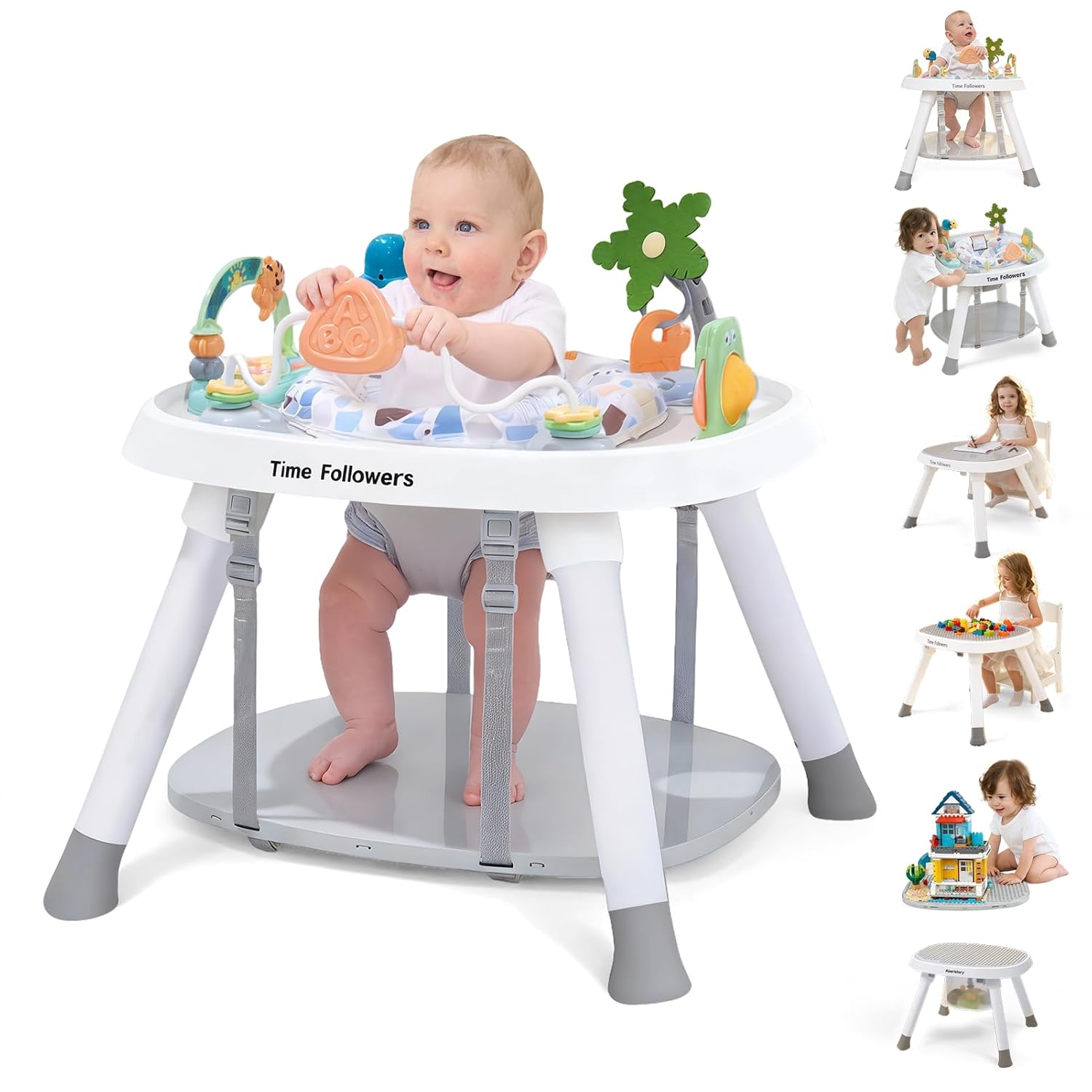 Time Followers 6-in-1 Montessori |
|
| $139.99 | Check price $139.99 |
Skip Hop Explore & More 3-Stage
Check price on Amazon $149.99
Skip Hop Discoverosity Montessori-Inspired
Check price on Amazon $184.99
Time Followers 6-in-1 Montessori
Check price on Amazon $139.99
Skip Hop Explore & More 3-Stage — full review
The Skip Hop Explore & More is a well-reviewed grow-with-me stationary center: the 360° rotation lets the baby reach every toy without needing to twist their trunk, and the 3 height settings carry usability from the ~4-month “can hold head up unsupported” milestone through the ~10-month “pulling to stand” milestone, when pediatric guidance says to discontinue use of any seated activity center. Skip Hop’s own listing highlights an adjustable foot-support platform, but it does not publish a seat-opening width or hip-position specification — so we can’t certify this unit’s geometry against IHDI’s hip-healthy positioning principles one way or the other.
What we can tell you is the general principle worth applying when you have the unit in front of you: IHDI’s hip-healthy guidance (published for swaddling and babywearing, and extended by pediatric-rehab sources to seated devices like this one) favors a seat that lets a baby’s thighs relax into their own natural, slightly bent and spread position, over one that pins the legs straight down and pressed together. Neither this unit nor any competitor we found publishes measurements that would let us grade that from a spec sheet — check it yourself with the baby seated, rather than relying on any brand’s marketing language, including ours.
The toy array is genuinely well-designed for the activity-center use case: cause-and-effect mirrors and rattles at the seat-height stage, then movable attachments that let parents refresh novelty without buying replacement parts. Light and sound are dialed down compared to the brightest competitor centers, which keeps the device from becoming an over-stimulating sensory bombardment during the 15–20 minute use windows the IHDI recommends.
The hard limits apply: don’t exceed 25 lbs of baby weight in the seat, don’t use beyond the age the baby can pull to stand, and cap daily use at 15–20 minutes. Within those limits, this is the activity center we’d put in our own homes.
Check price on Amazon → $149.99
Skip Hop Discoverosity Montessori-Inspired — full review
The Discoverosity is the unit that solves the post-9-month problem: what do you do with an activity center once the baby is pulling to stand and the IHDI says to discontinue use? Most centers become bulky basement storage at that point. The Discoverosity converts cleanly into a standing play table, which keeps the wooden-look surface and the cause-and-effect toys in active rotation through the toddler years. That extended runway is what justifies the $185 price tag against the $150 standard Skip Hop center.
The Montessori alignment shows up in the toy choices. Where mainstream centers lean on light-up buttons and electronic music loops, the Discoverosity emphasizes wooden-aesthetic textures, cause-and-effect mechanisms (push a lever, a ball drops; spin a wheel, a piece rotates), and sensory variety without sensory overload. For parents who already lean toward Montessori-inspired play (open-ended, low-tech, child-directed), this is the activity center that fits the rest of the nursery.
Skip Hop’s Discoverosity listing highlights an adjustable foot platform and a 360° rotating seat, but like its sibling Explore & More, it does not publish a seat-opening or hip-position specification — so “hip-safe geometry, verified” isn’t a claim we can actually stand behind for this or any unit in this category. The manufacturer-documented basics are solid: a 4-month-and-up age range, a discontinuation milestone once the baby can pull to stand, and a conversion to play-table mode that shifts play to the floor. For the hip-positioning question specifically, use the same in-person check described in our buying guide: legs should fall into a relaxed, slightly bent and spread position, not be pinned straight down.
The trade-offs are deliberate. The Discoverosity has fewer integrated electronic toys than the Explore & More, which means parents who count on the activity center to keep a baby engaged at the seat stage might find the engagement window shorter. The price is also a real consideration: at $185, it’s roughly 25% above the standard Skip Hop and 70% above the Time Followers value pick. The investment is defensible only if you’ll actively use the play-table conversion in the toddler years — otherwise the standard Explore & More is the better value.
Check price on Amazon → $184.99
Time Followers 6-in-1 Montessori — full review
The Time Followers 6-in-1 is the best baby activity center for families who want one piece of furniture to carry them from the early-sitting stage at 6 months through the toddler years at 24 months. The 4-stage transformation is the differentiator: stage one is the infant activity seat (feet planted on a footrest; no published hip-position spec), stage two is the seated play surface around 12 months, stages three and four are increasingly standing-friendly toddler play configurations through 24 months. That runway makes the $139.99 price tag look like a genuine value when amortized across 18 months of use.
We couldn’t verify a hip-position specification for the Time Followers seat any more than we could for the Skip Hop picks — none of these manufacturers publish one. What is documented is the weight-bearing design: the feet plant on the base and weight transfers through the legs to the floor rather than suspending the baby by the crotch, which is a separate (and genuinely verifiable) developmental-readiness consideration from hip positioning. The Montessori-inspired toy choices skew wooden and cause-and-effect rather than electronic and over-stimulating, which is consistent with current pediatric guidance on infant sensory environments.
The trade-offs are real. The 6-month minimum age is later than the 4-month start of the Skip Hop picks, which means families looking for hands-free containment in the early months will need to bridge with a different solution (floor play with a mat, a non-vibrating bouncer for short stretches). The Time Followers brand is newer than Skip Hop and has a smaller review base, so the long-term durability data is less established — a real unknown rather than a red flag, but worth weighing if you want a brand with a decade of failure reports behind it.
For families on a budget who want one investment that lasts the whole activity-center-and-toddler-table window, the Time Followers is the value play. For families with a younger infant who need 4-month-and-up usability, the Skip Hop Explore & More remains the right starting point.
Check price on Amazon → $139.99
5 things to know before buying the best baby activity center
Stationary, not mobile — the AAP wants walkers banned
The American Academy of Pediatrics has formally called for a ban on the sale of mobile baby walkers in the United States. The reasoning is unambiguous: walkers were linked to more than 230,000 ER visits over a 25-year surveillance period, 1990-2014, for stair falls, burns, drowning, and head trauma, and they actually delay rather than accelerate motor milestones because babies learn to push with their toes rather than activate their core. A stationary activity center eliminates the mobility-injury vector entirely. Never buy a sit-in walker. Read the full AAP position statement on baby walkers at HealthyChildren.org before any purchase in this category.
Hip positioning is a general principle — not an IHDI activity-center standard
The International Hip Dysplasia Institute’s published guidance (for swaddling and babywearing) is that a baby’s hips are healthiest when the legs can fall into a natural, slightly bent and spread (‘frog-leg’ or M-position) posture, rather than being held straight down with the thighs pressed together. IHDI has not published a specific standard for stationary activity centers, exersaucers, or jumpers. Pediatric-rehab sources that do discuss this product category — including Children’s Rehabilitation Institute TeletonUSA and Nebraska Medicine’s orthopaedics team — apply the same general principle to it, cautioning against seats that hold the legs straight and pressed tightly together. When you’re evaluating a unit in person, look for a seat that lets your baby’s thighs settle into their own natural, slightly bent and spread position rather than one that pins the legs straight down. Always check the IHDI’s published hip-healthy positioning guidance for the general principle.
15–20 minutes daily is the hard cap, no exceptions
Even the best baby activity center is a containment device, and containment devices in excess cause “container baby syndrome” — the cluster of motor delays, plagiocephaly (flat head), torticollis (tight neck), and weak core musculature that pediatric PTs see in babies who spend most of their waking hours strapped into seats, swings, bouncers, and centers. The IHDI cap is 15–20 minutes per session and ideally not multiple sessions per day. Read our container baby syndrome prevention guide for the full framework.
Discontinue at the pull-to-stand milestone
Every manufacturer ships the device with a discontinuation milestone — usually phrased as “stop using when baby can pull to stand independently” or “discontinue at 30 lbs / 32 inches, whichever comes first.” Both AAP and IHDI guidance reinforce this. Past the pull-to-stand milestone, the device becomes a tipping hazard (a baby who can lean their weight forward against the tray can flip the unit), a free-movement constraint (the baby needs to practice cruising and walking, not stay contained), and a hip-safety risk again (extended weight-bearing in a fixed seat past this developmental window is no longer indicated).
Floor play is still the gold standard — the activity center is a complement
The AAP and the CDC both emphasize that unrestricted floor play is the single most important environment for infant motor development. Tummy time, rolling, reaching, scooting, crawling, pulling to stand — all of these milestones require the baby to be on the floor practicing them. The best baby activity center is a 15–20-minute hands-free buffer when you genuinely cannot supervise active floor play (cooking, a phone call, a shower). It is never a substitute for the floor time that builds the motor system. Pair the activity center with our best activity tables for toddlers and a category-wide look at all of our play-stage gear reviews.
If a documented hip-position spec matters more to you than play features, one seat actually publishes one
None of the 3 activity centers above publish a seat-opening or hip-position measurement, so we can’t certify their geometry either way — that’s the honest limit of what’s checkable on this product category. If you’d rather have a documented spec than a "check it yourself" judgment call, the  GiggleGlow Baby Floor Seat at $74.99 is a genuinely different product — a feeding-and-floor seat, not a rotating activity center — but its manufacturer publishes exactly the spec our 3 activity-center picks don’t: a 3.35-inch-wide leg opening built to avoid pinning the thighs together, for babies from 6 months (once they can sit upright unassisted) up to 33 lbs. It has no toy bar and no 360° rotating seat, so it isn’t a swap-in replacement for the play value of the picks above — it’s the right choice specifically when a documented hip-position spec outweighs active-play features for you. Check price on Amazon $74.99
Best baby activity center: frequently asked questions
Pediatric hip specialists emphasize a general hip-positioning principle: a baby’s legs should be able to fall into a natural, slightly bent and spread (‘frog-leg’ or M-position) posture, not held straight down with the thighs pressed tightly together, because sustained straight-legs-together positioning is the pattern linked to a higher risk of hip dysplasia. That guidance comes from the International Hip Dysplasia Institute’s swaddling and babywearing publications; IHDI has not published a stationary-activity-center-specific standard. Pediatric-rehab sources that do address this product category apply the same principle, cautioning against seats that hold the legs straight and pressed together. Sit-in mobile walkers are separately considered unsafe by the AAP because of the injury rate from mobility. Whatever unit you choose, look for a seat that lets your baby’s legs settle naturally rather than one that pins them straight down, and stick to the 15–20 minute daily-use cap.
Most stationary activity centers start at 4 months, conditional on the baby having developed unsupported head control. The Skip Hop Explore & More and Skip Hop Discoverosity both list 4 months as the minimum age. The Time Followers 6-in-1 starts at 6 months. Always meet the head-control milestone before introducing any seated containment device, and discontinue when the baby can pull to stand independently — typically around 9–10 months for most infants. Beyond the pull-to-stand milestone, the device becomes a tipping hazard and a free-movement constraint.
The IHDI and AAP recommend a hard cap of 15–20 minutes per session in any containment device, ideally not multiple sessions per day. The reasoning is that infants need substantial daily floor play to develop core strength, head control, rolling, scooting, and crawling — all of which are impossible while strapped into a seat.
Babies who spend excessive time in containment devices (car seats, swings, bouncers, activity centers, seat carriers) develop the cluster of issues pediatric PTs call container baby syndrome: flat head, tight neck, weak core, delayed motor milestones. The best baby activity center is a hands-free buffer for the moments you genuinely need both hands, not an all-day holding pen.
An activity center has a stationary base — it doesn’t roll. A baby walker has wheels under the base and is designed to let a non-walking baby move around the room. The AAP has called for a ban on the sale of mobile baby walkers in the United States because they were linked to more than 230,000 ER visits over a 25-year surveillance period, 1990-2014 (stair falls, burns, drowning, head trauma) and because they actually delay rather than accelerate motor milestones. The best baby activity center is always stationary — never buy a sit-in walker.
Mobile baby walkers have documented motor-milestone delays. The evidence for stationary activity centers is less stark, but the principle is the same: time spent in any containment device is time not spent on the floor practicing the movements that build the motor system. A 15–20 minute daily session in a stationary activity center is unlikely to meaningfully delay walking. Multiple hours of daily use can contribute to the broader container baby syndrome cluster of motor delays.
The fix is dosage discipline: short sessions, lots of floor play around them, and discontinuation at the pull-to-stand milestone. Reference the CDC’s developmental milestone tracker to make sure your baby is hitting milestones on schedule.
We can’t confirm that with certainty: neither Skip Hop nor Time Followers publishes a seat-opening or hip-position specification for these units, and neither IHDI nor the AAP has published a stationary-activity-center-specific hip-safety standard to check them against. What we can tell you is the general hip-healthy positioning principle IHDI publishes for swaddling and babywearing: legs should be able to fall into a natural, slightly bent and spread (‘frog-leg’ or M-position) posture, not held straight down with the thighs pressed together. You can eyeball that on any seat at home: with the baby seated, do the thighs relax outward and down, or are they pinned straight together? Make that visual check yourself rather than relying on any brand’s marketing language, including ours, and stick to the 15–20 minute daily-use cap regardless of seat design.
There isn’t a single ‘best for hip development’ pick we can certify: no activity-center manufacturer we found, including our three picks, publishes a seat-opening or hip-position specification, and neither IHDI nor the AAP has published a standard for this product category specifically. The general principle worth applying, per IHDI’s swaddling and babywearing guidance, is to favor a seat that lets your baby’s thighs settle into a natural, slightly bent and spread position rather than one that holds the legs straight down and pressed together. Check that visually on whichever unit you’re considering, and cap daily use at 15–20 minutes regardless of seat design. If a documented spec matters more than play features to you, the GiggleGlow Baby Floor Seat is a genuinely different product (a floor/feeding seat, not an activity center) that does publish one: a 3.35-inch-wide leg opening, for babies from 6 months up to 33 lbs.
Our #1 best baby activity center pick: Skip Hop Explore & More 3-Stage
The most balanced hip-healthy stationary activity center of our three picks, with an adjustable-height foot platform (Skip Hop does not publish a hip-position spec for this seat, so check the fit yourself), a 360° rotating seat that lets baby reach every toy without trunk twist, and a 3-stage height adjustment that carries usability from the 4-month head-control milestone through the 10-month pull-to-stand discontinuation milestone. At $149.99 it’s the right starting point for parents who want one well-engineered piece of furniture for the entire activity-center window — used within the 15–20 minute daily cap and paired with substantial unrestricted floor play.
Check price on Amazon → $149.99
Medical disclaimer: Not medical advice. Equipment selection and use should always be made in consultation with your child’s pediatrician, especially when concerns exist about hip development, motor milestones, or developmental dysplasia of the hip. The information here is educational and reflects current clinical guidance as of the last review date. Consult HealthyChildren.org (AAP), the International Hip Dysplasia Institute, and the CDC for additional pediatric guidance.
Prices: Reflect typical Amazon pricing as of May 2026 and may vary. Manufacturer model numbers occasionally change — verify on the linked product page before ordering.
- Tamai J. Developmental Dysplasia of the Hip (DDH). Medscape Drugs & Diseases (eMedicine); updated Apr 22, 2024. Healthy hip development depends on the femoral head sitting deeply in the acetabulum; positioning that holds the hips extended and adducted (tight swaddling, some carriers) is a recognized DDH risk, while hip-abducted ‘M’ positioning is protective.