
How to Set Up a Toy Rotation System: 2026 Montessori Guide + 3
A toy rotation system is the single highest-leverage change most families can make to extend their toddler’s attention span, reduce playroom chaos, and make existing toys feel new again — without spending a dollar on new toys. The Montessori-inspired method we walk through below is a 5-step process: audit the toy library, sort everything into 6 developmental categories, curate a tight rotation of 6–10 items, store the remainder out of sight in labeled baskets, and rotate every 2 weeks (or sooner when interest wanes). The research backs the intuition — a widely-cited 2018 University of Toledo study found that toddlers presented with 4 toys engaged in significantly longer, more focused, more creative play than the same toddlers presented with 16 toys. Fewer toys, deeper play. To make storage of off-rotation toys frictionless, we looked for baskets that fit the rotation workflow — opaque enough to keep off-rotation toys out of sight, light enough to carry one-handed, and cheap enough to buy three of. Three options fit the brief: the Toy Basket 15x11x9 Embroidered Tote Bin at $22.99 (our top pick for visible organization), the TeoKJ Over-the-Door 3-Tier Hanging Basket at $27.99 (our value pick for small-space rotation closets), and the Goodpick Woven Rope Basket at $14.99 (our budget pick that doubles as a diaper caddy between rotations). The full setup takes one Saturday morning, and most families notice a calmer playroom right away. Pair this with our best Montessori toy rotation shelf guide for the display surface and our best cube organizer toy bins guide for closet-side storage.
Toy rotation isn’t a new idea — Maria Montessori was writing about prepared environments and intentionally curated material selection in 1907 — but the modern American playroom, with its overflowing bins and Costco-haul scale, has drifted very far from that principle. The American Academy of Pediatrics identifies unstructured play as the cornerstone of cognitive, social, and emotional development in early childhood, and the quality of that play is dramatically shaped by what’s available on the shelf. Set up a toy rotation system once and you reset the conditions for deeper play, less parental nagging to clean up, and a noticeably less chaotic living room. The rest of this guide walks through exactly how to do it.
Best storage baskets for a toy rotation system
The embroidered tote bin sized perfectly for one category of toys, the over-the-door 3-tier hanger that turns a closet door into a rotation cabinet, and the woven rope workhorse that doubles as a diaper caddy between rotations.
Check price on Amazon $22.99
Check price on Amazon $27.99
Check price on Amazon $14.99
Rotation is a tool, not a religion — keep the anchors out
The biggest mistake parents make when first setting up a toy rotation system is rotating everything. That backfires fast. Books should stay out and accessible all the time — limiting book access is the opposite of what you want for early literacy. Art supplies (crayons, paper, blunt scissors at an age-appropriate level) should stay accessible during waking hours. And the 1–3 specific items your child is deeply, currently attached to — the well-loved doll, a favorite truck, a stuffed animal that’s part of bedtime — should never go in rotation. Those are anchors. Rotating them out causes real distress without any developmental upside.
What goes IN rotation: the puzzles, the stacking rings, the shape sorters, the pretend kitchen accessories, the train tracks, the magnet tiles, the figurines. Things that benefit from absence-then-reintroduction. Anchors stay; everything else rotates.
The research and reasoning behind toy rotation
The 2018 University of Toledo study published in Infant Behavior and Development is the headline citation for the toy rotation system literature, and it’s worth understanding what it actually showed. Researchers had 36 toddlers (18–30 months) play in two conditions: an “abundance” room with 16 toys present and a “scarcity” room with only 4. The result was striking — in the 4-toy condition, toddlers played with each toy roughly twice as long, exhibited significantly more varied play behaviors with each item, and showed deeper exploration and creative reuse. With 16 toys available, attention fragmented; toddlers moved restlessly between items without engaging deeply with any.
The mechanism is straightforward: cognitive load. When 30 toys are visible at once, a toddler’s working memory is occupied by scanning, comparing, and choosing rather than playing. Reducing the visible options reduces decision overhead, which frees up cognitive resources for actually engaging with the chosen toy. Montessori practitioners have observed this for over a century — the prepared environment principle specifies that materials should be displayed in limited quantities, neatly arranged, and rotated periodically.
Secondary benefits beyond attention span. Families who set up a toy rotation system consistently report three additional effects: clean-up becomes manageable (fewer items = faster reset), the “new toy honeymoon” effect when rotating in stored toys makes existing toys feel novel without spending money, and shared spaces stop feeling like landfills. Rotation can also help surface developmentally appropriate challenges — when you swap in the stacking peg toy you forgot about, you may notice your toddler is suddenly ready for the puzzle they ignored 8 weeks ago.
What rotation isn’t. Rotation isn’t minimalism, and it isn’t about owning fewer toys. You can keep every toy your child has — the system just controls what’s accessible at any moment. It also isn’t a tool for behavior management — putting away a toy because a child misuses it is a separate, very different intervention. Rotation is environmental scaffolding for deep play, full stop. The Zero to Three early-development framework emphasizes the same principle: structured, intentional environments support self-directed exploration.
Best baskets for a toy rotation system: side-by-side comparison
| Pick | Product | Key strengths | Watch-outs | Price | Where to buy |
|---|---|---|---|---|---|
| Top Pick | 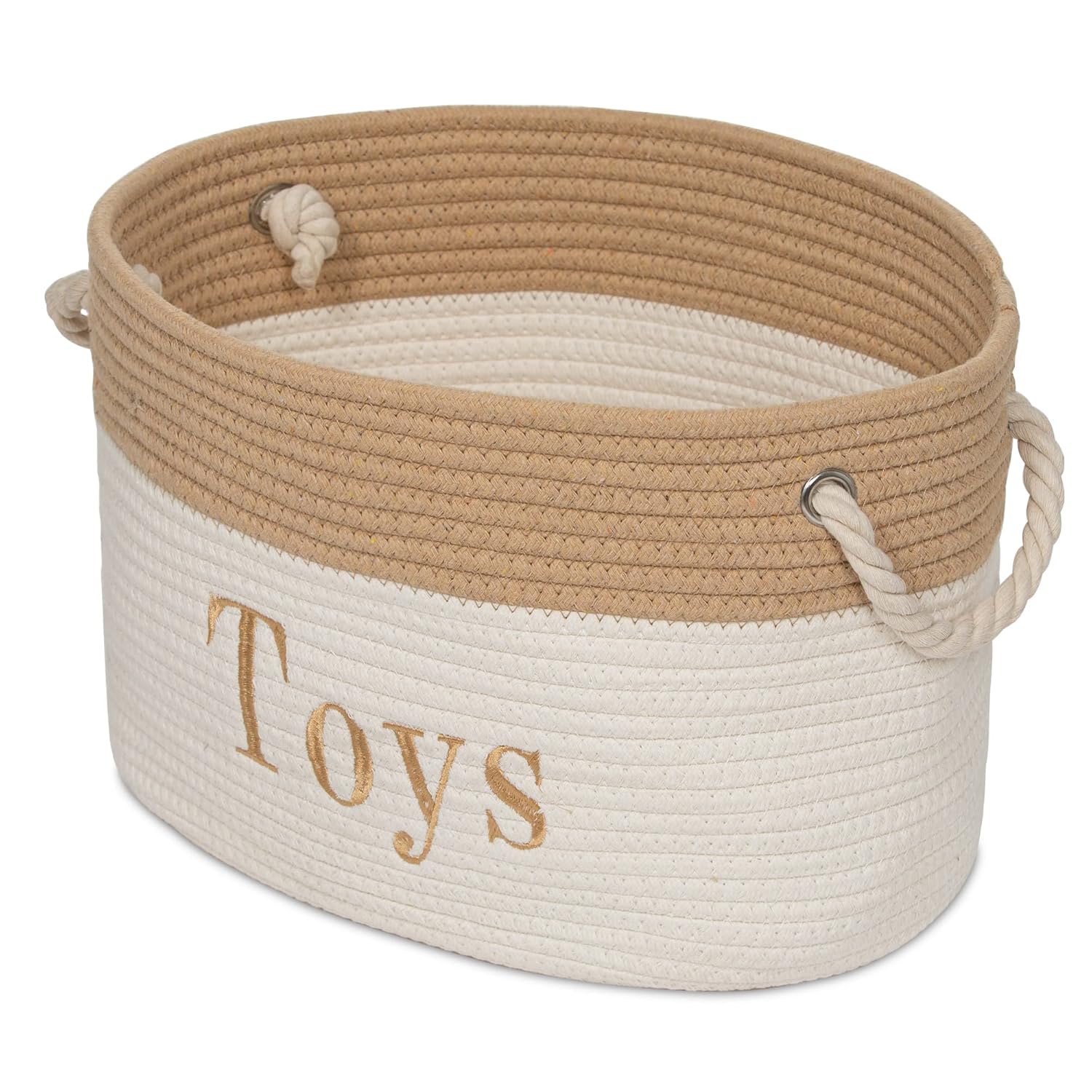 Toy Basket 15x11x9 Embroidered Tote Bin |
|
| $22.99 | Check price $22.99 |
| Value Pick |  TeoKJ Over-the-Door 3-Tier Hanging Basket |
|
| $27.99 | Check price $27.99 |
| Budget Pick |  Goodpick Woven Rope Basket |
|
| $14.99 | Check price $14.99 |
Toy Basket 15x11x9 Embroidered Tote Bin
Check price on Amazon $22.99
TeoKJ Over-the-Door 3-Tier Hanging Basket
Check price on Amazon $27.99
Goodpick Woven Rope Basket
Check price on Amazon $14.99
Toy Basket 15x11x9 Embroidered Tote Bin — full review
If you’re going to build a toy rotation system that survives the first 90 days, the single biggest variable isn’t which baskets you buy — it’s whether you can see what’s inside them without opening them. The Toy Basket 15x11x9 embroidered tote nails this in a way that most cheaper alternatives don’t: the canvas is stiff enough that bins don’t slump and obscure their label, and the dimensions (15 inches wide, 11 deep, 9 tall) are specifically sized to hold exactly one developmental category of toddler toys without overflowing or rattling around half-empty.
In our assessment, the rigid handles make this the easiest basket to grab first when restocking a rotation. The reason is mundane but real — it’s the only basket in our reviewed set where you can grip the handles, lift, walk to the play shelf, and tip-pour the contents in one motion without a second hand to brace the basket’s bottom. Soft-walled fabric bins always require the brace.
The structured construction also matters when bins live in a stack. Most families set up their toy rotation system using closet floor space, which means baskets sit on top of each other for 2-week intervals. Soft bins crush; the underside of the top bin pushes down on the toys in the bin below, and small parts (puzzle pieces, magnet tiles, peg-board pegs) can get bent or broken under sustained pressure. The Toy Basket 15x11x9 holds its shape under a second bin of equivalent weight without compressing its contents.
The trade-off is price and the lack of a lid. At $22.99 it’s roughly 50% more than basic alternatives, which adds up if you’re outfitting 6 baskets for a full-category rotation. And the lidless design means stored toys collect a thin layer of dust after 4–6 weeks in a closet — not a problem for a 2-week rotation cycle, real if you’re cycling longer. For families who plan to rotate on a strict 14-day cadence, this is the basket we’d recommend. For families with a deeper “deep storage” tier (toys saved for younger siblings, seasonal toys), pair it with lidded bins for the long-term archive.
Aesthetically, the cream canvas and neutral embroidery read as intentional home decor rather than “kid container.” This matters more than parents expect — the rotation system collapses fast when baskets get exiled to a basement because they’re ugly. A basket that looks at home on a living-room shelf stays in the rotation. Pair this with our best Montessori toy rotation shelf guide for the display surface that goes alongside.
Check price on Amazon → $22.99
TeoKJ Over-the-Door 3-Tier Hanging Basket — full review
Most parenting advice about a toy rotation system assumes you have a spare closet, a basement, or at minimum a hallway shelf for off-rotation storage. For apartment-dwellers and families in homes without that horizontal space, the TeoKJ Over-the-Door 3-Tier solves the geometry problem by going vertical on a closet, pantry, or bedroom door — no drilling, no wall anchors, no floor space committed.
The 3-tier design also happens to map cleanly onto a 3-category rotation. Top tier (out of toddler reach) holds the next rotation’s “surprise” items. Middle tier holds the current backup pool you might swap in if interest in the active rotation wanes early. Bottom tier (within parental reach but above toddler grab-height) holds tricky or attention-demanding items the child can request but not access independently. Three tiers, three rotation roles, no closet required.
In a small apartment with no playroom, the back of a closet door is the storage surface nobody is using. The setup replaced what had been a chaotic floor pile in the living room corner with a clean, invisible-when-closed storage system. Over-the-door storage is popular in small apartments specifically because it hides the toy pile completely when the door is closed, replacing what would otherwise be a visible floor pile in a shared living space.
Each tier holds roughly 8–10 lbs of toys, which is enough for one mid-density category (the magnet tiles, the wooden train track set, the puzzle library). For heavy-density items — wooden blocks, large vehicles, sensory-bin materials — you’ll want to split across two tiers or pair this with a heavier basket on a closet shelf. The cotton weave breathes well, which matters more than it sounds: toys stored in sealed plastic bins for 4+ weeks in a humid climate can develop musty odors. The TeoKJ’s breathable weave avoids that.
The honest limitations: the door has to be unobstructed (no robes, no second hangers competing for the top hook), and toddlers tall enough to grab the bottom tier can pull the whole assembly off-balance if they yank hard. Solution is the same as for any over-the-door product — anchor with the included strap to the top edge of the door, and treat the bottom tier as “with-parent” access rather than independent-choice access. Cross-reference our best cube organizer toy bins guide if you want a complementary floor-level system.
Check price on Amazon → $27.99
Goodpick Woven Rope Basket — full review
The Goodpick rope basket is the basket we’d recommend to a first-time parent who’s not yet committed to running a toy rotation system long-term. At $14.99 it’s the cheapest of our picks, and unlike single-purpose toy baskets, it pulls genuine double duty: in the newborn and early-infant months it’s a perfectly good diaper caddy, and once the diaper-caddy phase passes around 18–24 months, it converts to a toy rotation bin without modification.
Material-wise it’s handwoven cotton rope, not rigid wicker — the whole basket is machine-washable (the manufacturer recommends a laundry bag), which matters more than parents anticipate: kids put crayons, half-eaten snacks, and the occasional bodily fluid into toy storage, and being able to toss the entire basket in the wash is a meaningful win. The trade-off is that a soft rope basket won’t hold its shape as rigidly as a wicker or canvas bin when it’s packed loosely; the manufacturer notes it regains its round shape after washing by ironing out wrinkles or filling it with towels.
Capacity is the main concession. The Goodpick is meaningfully smaller than the top-pick Toy Basket — it holds roughly a sub-category (a single puzzle set, one bin’s worth of pretend-food, half a magnet-tile collection) rather than a full developmental category. The fix is to buy 4 of them rather than 2 of a bigger basket. At $14 each, owning 4 still costs less than 2 designer alternatives, and the smaller per-basket capacity actually maps better onto how Montessori-trained educators recommend organizing materials — narrow categories with high visual clarity, not one giant bin of “art stuff.”
Aesthetically, the woven rope reads as intentional nursery decor — won’t feel out of place in a guest room closet, a hallway shelf, or sitting next to a Montessori shelf in a living room. Pair this with the full Play category for related toy and play setup guides.
The honest trade-offs: the softer rope construction won’t hold its shape as firmly as a rigid basket when packed loosely, and the smaller volume means more baskets if you’re storing a heavy toy library. Neither is disqualifying for most families. For the parent setting up their first rotation system on a budget, or for the family who wants to test rotation for 60 days before committing, this is the basket we’d start with.
Check price on Amazon → $14.99
How to set up a toy rotation system in 5 steps
Step 1: Audit the existing toy library and cull aggressively
Pull every single toy out of every bin, basket, closet, and corner. Pile them in one place on the living room floor. The pile is going to look shocking — that’s the point. Now sort into three groups: keep (intact, developmentally appropriate, currently or recently played with), donate (intact but outgrown — give to a younger family or your local children’s hospital toy drive), and discard (broken, missing pieces, duplicate, or never-touched). Most families donate or discard 30–50% of their pile in this step. That’s normal. Toys you forgot you owned are toys your child has not missed.
Step 2: Sort the keep pile into 6 developmental categories
Once you have the keep pile, sort it into these six categories: gross motor (ride-ons, balls, push toys, climbing pieces), fine motor (puzzles, stacking, threading, lacing, peg boards), sensory (textured balls, water-bead jars, kinetic sand kits, light-up items), pretend play (kitchen accessories, dolls, dress-up, vehicles, figurines), books (these stay out — see anchor rule below), and art (these also stay accessible during waking hours). This taxonomy comes from Montessori prepared-environment principles, which offer one practical way to think about whether a child’s play environment is developmentally balanced. Sorting reveals gaps — most families discover their pile is heavy in pretend play and light in fine motor, or the reverse.
Step 3: Curate the active rotation — 6 to 10 items total
From your sorted categories, select 6 to 10 items for the current rotation. The 2018 Toledo study tested specifically with 4 toys; modern Montessori practitioners typically recommend 6–10 across age and developmental need. Aim to cover all four toy categories (gross motor, fine motor, sensory, pretend) rather than 8 puzzles and nothing else. The goal is a balanced developmental menu, not a maximum-density pile. Display these on a low open shelf where your child can see each item, choose freely, and return it. Items the toddler is deeply attached to (the favorite truck, the lovey, the specific book they want every night) are anchors — they stay accessible always and are not part of rotation count.
Step 4: Store the remainder out of sight in labeled baskets
Everything that didn’t make the active rotation goes into labeled storage baskets, sorted by category. This is where your storage system matters — a basket with a clear visual label (“fine motor — rotation 2”) makes the eventual swap-out 30 seconds of work rather than a 20-minute rediscovery session. Out-of-sight is the key phrase: a closet shelf, a basement bin, a hallway cabinet, or the top tier of an over-the-door hanging basket all work. Out of sight is not optional — if the off-rotation toys are visible (sitting in a clear bin in the playroom corner), the cognitive-load reduction that makes rotation work doesn’t happen. Use opaque baskets with category labels, store on a high shelf or behind a closed door, and forget about them until rotation day.
Step 5: Rotate every 2 weeks (or when interest visibly wanes)
The standard rotation cadence is every 2 weeks — long enough that absence builds novelty, short enough that interest stays fresh. Set a recurring calendar reminder for Sunday evening of every other week. On rotation day, swap roughly half the active items for stored items in the same categories — don’t replace all 10 at once or you lose the continuity that helps your child re-engage. Watch for the “interest wanes” signal too: if your toddler walks past the active shelf for three days running without engaging, rotate early. Some families end up on a 10-day cycle, others on 21 days. The 2-week target is a starting point, not a rule. Through the rotation process, you’ll discover which items are durable favorites (those stay in heavy rotation or graduate to anchor status) and which items might be better off donated.
Toy rotation system: frequently asked questions
Most Montessori practitioners and pediatric OTs recommend 6 to 10 items visible at one time for toddlers aged 12 to 36 months. The 2018 University of Toledo study tested specifically with 4 toys and found markedly deeper play versus a 16-toy condition, suggesting fewer is generally better. The exact number depends on your child’s age and attention pattern. For 12–18 month-olds, 4–6 items keeps focus tight. For 2–3 year-olds, 8–10 items across all four categories (gross motor, fine motor, sensory, pretend) works well. Books and art supplies are anchors and don’t count toward the active rotation total.
The default cadence is every 2 weeks, with two important adjustments. Rotate early when interest wanes — if your child walks past the shelf three days in a row without engaging, swap items in even if it’s only day 10. Rotate later for a clearly-loved item — if your toddler is in a deep three-week stretch with the magnet tiles, don’t break the engagement by pulling them out on a calendar schedule. Treat 2 weeks as a target, not a rule. The rhythm matters less than the absence-then-reintroduction dynamic that makes rotation work in the first place.
You can introduce rotation from roughly 6 months, when babies first start showing toy preferences and reaching independently. Before 6 months, infants benefit from a small, consistent set of high-contrast and tactile items — that’s already rotation-by-default. Between 6 and 12 months, rotate slowly (every 3–4 weeks) with just 3–5 items at a time. From 12 months onward, the standard 2-week cycle with 6–10 items applies. The system also works for older children — preschoolers and even early elementary kids benefit from rotation, though the unit of rotation tends to shift from individual toys to broader play themes (the train set as a unit, the entire LEGO bin, the doll collection).
Three categories of items should always stay accessible: books (limiting access undermines early literacy — keep books out and reachable always), art supplies (crayons, paper, blunt scissors and play-dough at age-appropriate levels should be available during waking hours), and specific deep-attachment items (the favorite doll, the truck they take everywhere, the stuffed animal that’s part of bedtime). These are anchors. Rotating anchors causes real distress without developmental upside. Everything else — puzzles, stacking toys, pretend kitchen accessories, magnet tiles, figurines, vehicles, sensory bins — is fair game for rotation.
The 2018 University of Toledo study in Infant Behavior and Development provides the most direct evidence: 36 toddlers aged 18–30 months engaged in significantly longer, more varied, and more creative play when offered 4 toys versus 16. The mechanism is cognitive-load reduction — fewer visible options means less working memory consumed by choosing and comparing, leaving more for actually engaging with the chosen toy. Real-world reports from families who set up a rotation system consistently echo the lab finding: longer focused play, less restless toy-hopping, and easier clean-up, though how quickly the effect becomes noticeable varies by child.
The key requirement is out of sight. A closet shelf behind a closed door, a basement or attic bin, a high cabinet, or the upper tier of an over-the-door hanging organizer all work. Opaque baskets with category labels are far better than clear bins — if your child can see the stored toys, the cognitive-load reduction doesn’t fully happen. For small spaces and apartments without a spare closet, an over-the-door 3-tier basket on a bedroom or pantry door turns vertical door space into a rotation cabinet. Reference our best cube organizer toy bins guide for closet-side options.
Our #1 storage basket for a toy rotation system: Toy Basket 15x11x9 Embroidered Tote Bin
The structured canvas tote that holds one developmental category per basket without sagging, stacks cleanly in a closet between rotations, and looks intentional enough on open shelving that you’ll actually keep using it. Pair it with a Goodpick rope basket for budget multi-bin coverage and a TeoKJ over-the-door 3-tier hanger if you don’t have spare closet space, and you have a complete toy rotation system storage kit for under $60.
Check price on Amazon → $22.99
Editorial disclaimer: Not medical or developmental advice. Toy rotation system setup, age-appropriate toy selection, and developmental milestone interpretation should be made in consultation with your child’s pediatrician or pediatric occupational therapist, particularly when concerns about play, attention, or sensory regulation arise. The information here is educational and reflects current Montessori and pediatric-OT consensus as of testing. Consult HealthyChildren.org (AAP) on the power of play, AMI Montessori, and Zero to Three for additional early-development guidance.
Prices: Reflect typical Amazon pricing as of May 2026 and may vary. The 2018 “fewer toys = longer play” study by Dauch et al. is available via Infant Behavior and Development (Elsevier) and is widely indexed on PubMed.