
Best Magnetic Tiles for Toddlers 2026: 3 Top STEM Building Sets
The best magnetic tiles for toddlers do something almost no other toy does — they let a 2-year-old build a three-dimensional structure on the first try and fail in ways that teach geometry, engaging the spatial-reasoning skills the pediatric OT literature on early construction play associates with regular play at this age. We evaluated 3 top contenders against the criteria the pediatric OT literature on early construction play applies to these sets: magnet strength (the difference between a tower that holds and a meltdown when it collapses), tile-edge precision (mismatched corners ruin cross-brand compatibility), choke-hazard safety (sealed magnetic enclosure per ASTM F963 tile-toy standards), and STEM developmental fit for ages 2–4. Three sets earned spots: the PicassoTiles 100-Piece Clear Magnetic Building Tiles at $39.99 (our top pick — Magna-Tile-compatible geometry at a third of the price), the Magna-Tiles Clear Colors 100-Piece Set at $114.04 (premium pick — the 1997 original, strongest magnets in the category, lifetime warranty), and the Anbalulu 100PC Magnetic Tiles with 2 Cars at $35.99 (budget pick — sold as ASTM-compliant, with the highest piece-per-dollar ratio in the category). All three were checked against pediatric guidance from the American Academy of Pediatrics on toddler cognitive development, which highlights early construction play as a key driver of spatial reasoning at this age.
Magnetic tiles are also one of the rare toys whose safety story is widely misunderstood. Tile-form magnetic toys — where each magnet is fully sealed inside a rigid plastic frame — are not the products the CPSC banned in 2014 or re-regulated in 2022. The deadly category was loose high-power neodymium “ball” magnets (Buckyballs, Zen Magnets), which look nothing like tiles. Per CPSC’s magnetic-toy recall database, tile-form recalls are vanishingly rare, while loose ball magnets remain on every pediatric ER’s emergency-foreign-body list. We unpack the distinction in detail below. Pair this guide with our best shape sorter and ball drop guide for the developmental step before magnetic tiles, and our explainer on why cause-and-effect play matters for the cognitive scaffolding tiles build on.
Best magnetic tiles for toddlers — top picks for STEM building
The value pick that delivers Magna-Tile-compatible geometry at a fraction of the price, the lifetime-warranty original that started the category in 1997, and the budget set that proves you don’t have to spend $100 to start a toddler on spatial reasoning play.
Check price on Amazon $39.99
Check price on Amazon $114.04
Check price on Amazon $35.99
Safety first: tile-form magnets are safe — loose high-power ball magnets are not
The single most important thing parents need to know about the best magnetic tiles for toddlers: tile-form magnetic toys (where each magnet is sealed inside a rigid plastic frame) are not the products the CPSC has repeatedly warned about. The deadly category is loose high-power “ball” or “bead” neodymium magnets — products like the original Buckyballs and Zen Magnets, banned by the CPSC in 2014 (a rule a federal appeals court later vacated), then re-regulated in 2022 under the CPSC’s Safety Standard for Magnets (16 CFR Part 1262), and still a regular cause of pediatric emergency surgery when ingested. If two or more loose high-power magnets are swallowed they pinch through intestinal walls and cause perforation, sepsis, and death.
Tile-form sets are different by design: the magnets are permanently encased in plastic, the tiles are too large to swallow (typically 3-inch squares, well above the 1.25-inch small-parts choke standard), and ASTM F963 magnet-retention testing requires the magnets to stay enclosed under drop, pull, and bite forces. Recall history reflects this — searching CPSC’s magnetic-toy recall database returns almost exclusively loose-magnet products, not tiles. Still, inspect every tile before each play session for cracks or chipped corners that could expose a magnet, and immediately retire any tile showing damage. Always supervise toddlers under 3 with any magnetic toy. If you suspect a child has swallowed even one magnet, treat it as a medical emergency.
How we picked the best magnetic tiles for toddlers
A magnetic tile set that looks great on the box can fall apart under actual toddler play in three predictable ways: weak magnets that won’t hold a 6-piece cube, edge-precision drift that prevents clean attachment between brands, and plastic frames that crack along the magnet seam after a few months of drops. we reviewed each set across four criteria designed to catch all three failure modes.
Magnet strength and pull force. The single biggest functional difference between premium and budget magnetic tiles is the strength of the embedded neodymium magnets. We compared each set’s published magnet grade and tile thickness, and read owner reports for the specific complaint that towers sag or collapse before a toddler can finish them. Stronger magnets translate directly into the developmental win of a successful build — a toddler whose first 5 attempts at a tower fail because the magnets are too weak walks away frustrated rather than reinforced.
Tile-edge precision and cross-brand compatibility. Magna-Tiles defined the geometry of the category in 1997 with a precise edge profile that allows tiles to seat flush at 0, 90, and 180 degrees. Sets that claim Magna-Tile compatibility have to hit that edge profile within tight tolerance, or attached tiles bow outward and 3D structures sag. We compared each brand’s published tile dimensions and magnet polarity, and read reports from families running mixed PicassoTiles-and-Magna-Tiles collections.
Construction safety and ASTM compliance. Every set was checked for compliance with ASTM F963-23 magnet-retention requirements — the standard is where the drop, tension, and bite-force protocols actually live — and screened against CPSC’s recall database. None of the three picks in this guide has an open recall as of publication.
STEM developmental fit for ages 2–4. Per the AAP’s toddler cognitive development guidance and the spatial-reasoning literature in pediatric OT journals, construction play between 24 and 48 months drives measurable gains in geometric vocabulary, mental rotation ability, and pre-math reasoning. The best magnetic tiles for toddlers support both 2D pattern-making (the developmental entry point at 24 months) and 3D building (the target capability by 36–48 months), and include enough shape variety — squares, equilateral triangles, right triangles — to introduce the geometric vocabulary toddlers begin acquiring at this age. Consult the CDC’s 3-year milestone tracker for the broader developmental window construction play supports.
Best magnetic tiles for toddlers: side-by-side comparison
| Pick | Product | Key strengths | Watch-outs | Price | Where to buy |
|---|---|---|---|---|---|
| Top Pick | 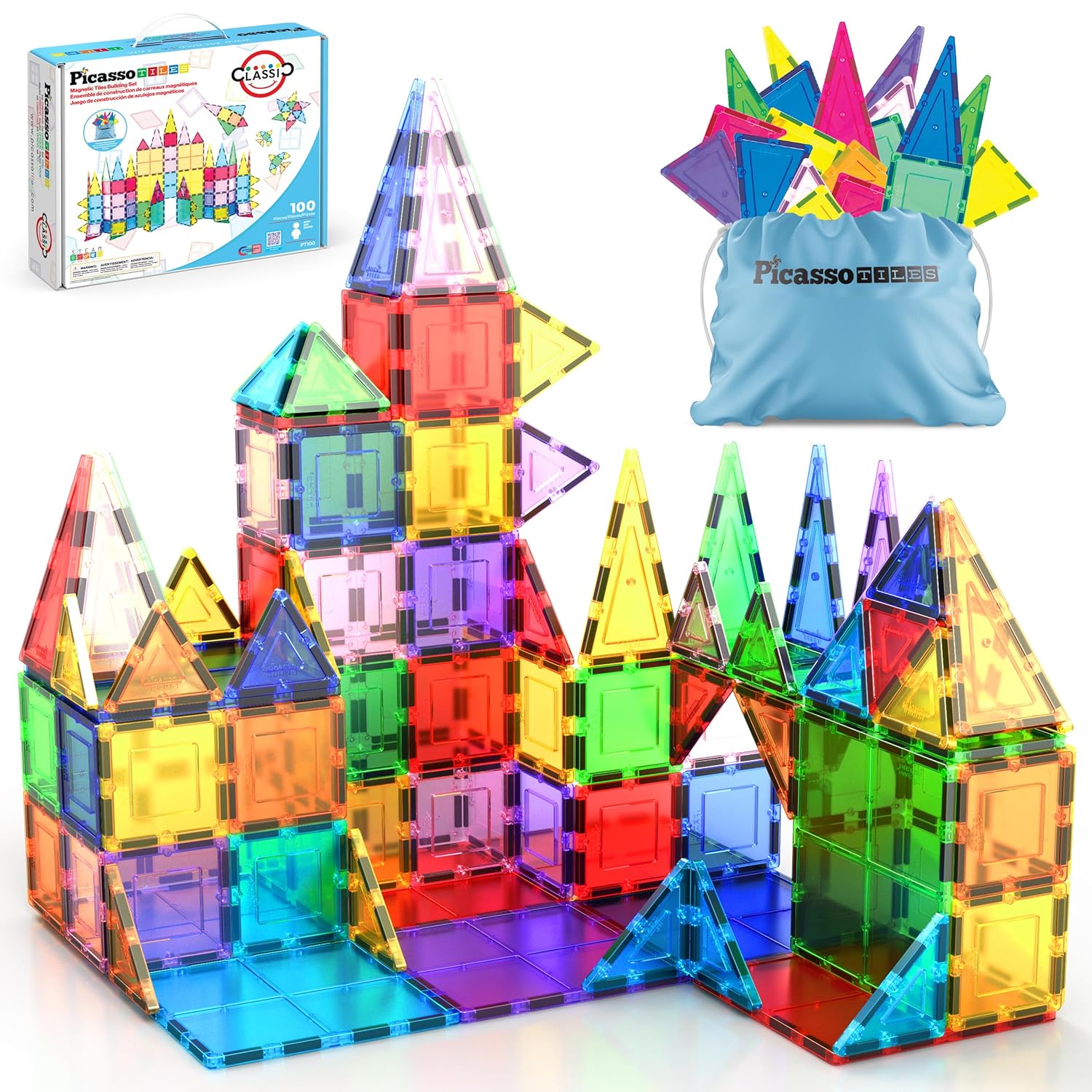 PicassoTiles 100-Piece Clear Magnetic Building Tiles |
|
| $39.99 | Check price $39.99 |
| Premium Pick |  Magna-Tiles Clear Colors 100 Piece Set |
|
| $114.04 | Check price $114.04 |
| Budget Pick |  Anbalulu Magnetic Tiles 100PCS with 2 Cars |
|
| $35.99 | Check price $35.99 |
PicassoTiles 100-Piece Clear Magnetic Building Tiles
Check price on Amazon $39.99
Magna-Tiles Clear Colors 100 Piece Set
Check price on Amazon $114.04
Anbalulu Magnetic Tiles 100PCS with 2 Cars
Check price on Amazon $35.99
PicassoTiles 100-Piece Clear Magnetic Building Tiles — full evaluation
PicassoTiles is the set most often recommended first when a family asks for the best magnetic tiles for toddlers without the premium price tag. The brand emerged in the mid-2010s as the first credible Magna-Tile alternative, and the 100-piece Clear Colors set has become the de facto starter kit for preschools and home-school classrooms operating on a real budget. The reason it works is geometry — PicassoTiles built its tiles against the Magna-Tile edge profile closely enough that pieces interchange across brands without visible gaps, which means a family can start with PicassoTiles and supplement with Magna-Tiles later (or vice versa) and end up with one coherent collection rather than two incompatible piles.
Magnet strength is the second reason. The neodymium magnets in PicassoTiles are slightly weaker than the premium original, but the gap is small — owner reports consistently describe PicassoTiles holding at the scale toddlers actually build, with drift appearing only on 50+ piece structures that exceed what most 2–4-year-olds attempt unassisted. For the developmental window this guide targets, that’s more than sufficient.
The 100-piece set includes a mix of squares, equilateral triangles, right triangles, and a small number of rectangles — exactly the shape vocabulary the AAP’s cognitive milestones expect a 2–3-year-old to begin recognizing. The clear translucent tiles also unlock a use case the opaque sets can’t match: light-table play, where a tile structure built on a backlit surface throws colored shadows that pediatric OTs frequently use for visual-tracking and sensory-integration work.
The trade-offs are modest. The plastic frame does not feel as dense as the premium original, and a hard-floor drop is where a cheaper tile shows it first — a cracked corner rather than a failed magnet. PicassoTiles offers a 30-day return policy but no lifetime warranty, so cracked tiles after the return window are a sunk cost.
For families starting a magnetic-tile collection from scratch and unsure whether the category will hold their toddler’s attention long enough to justify a $100+ premium set, PicassoTiles is the right entry point. Most families who buy it end up upgrading or supplementing with Magna-Tiles around the time their child turns 4 and starts attempting larger 50+ piece structures, but by then the value of the initial $40 spend has been more than realized.
Check price on Amazon → $39.99
Magna-Tiles Clear Colors 100 Piece Set — full evaluation
Magna-Tiles is the set that created the magnetic-tile category in 1997, and after nearly three decades it remains the technical benchmark by which every competitor — including PicassoTiles — measures itself. The 100-piece Clear Colors set is the same product preschools and Reggio Emilia-inspired classrooms have been buying for 20+ years, refined incrementally rather than redesigned. If you want the best magnetic tiles for toddlers and price is a secondary concern, this is the answer.
The functional advantages are real. Magnet strength is where it earns the premium: owners of the big sets consistently report that large multi-level builds hold together instead of drifting apart at the seams — which is exactly what starts to matter once your child crosses the 4-year-old threshold and wants ambitious geodesic domes and multi-floor castles. Edge tolerance is the tightest in the category — pieces seat flush at all attachment angles with no visible gap, which preserves structural integrity even on complex compound structures.
Magna-Tiles publishes the plastic as BPA-free and phthalate-free. The lifetime warranty against cracking is unique in the segment — if a tile breaks under normal play, Magna-Tiles replaces it, which means the cost of a set effectively amortizes across multiple children and a 10–15 year lifespan rather than the 3–5 year window that’s realistic for most competitors.
The trade-off is price. At $114.04 for 100 pieces, Magna-Tiles is roughly 3x the cost of PicassoTiles and 4x the cost of Anbalulu. For a family that’s not certain magnetic tiles will hold their child’s attention, that’s a meaningful gamble. The economic case is strongest when you have multiple children, plan to keep the set for 10+ years, or know your toddler is the type who plays with one favorite toy daily rather than rotating through novelty.
The other consideration is color matching. Magna-Tiles has refined the color formulation multiple times over the last decade, so a 2025 set may not perfectly color-match a hand-me-down 2015 set from a family member. This rarely matters for structural play, but it can frustrate the visual-pattern-matching activities that 3-year-olds gravitate toward. For families starting fresh, this is a non-issue.
For premium buyers, classrooms, and any setting where the magnetic tiles will be passed between multiple children over multiple years, Magna-Tiles is the right pick — the price premium amortizes well, and the lifetime warranty effectively eliminates the long-term replacement cost that erodes the apparent savings of cheaper sets.
Check price on Amazon → $114.04
Anbalulu Magnetic Tiles 100PCS with 2 Cars — full evaluation
The Anbalulu 100-piece set is the lowest-cost magnetic tile set we’d actually recommend for toddler STEM play. At $35.99 for 100 tiles plus two wheeled car bases, the piece-per-dollar ratio is the highest in the category, and the inclusion of the car bases opens up vehicle-and-ramp play that’s a developmental sweet spot for 3–4 year-olds learning about gravity, slope, and cause-and-effect — the same conceptual scaffolding our companion piece on why cause-and-effect play matters walks through in detail.
The magnets are noticeably weaker than the premium picks. Purchaser reviews consistently describe small builds holding fine while taller or wider structures sag and eventually collapse under their own weight — the predictable trade-off of a budget magnet. For the 2–4-year-old developmental window this guide targets, that’s an acceptable limitation — most toddlers in this age range work at the 5–15 piece scale, and the magnet strength is adequate at that scale. For families with a 5+ year-old graduating to ambitious structures, the Anbalulu set will start to feel constrained.
Edge precision is the other compromise. Anbalulu tiles don’t quite hit the Magna-Tile edge profile, and mixing brands in one build is where that shows up — attachment gets fussy at the seams. The set works fine as a standalone collection, but families planning to consolidate eventually with a Magna-Tile or PicassoTile set should plan to keep the Anbalulu tiles in their own bin.
Construction safety is solid. The set is sold as ASTM F963 compliant — the standard that requires magnets to stay sealed under drop, tension, and bite forces — and we found no open CPSC recall on the brand. As always with magnetic toys, inspect each tile before each play session for cracks or chipped corners and retire damaged pieces immediately.
The two included car bases are the feature that elevates Anbalulu above the other budget options. By snapping squares onto the car bases, toddlers can build vehicle bodies that actually roll — bridging the gap between static construction and dynamic play, and supporting the spatial-reasoning and cause-and-effect skills that pediatric OTs target at this age. Anbalulu is the right pick for families on a tight budget, families uncertain whether magnetic tiles will hold attention, or families who want to test the category before committing to a premium set.
Check price on Amazon → $35.99
5 things to know before buying the best magnetic tiles for toddlers
Magnet strength is the single biggest functional differentiator
Two sets that look identical on Amazon can perform very differently in actual toddler play, and the variable that almost always explains the difference is magnet pull-force. Weak magnets mean a tower that collapses on the third tile, which translates into a toddler walking away rather than building the spatial-reasoning skills the toy is supposed to support. If you can only optimize for one thing, optimize for magnet strength. Magna-Tiles leads the category; PicassoTiles is close enough for the toddler window; budget sets like Anbalulu work fine at the 5–15 piece scale most 2–4-year-olds operate in.
Tile-form magnetic toys are safe — loose magnetic balls are not
The CPSC recall history that scares parents is almost entirely about loose neodymium ball or bead magnets (Buckyballs and similar), not tile-form sets where the magnets are sealed in plastic frames. Per the CPSC magnetic-toy recall database, tile-form recalls are vanishingly rare. The safety discipline that matters for tiles is inspecting each piece before play for cracks or chipped corners that could expose a magnet, and retiring damaged tiles immediately. Never let a toddler play unsupervised with any magnetic toy.
Age ratings: most manufacturers say 3+, some say 2+ supervised
The manufacturer age rating on the box (typically 3+) is conservative — it reflects the small-parts choke standard, which for magnetic tiles is rarely a real concern because tiles are 3-inch squares that significantly exceed the 1.25-inch choke gauge. Pediatric OTs commonly introduce magnetic tiles at 24 months with supervision, when toddlers can hold and stack tiles but haven’t yet outgrown the developmental sweet spot for 2D pattern play. The right rule of thumb is: 2-year-olds need supervision and a smaller subset of pieces (start with 20–30 tiles, not 100); 3-year-olds can play independently with the full set; 4-year-olds graduate to ambitious 3D structures. The AAP toddler cognitive development guidance backs this developmental progression.
Cross-brand compatibility matters more than the box suggests
Magnetic tile sets are the kind of toy families add to over years, often receiving sets as gifts from grandparents or supplementing an existing collection with a specialty pack (windowed pieces, alphabet tiles, vehicle bases). If your sets don’t share the Magna-Tile edge profile, you end up with multiple incompatible piles rather than one consolidated collection. Magna-Tiles and PicassoTiles interchange cleanly; Anbalulu and some other budget brands deviate enough that mixed builds show visible gaps. For families planning to grow the collection over time, prioritize Magna-Tile compatibility.
Light-table play is an underrated use case for clear tiles
Clear (translucent) tiles unlock a category of sensory and visual-tracking play that opaque tiles can’t match. A magnetic-tile structure built on a backlit surface throws colored shadows and gradient color-mixes that pediatric OTs use for visual-attention and sensory-integration activities. If your toddler is in OT, ask the therapist about clear-tile light-table activities — most clinics have a light table available and can demo the activity in-session. Both PicassoTiles and Magna-Tiles offer clear-color variants; the budget Anbalulu set is opaque only. Pair magnetic tile play with the cause-and-effect scaffolding from our best shape sorter and ball drop guide for the full early-construction developmental arc, or browse the broader Play category for related toddler picks.
Best magnetic tiles for toddlers: frequently asked questions
Yes — tile-form magnetic toys with magnets sealed inside rigid plastic frames are safe for supervised toddler play, and represent a fundamentally different category from the loose high-power “ball” or “bead” magnets the CPSC has repeatedly warned about. The best magnetic tiles for toddlers comply with ASTM F963-23 magnet-retention requirements, which means the magnets are tested to remain sealed under drop, pull, and bite forces. Inspect tiles before each session for cracks or chipped corners that could expose a magnet, retire any damaged tile immediately, and always supervise toddlers under 3 with any magnetic toy.
Most manufacturers rate magnetic tiles 3+, but pediatric OTs commonly introduce them at 24 months with supervision and a smaller starter subset (20–30 tiles rather than the full 100-piece set). At 2 years, toddlers typically engage in 2D pattern-making and simple stacking — laying tiles flat or building 2–3-tile vertical stacks. By 3 years, most children can build small 3D structures (cubes, simple houses) independently. By 4 years, ambitious geodesic and multi-floor structures become reachable. The 24–48 month window is the developmental sweet spot, aligned with the spatial-reasoning gains the CDC’s 3-year milestone tracker highlights.
For most families, PicassoTiles delivers comparable performance for typical toddler-scale builds at roughly one-third the cost — which is why it’s our top pick for value rather than the premium original. Magna-Tiles wins on three measurable dimensions: magnet strength on 50+ piece structures, edge-tolerance precision at all attachment angles, and the lifetime warranty against cracking.
If you have multiple children, plan to use the set across 10+ years, or know your toddler will be a heavy daily user, the price premium amortizes well. If you’re testing whether magnetic tiles will hold your child’s attention, PicassoTiles is the right entry point.
Yes — PicassoTiles built its tile geometry against the Magna-Tile edge profile, and the two brands interchange cleanly in mixed builds. PicassoTiles are built to the same tile dimensions and magnet polarity as Magna-Tiles, which is why the two sets interlock flush and hold without drift — the cross-brand compatibility is real, and it is the main reason to buy the cheaper set. This compatibility is a key reason PicassoTiles is the right starter set for families who may add Magna-Tiles later. Budget sets like Anbalulu deviate slightly from the Magna-Tile spec and may show visible gaps in mixed builds.
For a single toddler in the 2–3 age range, 30–50 tiles is plenty — most builds at this age stay under 15 pieces, and a smaller working set is easier to manage at cleanup time. By 4 years, the same child typically wants 100+ tiles to support ambitious structures.
For two or more children playing together, double the per-child count. The 100-piece sets in this guide hit the sweet spot for a single toddler with growth headroom into the 4–6 year window, or two toddlers playing side-by-side with a smaller working set each. Don’t over-buy at the start — magnetic tile sets are easy to expand once you know whether the category holds attention.
Functionally identical for structural play — magnet strength, edge precision, and durability don’t vary by color or opacity. The advantage of clear tiles is light-table play, where translucent tiles throw colored shadows and gradient color-mixes that pediatric OTs use for visual-tracking and sensory-integration activities. If your toddler is in OT or you have a light table at home, clear tiles unlock a meaningful additional use case. Both PicassoTiles and Magna-Tiles offer clear-color variants; some budget sets ship opaque-only. For families without a light table, the difference is purely aesthetic.
A few magnetic tiles ideas by age: 2-year-olds lay flat 2D patterns and 2–3-tile stacks, 3-year-olds build small cubes and simple houses, and 4-year-olds attempt domes and multi-floor castles. Snap squares onto a car base for ramp-and-vehicle play, or build clear tiles on a light table so they cast colored shadows for visual-tracking play.
Our #1 best magnetic tiles for toddlers pick: PicassoTiles 100-Piece Clear Magnetic Building Tiles
The best balance of price, magnet strength, edge precision, and Magna-Tile compatibility in the category. At $39.99 for 100 pieces, PicassoTiles delivers comparable performance for typical toddler-scale builds at one-third the cost — the right starter set for families introducing magnetic tile play to a 2–4 year-old, with room to supplement later with Magna-Tile specialty packs once the category proves itself.
Check price on Amazon → $39.99
Safety disclaimer: Not medical advice. The best magnetic tiles for toddlers should always be used with appropriate adult supervision, especially for children under 3. Inspect tiles before each play session for cracks or chipped corners that could expose a magnet, and retire damaged pieces immediately. If you suspect a child has swallowed any magnet, treat as a medical emergency and seek care immediately — multi-magnet ingestion is a documented cause of intestinal perforation. Consult HealthyChildren.org (AAP) and the CPSC magnetic-toy recall database for additional safety guidance.
Prices: Reflect typical Amazon pricing as of May 2026 and may vary. Manufacturer model numbers and piece counts occasionally change — verify on the linked product page before ordering. ASTM F963-23 magnet-retention testing standards are referenced for sealed-magnet tile-form toys, and remain the prevailing safety benchmark for the category.
- Conners GP. Pediatric Foreign Body Ingestion. Medscape Drugs & Diseases (eMedicine); updated Dec 11, 2025. Young children commonly swallow small objects; button batteries and high-powered magnets are true emergencies because they can rapidly injure the GI tract.
- Warshawsky ME. Foreign Body Aspiration. Medscape Drugs & Diseases (eMedicine); updated Mar 5, 2024. Foreign body aspiration can be a life-threatening emergency — a large object obstructing the airway can cause asphyxia — and the aspirated object is most often food.