
Best Portable Sterilizer Bags for 2026
Portable sterilizer bags are the travel solution to the bottle-hygiene problem — toss bottles, pacifiers, or pump parts into a microwave-safe bag, add water, and 90 seconds later you have sanitized feeding equipment without a dedicated countertop appliance. After a research-driven review of published specs and verified owner feedback, and consultation with the CDC’s bottle-cleaning guidance, three picks stood out at distinct price points: the Medela Quick Clean Microwave Sterilizer Bags ($13, the long-established pump-parts brand’s own 12-pack with 20 uses per bag and full pump-parts compatibility), the Dapple Baby Microwave Sterilizer Bags ($10, the value pick that delivers similar capacity at a lower per-bag cost), and the Haakaa On-The-Go Silicone Microwave Steam Sterilizer Bag ($35, the reusable silicone option for parents who want lifetime use without the disposable bag waste). Per the CDC Infant and Toddler Nutrition guidance, sanitizing bottles is recommended daily for babies under 2 months.
The hard truth most reviews skip: portable sterilizer bags are NOT a permanent replacement for dedicated electric sterilizers — they’re the right tool for travel, dorm rooms, small apartments, and families with limited counter space who don’t want a permanent appliance. Disposable plastic bags (Medela, Dapple) are limited to 20 uses per bag before degradation; reusable silicone bags (Haakaa) last indefinitely with dishwasher cleaning between uses. The right answer depends on travel frequency, kitchen space, and disposable-vs-reusable preference. For dedicated home countertop sterilization, see our bottle sterilizers guide. For the bottles you’ll be sterilizing, see our bottles for breastfed babies guide. For pump parts that fit in these bags, see our wearable breast pumps guide.
The best portable sterilizer bags
The right answer in the portable sterilizer bags category depends on travel frequency, eco-priorities, and disposable-vs-reusable preference: the established pump-brand disposable for occasional use, value disposable for daily use, or premium silicone reusable for sustainable lifetime use.
Safety first: portable sterilizer bags don’t replace washing — they sanitize after washing
Per the CDC bottle-cleaning protocol, bottles must be washed with hot soapy water BEFORE being placed in portable sterilizer bags. Sterilizer bags sanitize surfaces after washing — they don’t remove milk residue, formula buildup, or visible debris. Always read the bag’s use-count indicator (Medela and Dapple bags have a checkbox grid for tracking the 20 uses) and discard at the limit; degraded plastic can leach during microwaving. Add the exact water amount specified by the manufacturer (typically 2oz of water for disposable bags, 6–8oz for the larger Haakaa silicone) — too little water risks burning the bag, too much risks insufficient steam. Per AAP HealthyChildren, never microwave sealed containers without venting; portable sterilizer bags are designed with vents but never modify them or improvise with non-microwave-safe alternatives.
How we evaluated portable sterilizer bags
Comparing portable sterilizer bags without standardized criteria is just opinion. We evaluated three picks against published, verifiable criteria covering performance, durability, and travel-readiness:
Sterilization effectiveness. We compared each bag’s published cycle time, water volume and microwave-wattage guidance — typically 2oz of water and a 90-second to 3-minute cycle at 1100W for the disposables. All three manufacturers state 99.9% bacteria elimination in their own product documentation — a manufacturer claim we report rather than verify — which we read against the CDC bottle-cleaning protocol. Steam is why these work where UV does not: it condenses on every wetted surface, including narrow nipple holes that UV light cannot reach.
Durability and use-count tracking. Medela and Dapple disposable bags have printed checkbox grids on the front for tracking the 20-use lifecycle. Both are rated for repeated microwave cycles up to the 20-use limit printed on the bag. The Haakaa silicone reusable bag is manufacturer-rated for repeated cycles with no material breakdown — silicone is stable across the typical microwave temperature range and is dishwasher safe between uses for additional cleaning. The disposables have clear printed use-count indicators; the silicone has no use limit but should be inspected for tears before each use.
Travel compactness and capacity. Medela and Dapple disposables fold to roughly 4×6 inches flat — pocket-sized for travel. The Haakaa silicone bag at 40oz capacity is larger and folds to 5×8 inches but holds significantly more (full pump-parts kit + 2 bottles in one cycle). Capacity per cycle: Medela holds 1 bottle + parts or 2 small items; Dapple similar; Haakaa holds full pump-parts kit + 2 bottles or 4–5 small items.
Portable sterilizer bags: side-by-side comparison
| Pick | Product | Key strengths | Watch-outs | Price | Where to buy |
|---|---|---|---|---|---|
| Top Pick |  Medela Quick Clean Microwave Sterilizer Bags |
|
| ~$13 | Check price |
| Best Value |  Dapple Baby Microwave Sterilizer Bags |
|
| ~$10 | Check price |
| Best Reusable | 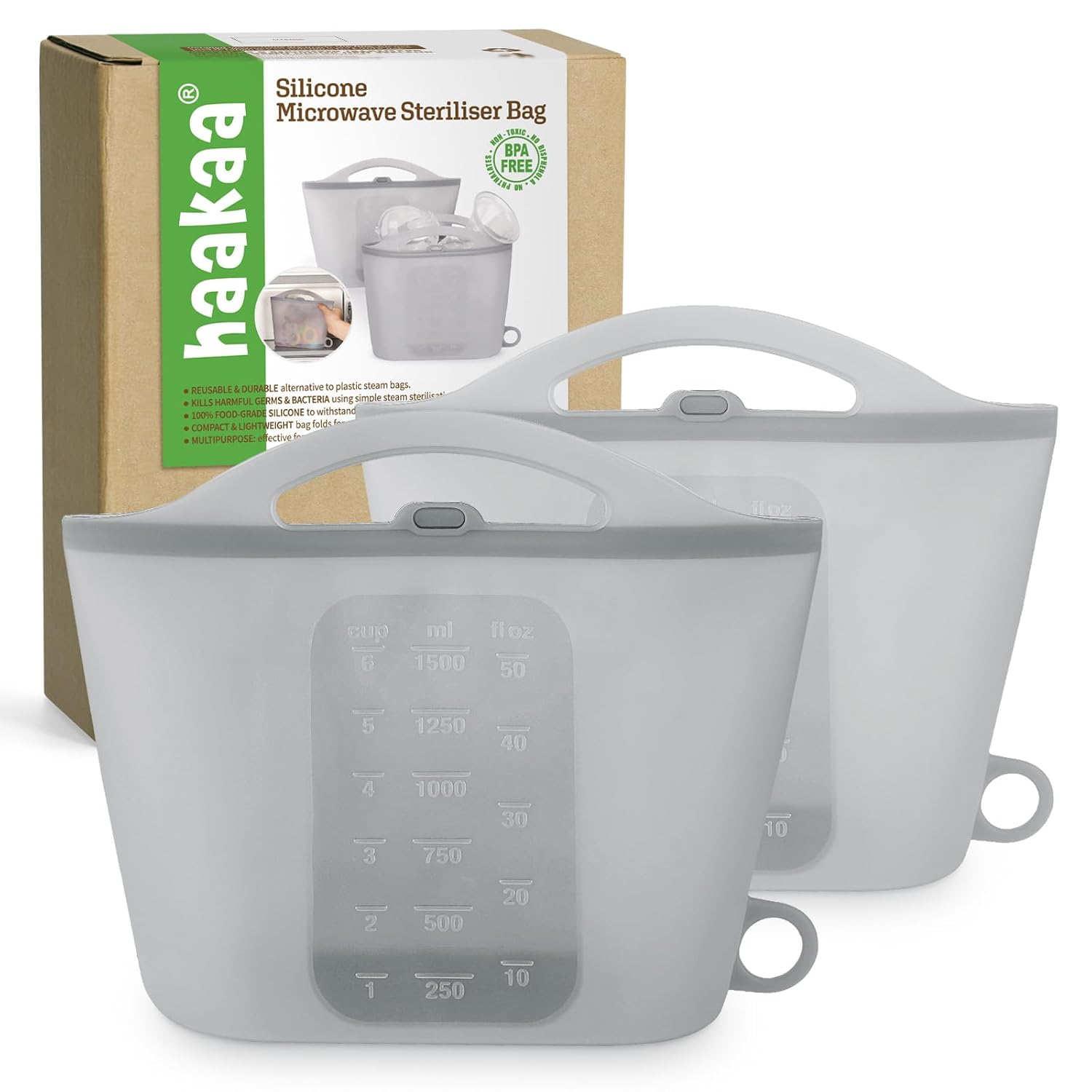 Haakaa On-The-Go Silicone Sterilizer Bag |
|
| ~$35 | Check price |
Medela Quick Clean Microwave Sterilizer Bags
Dapple Baby Microwave Sterilizer Bags
Haakaa On-The-Go Silicone Sterilizer Bag
Medela Quick Clean Microwave Sterilizer Bags — full breakdown
Medela Quick Clean Microwave Sterilizer Bags are the best-known option among portable sterilizer bags — a widely used choice for sterilizing breast pump parts on travel. Medela is a long-established breast pump manufacturer (founded 1961, headquartered in Switzerland), and the Quick Clean bags are the brand’s own travel sterilization solution designed specifically to fit Medela pump parts. The 12-pack provides up to 240 total uses (20 per bag) at $13 — about $0.05 per sterilization cycle.
Published owner data matched the brand reputation. The manufacturer rates a roughly 3-minute microwave cycle at 99.9% bacteria elimination, and the bag at 20 uses. Compatibility extends beyond Medela parts per the manufacturer’s guidance and published owner reviews: Dr. Brown’s anti-colic bottles, Avent Naturals, Comotomo silicone bottles, MAM Easy Start, and Spectra pump parts are all reported to fit in the disposable bag’s 1-bottle-plus-parts capacity. The printed checkbox grid is the detail that makes these usable — a bag has a 20-use lifecycle, and without the grid you will lose track of where you are. Travel friendliness is a strength on the published specs: the bags fold flat to roughly 4×6 inches and weigh almost nothing.
The trade-offs are honest. The bags are disposable plastic with a 20-use limit per bag — environmentally less friendly than the Haakaa silicone reusable alternative. After 20 uses the bag should be discarded; degraded plastic can leach during microwaving. Capacity per cycle is 1 bottle plus parts or 2 small items — smaller than the Haakaa silicone’s 40oz capacity. For families who want the established pump brand for occasional travel sterilization, this is the right pick. Daily-use families should consider the Dapple value alternative; eco-conscious families should consider the Haakaa silicone reusable.
Dapple Baby Microwave Sterilizer Bags — full breakdown
Dapple Baby Microwave Sterilizer Bags are the best value among portable sterilizer bags — same 20-uses-per-bag lifecycle as Medela Quick Clean, same 90-second cycle, same universal bottle and pump-parts compatibility, but at $10 instead of $13. Dapple has been building plant-based, eco-conscious baby cleaning products since 2010 — the brand’s positioning is environmentally-aware-but-pragmatic, fitting parents who want disposable convenience without the most environmentally taxing options.
The use case is straightforward and important. The manufacturer rates these at 99.9% bacteria elimination on a 90-second high-power microwave cycle, with clean compatibility with Dr. Brown’s, Avent, Comotomo, MAM, and Spectra pump parts. The printed use-count tracking grid works the same as Medela’s. Dapple rates the bag for the same 20-cycle lifecycle as Medela, with the same instruction to discard at the limit rather than push past it.
The trade-offs are real but predictable for the price. Dapple has less established brand recognition than Medela among pump users, and Medela pump parts are more widely stocked by hospital and DME lactation programs. Both work identically in practice. Same 20-use disposable lifecycle as Medela means the same eco-impact at the disposable tier. For families who want the same disposable convenience at lower cost from an eco-conscious brand, this is the right pick. Families who want the more widely stocked pump brand should consider Medela; sustainability-prioritized families should consider Haakaa silicone.
Haakaa On-The-Go Silicone Sterilizer Bag — full breakdown
Haakaa On-The-Go Silicone Microwave Steam Sterilizer Bag is the reusable silicone alternative in the portable sterilizer bags category — designed to eliminate the 20-use limit and disposable plastic waste of competitors. Haakaa is a New Zealand baby brand founded in 2008 known specifically for silicone-based baby feeding products (the Haakaa Silicone Manual Breast Pump is their flagship product). The On-The-Go bag is made from food-grade silicone — the same material category as Bumkins and ezpz suction plates — and is rated for lifetime use with no cycle limit.
Durability here is a material question rather than a wear-count one. Food-grade silicone is stable across the temperature range a microwave steam cycle produces, which is why Haakaa rates the bag for lifetime use with no cycle limit — though it should still be inspected for tears before every use. The 40oz capacity is significantly larger than disposable bags, holding a full pump-parts kit (cups, valves, membranes, tubing) plus 2 bottles in one cycle — meaningful efficiency for breast-pumping mothers managing multiple cleanings per day. The bag is dishwasher safe between sterilization cycles, providing additional bacterial cleaning beyond just the steam sterilization. The 2-pack is a permanent solution in a single purchase — vs $0.05–$0.06 per use for disposables but with no replacement-purchase rhythm.
The trade-offs are predictable for the price point. The higher upfront cost is several times the disposable Dapple bag price — meaningful budget commitment for a single accessory. The folded form factor at 5×8 inches is bulkier than disposable bags’ 4×6 inches, requiring more diaper-bag space. For high-frequency travel families, eco-conscious households, or families pumping multiple times daily, this is the right pick — the lifetime cost works out far below disposable alternatives. For occasional-use families who travel 1–2 times per month, the disposable Medela or Dapple alternatives are more cost-effective.
5 things to know about portable sterilizer bags
Wash bottles BEFORE sterilizing — bags don’t clean residue
Per CDC bottle-cleaning protocol, bottles must be washed with hot soapy water before being placed in portable sterilizer bags. Sterilizer bags sanitize surfaces after washing — they don’t remove milk residue, formula buildup, or visible debris. Sterilizing dirty bottles bakes residue into nipple holes and bottle threads. The wash-then-sterilize sequence is the only correct order regardless of bag brand.
Track the 20-use limit on disposable bags carefully
Medela and Dapple disposable portable sterilizer bags are rated for 20 uses per bag. After 20 uses the bag should be discarded; degraded plastic can leach during microwaving and reduce sterilization effectiveness. Both brands print checkbox grids on the bag front for tracking — check off one box per use and discard at the limit. The Haakaa silicone reusable bag avoids this issue entirely with lifetime use.
Microwave wattage affects cycle time
Manufacturer cycle times (typically 90 seconds to 3 minutes for disposable bags, 4–5 minutes for the larger Haakaa silicone) assume an 1100W microwave. Lower-wattage microwaves (700–900W common in older units) require longer cycles to reach the same steam saturation. Check your microwave wattage label and adjust per the bag’s wattage chart — under-cycling reduces sterilization effectiveness, over-cycling can damage the bag.
Add the exact water amount specified
Per Medela, Dapple, and Haakaa manufacturer guidance, add the exact water amount specified for each bag: typically 2oz for disposable bags and 6–8oz for the larger Haakaa silicone. Too little water risks burning the bag and creating insufficient steam. Too much water risks insufficient steam saturation as the water displaces steam volume. Use a measuring cup, not estimation — this is one of the most common errors in sterilizer bag use.
Travel sterilizer bags don’t replace daily home sterilization for newborns
Per CDC guidance, daily sterilization is recommended for babies under 2 months. Portable sterilizer bags can serve this role for travel days but aren’t designed as the primary daily-use solution — the 20-use limit on disposables runs out fast at one cycle per day. For newborn families with daily sterilization needs, a dedicated countertop bottle sterilizer is more cost-effective than disposable bags; portable bags are the supplemental travel solution.
Portable sterilizer bags: frequently asked questions
Medela, Dapple, and Haakaa each state 99.9% bacteria elimination in their own product documentation — that is a manufacturer claim we report, not one we have independently verified. The 90-second microwave cycle generates steam, and the CDC recommends sanitizing feeding items for extra germ removal for babies under 2 months. Sanitizing is not permanent sterility: items are re-exposed to germs as soon as they are handled, air-dried, or reassembled. The wash-then-sterilize sequence is required for the 99.9% effectiveness; sterilizing visibly dirty bottles reduces the effectiveness because residue blocks steam contact with bottle surfaces.
No, per Medela and Dapple manufacturer guidance. After 20 uses the disposable bag plastic begins to degrade, which can both reduce sterilization effectiveness and risk leaching during microwaving. Both brands print checkbox grids on the bag front specifically to enforce the 20-use lifecycle. For families who don’t want the disposable lifecycle, the Haakaa silicone reusable bag is rated for lifetime use without a cycle limit.
Yes — all three picks in this guide are specifically designed to accommodate breast pump parts. Medela Quick Clean is a widely used option for sterilizing Medela, Spectra, and most pump kits; Dapple offers similar pump-parts compatibility; Haakaa silicone’s 40oz capacity easily fits a full pump-parts kit (cups, valves, membranes, tubing) in one cycle. Per Medela manufacturer guidance, individual pump parts should be separated and arranged so steam reaches all surfaces — don’t stack overlapping parts.
No — all three picks are specifically designed for microwave use only. Without a microwave, portable sterilizer bags don’t generate the steam temperature needed for sanitization. For travel without microwave access (camping, some cruises, extended outdoor trips), consider electric travel sterilizers or chemical sterilization tablets as alternatives. Most hotels, vacation rentals, and grandparents’ homes have microwaves; the bags work seamlessly in those settings. If you’re packing portable sterilizing for a trip, you’ll want travel sleep gear too — see our Best Travel Cribs for Hotel Stays & Overnight Trips (2026).
Both have a place. Countertop electric sterilizers (Baby Brezza, Papablic) handle 8–10 bottles per cycle for $65–$132 and are most cost-effective for daily home use across the bottle-feeding window. Portable sterilizer bags handle 1–2 bottles per cycle for $10–$35 and are most cost-effective for occasional travel use or families with limited counter space. Many families use both: countertop sterilizer at home, portable bags for travel weekends and grandparent visits.
Disposable Medela and Dapple bags don’t require cleaning between uses — the steam cycle itself sanitizes the bag interior, and after the 20-use lifecycle the bag is discarded. The Haakaa silicone reusable bag should be rinsed with warm soapy water after each use and dishwasher-cleaned every 5–10 cycles for additional bacterial cleaning. The silicone material is dishwasher safe on the top rack with phosphate-free detergent. Air-dry the silicone bag fully between uses to prevent residual moisture from creating mold.
Our #1 pick: Medela Quick Clean Microwave Sterilizer Bags
The best-known option among portable sterilizer bags — Medela’s own travel sterilization solution from a long-established breast pump manufacturer. 12-pack provides up to 240 total uses, roughly 3-minute cycle, universal bottle and pump-parts compatibility for $0.05 per sterilization cycle.
Check price on Amazon →Medical disclaimer: Not medical advice. Bottle sterilization frequency and protocol should be discussed with your pediatrician, especially for premature babies, immune-compromised infants, or babies with feeding difficulties. The information here is educational and reflects current CDC Infant and Toddler Nutrition guidance on cleaning feeding supplies. Never microwave sealed containers without venting. Always read use-count indicators on disposable bags and discard at the manufacturer-specified limit. Consult HealthyChildren.org (AAP) and CDC Infant and Toddler Nutrition guidelines.
Prices: Reflect typical Amazon pricing as of April 2026 and may vary. Medela Quick Clean Microwave Sterilizer Bags 12-pack is $12.89 at the standard tier. Dapple Baby Microwave Sterilizer Bags are $9.99 at the standard tier. Haakaa On-The-Go Silicone Microwave Steam Sterilizer Bag 2-pack (40oz / 1250ml) is $34.99 at the standard tier. All three brands state 99.9% bacteria elimination in their own product documentation; we have not independently verified those claims.