
Best Bottle Sterilizers for 2026
Bottle sterilizers do one job — sanitize baby bottles, nipples, pacifiers, and pump parts after washing, reducing the germs left on feeding equipment used by newborns and immune-compromised infants. After a research-driven review of published specs and verified owner feedback, and consultation with the CDC’s bottle-cleaning guidance, three picks stood out at distinct price points: the Baby Brezza Bottle Sterilizer and Dryer Advanced ($132, the institution that combines steam sterilization with HEPA-filtered drying in one cycle), the Papablic Baby Bottle Sterilizer and Dryer Pro ($65, the value pick that delivers similar electric steam + dry functionality at half the Baby Brezza price), and the NUK Micro Express Microwave Sterilizer ($30, the budget microwave option that fits in any kitchen without dedicated counter space). Per the CDC Infant and Toddler Nutrition guidance, sterilizing bottles is recommended for babies under 2 months, premature infants, and babies with compromised immune systems.
The hard truth most reviews skip: bottle sterilizers are NOT all created equal. Microwave-bag and microwave-tray bottle sterilizers handle 4–6 bottles per cycle but require an empty microwave each time. Electric steam bottle sterilizers handle 8–10 bottles plus pump parts in one cycle and can dry as well. UV-LED bottle sterilizers handle smaller capacity but need no water or heat. The right answer depends on how many bottles you sterilize per day, whether you also need drying functionality, and whether your kitchen has counter space for a dedicated appliance. For the bottles you’ll sterilize, see our anti-colic bottles guide and bottles for breastfed babies guide. For warming sterilized bottles before feeding, see our bottle warmers guide.
The best bottle sterilizers
The right answer in the bottle sterilizers category depends on counter space, daily cycle volume, and budget: premium steam + HEPA dry combo, mid-tier steam + dry value pick, or microwave option that fits in any kitchen.
Safety first: bottle sterilizers don’t replace washing — they sanitize after washing
Per the CDC bottle-cleaning protocol, bottles must be washed with hot soapy water (or top-rack dishwashed) BEFORE sterilizing. Bottle sterilizers reduce the germs left on already-washed parts — they don’t remove milk residue, formula buildup, or visible debris. Sterilizing dirty bottles bakes residue into nipple holes and bottle threads. Per CDC guidance, sterilizing is recommended daily for babies under 2 months, premature infants, or babies with compromised immune systems. For older healthy babies, once-daily sterilizing or as-needed sterilizing is sufficient if bottles are properly washed between feeds. Always descale electric bottle sterilizers with white vinegar every 2–4 weeks per manufacturer guidance to prevent mineral buildup that can harbor bacteria. Per AAP HealthyChildren, never use chemical sterilizing tablets without rinsing thoroughly afterward, and never sterilize bottles with cracks or visible damage.
How we evaluated bottle sterilizers
Comparing bottle sterilizers without standardized criteria is just opinion. We evaluated three picks against published criteria covering performance, capacity, and value:
Cycle time and drying. Baby Brezza rates the Advanced at approximately 60 minutes for a full sterilize + dry cycle, with dry bottles at end of cycle. Papablic rates the Pro at 60–70 minutes for the same. The NUK Micro Express Microwave is rated at a 4-minute sterilizing cycle but requires air-drying afterward (15–30 additional minutes depending on humidity). That is the real dividing line in this category: the electric picks are specified to hand you dry bottles, the microwave pick hands you wet ones.
Capacity and pump-parts compatibility. The Baby Brezza Advanced fits 8 standard bottles plus pump parts simultaneously. The Papablic Pro markets a 10-bottle capacity and accommodates Spectra, Medela, and most major pump-parts kits. The NUK Micro Express Sterilizer fits 4 bottles per cycle — smaller capacity but compensated by 4-minute cycle time. All three picks accommodate Dr. Brown’s, Avent, Comotomo, and most major bottle brands per manufacturer compatibility documentation.
Counter-space footprint and operational simplicity. The Baby Brezza Advanced occupies approximately 11×9 inches of counter and the Papablic Pro approximately 11×10 inches, per published dimensions — both need clearance above for the lid to open. The NUK Micro Express Sterilizer requires zero permanent counter space — it stores in a cabinet between uses and only needs the microwave during cycles. On operational simplicity all three are straightforward: fill the reservoir (or the base, for the microwave unit), load, press start.
Bottle sterilizers: side-by-side comparison
| Pick | Product | Key strengths | Watch-outs | Price | Where to buy |
|---|---|---|---|---|---|
| Top Pick | 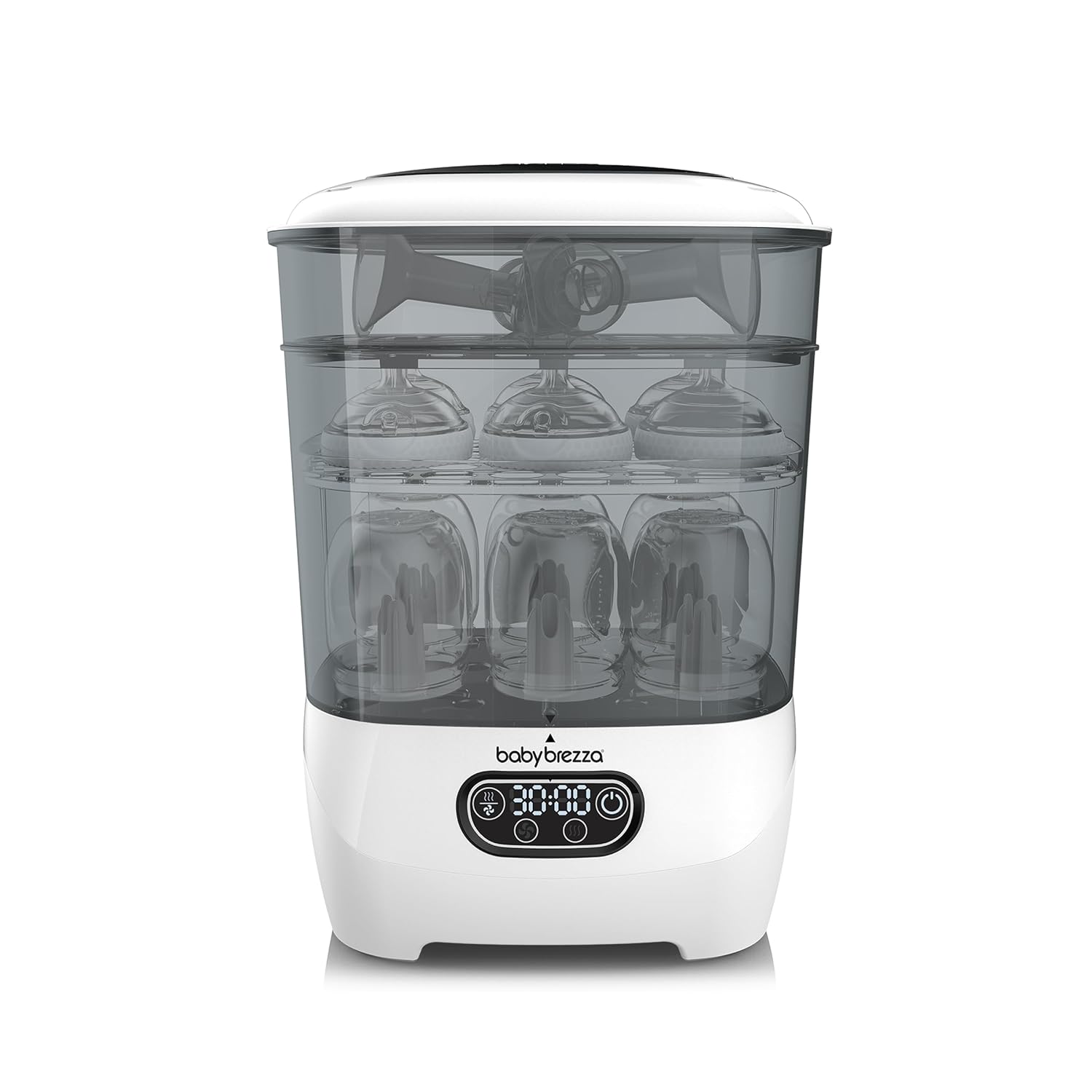 Baby Brezza Sterilizer Dryer Advanced |
|
| $102.99 | Check price $102.99 |
| Best Value |  Papablic Baby Bottle Sterilizer and Dryer Pro |
|
| $59.98 | Check price $59.98 |
| Best Budget |  NUK Micro Express Microwave Sterilizer |
|
| $27.73 | Check price $27.73 |
Baby Brezza Sterilizer Dryer Advanced
Papablic Baby Bottle Sterilizer and Dryer Pro
NUK Micro Express Microwave Sterilizer
Baby Brezza Sterilizer Dryer Advanced — full breakdown
Baby Brezza is the recognized institution in the bottle sterilizers category — the brand pioneered the all-in-one steam + dry combination that defines premium electric sterilizers today. Baby Brezza states the Advanced version runs 33% faster than the original Baby Brezza Sterilizer Dryer (which itself was the category benchmark since 2017), and adds a genuine HEPA air filter to the drying phase. This matters because most electric bottle sterilizers dry with room air — pulling whatever airborne particles are in your kitchen onto the freshly sterilized bottles. The HEPA filter is designed to reduce that exposure during the dry phase.
Published owner data matched the brand reputation. Baby Brezza rates the Advanced at approximately 60 minutes for a full sterilize + dry cycle — long enough that you set it and walk away, fast enough that bottles are ready before the next feeding window. The 8-bottle + pump-parts capacity comfortably handles a full day of feeds for one baby. Universal compatibility means Dr. Brown’s anti-colic bottles, Avent Naturals, Comotomo silicone, MAM Easy Start, and most other major brand bottles fit without adapters. Baby Brezza states 99.9% bacteria elimination, based on the brand’s own third-party lab testing documentation.
The trade-offs are honest. At $132, this is the most expensive entry in this guide — double the Papablic Pro for similar core functionality minus the HEPA filter. The 11×9 inch counter footprint requires permanent kitchen real estate, plus clearance above for the lid to swing open. White-vinegar descaling every 2–4 weeks is required to prevent mineral buildup. For families who want the proven institution, the HEPA drying premium, and willingness to dedicate counter space, this is the right choice. Cost-conscious families should consider the Papablic Pro at half the price; counter-space-limited families should consider the NUK Micro Express option.
Papablic Baby Bottle Sterilizer and Dryer Pro — full breakdown
Papablic Baby Bottle Sterilizer and Dryer Pro is the best value in the bottle sterilizers category for families who want full electric steam + dry functionality without paying the Baby Brezza premium. At $65, it’s the cheapest electric sterilizer-and-dryer combo from a major brand on Amazon — saving $67 over the Baby Brezza Advanced for what is essentially the same workflow minus the HEPA air filter. Papablic specifically markets the 10-bottle capacity, which is actually larger than Baby Brezza Advanced’s 8-bottle capacity at half the price.
The use case is straightforward and important. The 10-bottle capacity comfortably handles a day of feeds for twin newborns or a full day-plus for a single baby. The Spectra-and-Medela pump-parts compatibility (the two most common breast pump brands in the US) means moms can sterilize pump kits in the same cycle as feeding bottles. Manufacturer documentation states 99.9% bacteria elimination, with cycle times comparable to Baby Brezza (60–70 minutes total sterilize + dry). The 11×10 inch counter footprint matches Baby Brezza’s — meaning the savings come from materials and brand premium, not from a smaller, less capable machine.
The trade-offs are real but predictable. No HEPA air filter on the drying phase — meaning room air is what’s blown over the bottles during dry. For most families, room air is fine; for families with allergies, asthma, or significant kitchen dust concerns, the Baby Brezza HEPA upgrade may be worth the extra $67. Papablic has less established US brand recognition than Baby Brezza. For families who want full electric capability at the lowest price, this is the right pick. Allergy-conscious families should consider Baby Brezza Advanced; counter-space-limited families should consider NUK Micro Express.
NUK Micro Express Microwave Sterilizer — full breakdown
NUK Micro Express Microwave Sterilizer is the budget-conscious entry in the bottle sterilizers category for parents who don’t want a dedicated counter appliance. At $30, it’s less than one-third the Baby Brezza Advanced price and stores in a kitchen cabinet between uses — meaning zero permanent counter footprint. The 4-minute cycle time is the fastest of the three picks: by the time an electric sterilizer is just starting to heat up, the NUK Micro Express has already completed its full sterilization cycle.
The use case is well-defined. The 4-bottle capacity is smaller than electric alternatives but works well for families who don’t batch-sterilize: run a quick 4-minute cycle when you have 2–4 bottles ready, instead of waiting to fill an 8–10 bottle electric capacity. Travel works seamlessly — the unit fits in any standard microwave at hotels, grandparents’ houses, or vacation rentals. Per NUK documentation, the steam process eliminates 99.9% of bacteria; it uses the same steam principle as electric steam sterilizers. The simple two-piece design (base + lid) has no electric components to fail, no water reservoir to descale, and no HEPA filter to replace.
The trade-offs are real but predictable for the price point. No drying function — bottles come out of the cycle wet and need air-drying time before storing or refilling (15–30 minutes depending on kitchen humidity). The 4-bottle capacity means twin or high-volume families will run multiple cycles per day, vs the single 8–10 bottle cycle of electric options. The unit requires the microwave during use, blocking other microwave tasks. For families with limited counter space, twin-or-fewer babies, or who prefer not to invest in a dedicated appliance, this is the right pick. High-volume or counter-space-rich families should consider electric options.
5 things to know about bottle sterilizers
Bottle sterilizers don’t replace washing — they sanitize after washing
Per the CDC bottle-cleaning protocol, bottles must be washed with hot soapy water (or top-rack dishwashed) BEFORE sterilizing. Bottle sterilizers reduce the germs left on already-washed parts — they don’t remove milk residue, formula buildup, or visible debris. Sterilizing dirty bottles bakes residue into nipple holes and bottle threads, making subsequent cleaning harder. The wash-then-sterilize sequence is the only correct order.
Daily sterilization is recommended for babies under 2 months
Per CDC Infant and Toddler Nutrition guidance, bottle sterilizers should be used daily for babies under 2 months, premature infants, or babies with compromised immune systems. For older healthy babies, once-daily sterilization or as-needed sterilization is sufficient if bottles are properly washed between feeds. The CDC specifically calls out that sterilization is most critical in the first 2 months when baby’s immune system is still developing.
Steam beats UV for full bottle sterilization at this price tier
UV-LED bottle sterilizers (Coral UV, Wabi Baby, Mommed) eliminate bacteria via UV-C light without water or heat — convenient but with smaller capacity (3–4 bottles per cycle vs 8–10 for steam) and higher dollars-per-bottle-cycle cost. UV also can’t penetrate liquid or shadowed areas (inside narrow nipple holes, threaded bottle bases), meaning steam reaches surfaces UV can’t. For comprehensive sterilization at the $30–$132 price tier, electric or microwave steam outperforms UV-LED alternatives for most families.
Descaling matters more than parents realize
All electric bottle sterilizers with internal water reservoirs accumulate mineral deposits from tap water over time. Mineral buildup creates surfaces where bacteria can grow — ironically defeating the sanitization purpose of the appliance. Per Baby Brezza and Papablic manufacturer guidance, descale with white vinegar every 2–4 weeks. Filtered or distilled water reduces but doesn’t eliminate the descaling need. Microwave sterilizers like the NUK Micro Express avoid this issue entirely (no water reservoir).
Sterilizer + dryer combos save more time than sterilizer-only
The biggest workflow difference among bottle sterilizers is whether the appliance also dries the bottles. Electric sterilize+dry combos (Baby Brezza Advanced, Papablic Pro) finish a complete cycle in 60–70 minutes — ready to use immediately. Sterilize-only options (NUK Micro Express, basic electric steam) require 15–30 minutes of additional air-drying before use. Over 12–18 months of bottle feeding, the dry-cycle savings compound to dozens of hours.
Bottle sterilizers: frequently asked questions
Per CDC guidance, bottle sterilizers are specifically recommended for babies under 2 months, premature infants, or babies with compromised immune systems. For older healthy babies, a dishwasher run with hot water and a heated drying or sanitize cycle provides sanitization comparable to steam sterilization. If you have a healthy 4+ month old and a dishwasher with a sanitize cycle, you may not need a dedicated bottle sterilizer at all. The investment makes most sense for newborns, premature babies, immune-compromised infants, or families without dishwasher access.
Per CDC bottle-cleaning protocol: daily for babies under 2 months, premature infants, and immune-compromised babies; once-daily or as-needed for healthy babies over 2 months who use properly-washed bottles. Bottles should be washed with hot soapy water after every feed regardless of sterilization frequency. The wash-after-every-feed practice is non-negotiable; the additional sterilization step varies based on baby’s age and immune status.
The Baby Brezza Sterilizer Dryer Advanced and Papablic Pro both accommodate breast pump parts including Spectra, Medela, and Elvie pump kits per manufacturer compatibility documentation. The NUK Micro Express Microwave Sterilizer is bottles-only at typical capacity (4 bottles) but can fit small pump parts like membranes and valves alongside fewer bottles. For wearable pumps and smaller pump-parts collections, the microwave option works; for larger pump kits with multiple cup assemblies, electric sterilizers handle the volume better.
UV-LED bottle sterilizers (Coral UV, Wabi Baby) eliminate bacteria via UV-C light at comparable effectiveness to steam — on exposed surfaces. The limitation is that UV cannot penetrate liquid or reach shadowed areas (inside narrow nipple holes, threaded bottle bases). Steam can reach shadowed areas UV light cannot, such as inside nipple holes and threaded bottle bases, when parts are loaded so steam can circulate. For comprehensive sterilization without surface gaps, steam-based bottle sterilizers (electric or microwave) outperform UV-LED at the $30–$132 price tier covered in this guide. UV makes more sense for items where penetration isn’t critical: pacifiers, teething rings, smartphones.
Per CDC guidance, daily sterilization is most critical for babies under 2 months. After 2 months in healthy babies, sterilization can taper to once-daily or as-needed if bottles are properly washed between feeds. Most families stop daily sterilization between 6 and 12 months, transitioning to dishwasher sanitization or simple hot-soapy-water washing. Premature babies and immune-compromised babies should continue daily sterilization on a schedule discussed with their pediatrician. Always discuss with your pediatrician if uncertain about timing.
Properly maintained electric bottle sterilizers generally last through the bottle-feeding window and beyond, based on the pattern of verified owner reports rather than any independent durability testing. Baby Brezza and Papablic both offer 1-year manufacturer warranties; the failure modes owners most often describe after warranty are heating element wear and water reservoir mineral buildup from skipped descaling. Microwave sterilizers like the NUK Micro Express have fewer failure modes to begin with (no electric components). Most families pass down their sterilizers between siblings without issue if descaling has been consistent.
Our #1 pick: Baby Brezza Sterilizer Dryer Advanced
The institution in the bottle sterilizers category — the all-in-one steam + HEPA-filtered dry combo that defines premium electric sterilizers today. 33% faster than the original Baby Brezza per the brand, 8-bottle + pump-parts capacity, universal bottle compatibility, and HEPA-filtered drying air on the dry cycle.
Check price on Amazon → $102.99Medical disclaimer: Not medical advice. Bottle sterilization frequency and protocol should be discussed with your pediatrician, especially for premature babies, immune-compromised infants, or babies with feeding difficulties. The information here is educational and reflects current CDC Infant and Toddler Nutrition guidance on cleaning feeding supplies and AAP HealthyChildren guidance on bottle-feeding hygiene. Never sterilize bottles with cracks or visible damage. Consult HealthyChildren.org (AAP) and CDC Infant and Toddler Nutrition guidelines.
Prices: Reflect typical Amazon pricing as of April 2026 and may vary. Baby Brezza Sterilizer Dryer Advanced is $131.99 at the standard tier. Papablic Baby Bottle Sterilizer and Dryer Pro is $64.98 at the standard tier. NUK Micro Express Microwave Sterilizer is $29.99 at the standard tier. All three picks state 99.9% bacteria elimination per manufacturer third-party lab testing documentation.