
Flange Sizing Guide for 2026
Flange sizing is one of the biggest factors in pumping comfort and milk output — and it’s one of the most commonly overlooked settings on breast pumps sold in the US. The standard 24mm flange that ships with every major pump doesn’t fit many moms; a smaller insert is often needed. After researching the peer-reviewed sizing literature and IBCLC-published guidance, three sizing tools made our list: a complete Flange Sizing Kit with 10 silicone inserts plus a nipple ruler (~$10, an all-in-one measure-and-trial combo), an Insert-Only Kit with 13/15/17/19/21mm sizes ($8, the budget option for moms who already have a ruler), and a Soft Silicone Nipple Ruler set for accurate measurement (~$9, the dedicated measuring tool). Per the Cleveland Clinic, wrong flange sizing can cause pain, blocked ducts, nipple damage, and reduced milk output — and many moms are never re-measured after their initial insurance pump order. Once output is flowing comfortably, our best breastmilk storage bags guide covers protecting every ounce you pump.
The hard truth most online flange sizing tools skip: nipple diameter ranges across moms are 13mm to 36mm, but standard pumps only ship with 24mm or 28mm. A peer-reviewed 2025 pilot study published in the Journal of Human Lactation reported that smaller flange sizes determined by nipple-tip measurement were associated with higher milk output and greater comfort than traditional sizing methods — with 15mm and 17mm being the most common smaller-fit sizes. If you’re still struggling with output or comfort despite using a quality pump, your wearable breast pumps may not be the problem — flange sizing is one of the first things to re-check. For storing the milk you express once sized correctly, see our bottles for breastfed babies guide. For ergonomic feeding setup, our nursing pillows guide covers proper positioning.
The best flange sizing tools for accurate at-home measurement
Three sizing tool options depending on what you already have: a complete kit with both ruler and inserts, an insert-only kit if you have a ruler, or a dedicated measurement tool if you want to size up before buying inserts.
Safety first: flange sizing should be revisited multiple times
Nipple size fluctuates throughout breastfeeding — affected by hormones, time of day, hydration, recent feeding, and even temperature. The flange size that fits at 6 weeks postpartum may not fit at 6 months. Per Cleveland Clinic guidance, you should re-measure your nipple diameter and reassess flange fit any time you notice pain, blanching (skin turning white during pumping), reduced output, or visible nipple damage. Wrong flange sizing causes more than discomfort — it can lead to blocked ducts, mastitis, nipple trauma, and reduced milk supply. If you experience pain, see nipple blanching, notice rings around your areola after pumping, or your output drops suddenly, your flange size has likely changed and needs reassessment. When in doubt, consult an IBCLC (International Board Certified Lactation Consultant) — many insurance plans cover lactation consultations through the ACA, and DME providers like Aeroflow, Edgepark, and Lactation Network include IBCLC support with pump orders.
How to measure flange size at home: step-by-step
Flange sizing measurement at home requires three things: a ruler in millimeters (or a printable nipple sizing card), a relaxed nipple state, and patience to re-measure. The full process takes 5 minutes:
Step 1: Measure when nipple is at rest. Don’t pump or nurse for at least 30 minutes before measurement. Gently roll your nipple between thumb and pointer finger for 3–5 seconds (just enough to stimulate, not to elongate). Hold the ruler or sizing card flat against your breast. Measure the diameter (width) of the nipple in millimeters at the base where it meets the areola. Record the measurement to the nearest 1mm.
Step 2: Choose between traditional and tip-based sizing methods. The traditional method (used by most pump manufacturers): take your nipple base measurement and add 3–5mm to find your flange tunnel size. The newer tip-based method (examined in the peer-reviewed 2025 Flange FITS pilot study): measure the tip of the nipple and start with the closest matching flange size, then trial 1–2 sizes above and below. Both methods can work; tip-based often produces better output for elastic nipples or moms with significant breast tissue.
Step 3: Trial and verify with a real pumping session. Order inserts in 2–3 sizes around your measurement (e.g., if you measured 17mm at base, order 17mm, 19mm, and 21mm inserts to trial). Pump for 5 minutes per size, observing nipple movement, milk flow, and any pain or blanching. The right size pulls only the nipple (not areola) into the tunnel, with 1–3mm of wiggle room. Re-measure flange sizing every 4–6 weeks during active breastfeeding.
Flange sizing tools: side-by-side comparison
| Pick | Product | Key strengths | Watch-outs | Price | Where to buy |
|---|---|---|---|---|---|
| Top Pick |  Complete Sizing Kit (10pc + Ruler) |
|
| ~$10 | Check price |
| Best Value | 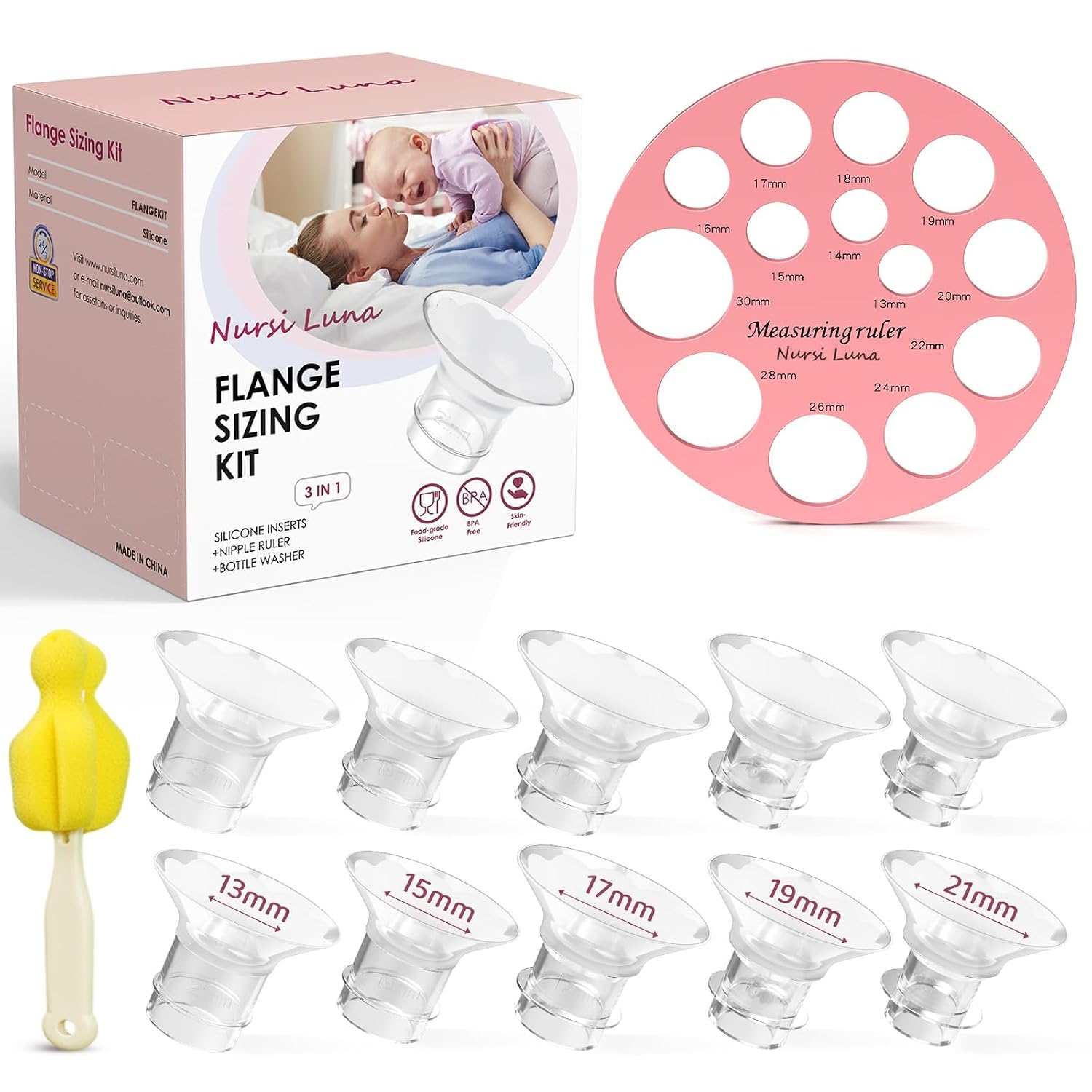 Insert-Only Kit (10pc) |
|
| ~$8 | Check price |
| Best Measuring Tool |  Soft Silicone Nipple Ruler (2-Piece) |
|
| ~$9 | Check price |
Complete Sizing Kit (10pc + Ruler)
Insert-Only Kit (10pc)
Soft Silicone Nipple Ruler (2-Piece)
Complete Sizing Kit — full breakdown
The Complete Sizing Kit is the most comprehensive flange sizing tool we evaluated — combining 10 silicone inserts (2 each of 13mm, 15mm, 17mm, 19mm, and 21mm) with a nipple ruler in one purchase (about $10). For first-time moms approaching flange sizing without prior knowledge, this single purchase covers measurement plus trial across the most common smaller-fit sizes that the peer-reviewed 2025 Flange FITS pilot study identified as producing higher comfort and milk output than standard 24mm fitment.
Compatibility is the standout feature. The 24mm-flange compatibility means this kit works with virtually every major pump on the US market: Medela, Spectra, Momcozy S12 Pro, Willow Go, Elvie Stride, eufy, Lansinoh, MomMed, NCVI, TSRETE, and Paruu — all of which ship with 24mm shields. The food-grade silicone inserts have a snug rim seal designed to keep milk from flowing back into the gap between insert and flange, which is a common complaint with cheaper or older insert designs. The included nipple ruler and instruction manual are straightforward but functional.
The trade-offs are honest. This kit only fits 24mm flanges — if you have a Spectra 28mm or 32mm pump (rare but exists), you’ll need a different sizing approach. The brand is generic rather than a long-established parts brand like Maymom or BeauGen, but at about $10 for 10 inserts plus a ruler, the value is hard to beat regardless. For moms who want a single-purchase complete flange sizing trial, this is the right starting point. After identifying your correct size, you can replace with brand-specific inserts (Maymom 17mm, BeauGen 19mm) if the silicone wears down with daily use after 3–6 months.
Insert-Only Kit — full breakdown
The Insert-Only Kit is the cheapest flange sizing trial path for moms who already have a measurement tool — perhaps from their pump (Momcozy S12 Pro ships with a nipple measure tool, Willow includes printable sizing) or from an IBCLC consultation. At $7.99 for 10 silicone inserts (2 each of 13/15/17/19/21mm), the per-insert cost is about $0.80 — below the Complete Kit’s per-insert cost.
The use case is straightforward: if you already know your approximate flange size from manufacturer sizing tools or insurance pump fitting, but want to trial 1–2 sizes above and below to confirm, this kit gives you that range without paying for a duplicate ruler. The food-grade silicone construction is comparable, and compatibility is the same (any 24mm flange from Medela, Spectra, Momcozy, Willow, Elvie). For moms who measured 17mm and want to trial 15mm/17mm/19mm to find the sweet spot, this is the most efficient path.
The trade-offs are minor. No ruler included — you’ll need to print a nipple sizing card from your pump manufacturer’s website (most have free downloads) or use the ruler that came with your pump. The kit is generic-brand, same as the Complete Kit. Same 24mm-only compatibility limitation. For moms who want only the inserts because they already have measurement covered, this is the cleanest, cheapest path. Skip this and buy the Complete Kit if you don’t already have a way to measure your nipple diameter.
Soft Silicone Nipple Ruler — full breakdown
The Soft Silicone Nipple Ruler is the dedicated flange sizing measurement tool for moms who want to confirm their size before purchasing inserts. The 2-piece set includes two soft silicone measuring rulers (pink and green) covering the full 13–36mm range. The soft silicone material is gentler on the nipple than hard plastic rulers — meaningful when measuring multiple times across the breastfeeding journey as nipple size fluctuates.
The use case is when you suspect you need a flange size outside the standard 13–21mm insert range. Plus-size moms, moms with naturally larger nipple bases, and moms whose nipples have stretched significantly during breastfeeding may need 24mm, 27mm, or even 30mm+ flanges — sizes the smaller-fit insert kits don’t cover. The full-range ruler set helps you measure accurately first, then purchase the correct flange or insert from a pump-brand-specific source (Maymom, BeauGen, or your pump manufacturer).
The trade-offs are minor but real. No inserts included — this is purely a measurement tool, so you’ll still need to purchase appropriate sizing inserts based on your measurement. Soft silicone rulers can flex slightly during measurement, which is why the 2-piece set provides redundancy: cross-check measurements across both rulers for accuracy. At about $9, this is a one-time purchase that lasts across multiple pregnancies and feeding journeys. For moms who want to measure carefully before spending on flange sizing inserts, this is the right starting point. For moms who suspect they fall in the standard 13–21mm range, the Complete Kit (around $10) includes a ruler and is more cost-effective.
5 things to know about flange sizing
The standard 24mm pump flange doesn’t fit many moms
The 24mm flange shipped with every major US breast pump doesn’t fit every mom. Many need an insert (smaller fit) or a larger replacement flange (above 24mm). Per the peer-reviewed 2025 Flange FITS pilot study published in PubMed, tip-based sizing produced better comfort and output than the traditional method; in practice, 15mm and 17mm are among the most common smaller-fit sizes moms end up needing — most who don’t fit the 24mm default need significantly smaller fitment than manufacturers ship by default.
Flange sizing methods differ — choose what works for your body
Two competing flange sizing methods exist: traditional “base measurement + 3–5mm” (used by most pump manufacturers) and the newer tip-based method (examined in the 2025 Flange FITS peer-reviewed pilot study). Traditional method works for many moms, but tip-based often produces better output for elastic nipples or moms with significant breast tissue. Trial both methods if your initial sizing doesn’t deliver comfort and output you expect.
Nipple size fluctuates — re-measure regularly
Per Cleveland Clinic guidance, nipple diameter fluctuates throughout breastfeeding due to hormones, time of day, hydration, and recent feeding. The flange size that fits at 6 weeks postpartum may not fit at 6 months. Re-measure every 4–6 weeks during active breastfeeding, and any time you notice pain, blanching, reduced output, or visible nipple changes. Keep flange sizing inserts in 2–3 sizes around your measurement for ongoing adjustment.
Wrong flange sizing causes more than discomfort
Beyond pain, wrong flange sizing leads to documented complications: blocked ducts, mastitis, nipple trauma, cracking, bleeding, and reduced milk supply. If pumping pain persists after 1–2 weeks of pumping, flange size is one of the most common causes — but persistent pain, cracking, bleeding, fever, or a hard, red, tender area of the breast should be evaluated by your clinician or an IBCLC, since mastitis, nipple vasospasm, and thrush can present the same way. Pumping should never hurt — consistent pain is your body signaling a sizing problem that needs immediate adjustment, not “toughening up.”
Insurance often covers IBCLC consultations
Per the ACA, most insurance plans cover lactation consultations with an International Board Certified Lactation Consultant (IBCLC). DME providers like Aeroflow, Edgepark, and Lactation Network often include IBCLC support with breast pump orders — some at $0 cost. If you’re struggling with flange sizing despite home measurement, an IBCLC consultation provides clinical-grade measurement plus assessment of nipple length, elasticity, and breast tissue that affect proper sizing beyond simple diameter.
Flange sizing: frequently asked questions
The most common signs of wrong flange sizing: pain during pumping, nipple rubbing against the flange tunnel, areola being pulled into the tunnel, blanching (skin turning white) where the flange touches, rings or marks around your areola after pumping, breast still feels full after a session, working very hard for each ounce, or sudden output drop. Per Cleveland Clinic, pumping should never hurt — if it does, sizing is the most likely cause. Also re-measure if you experience nipple cracking, bruising, or bleeding.
After birth, ideally 6–8 weeks postpartum once milk supply stabilizes. Pregnancy measurements are unreliable because hormones change nipple size throughout pregnancy and postpartum. The Lactation Network recommends waiting until breastfeeding establishes (around 4–6 weeks) for the most accurate flange sizing measurement. If you must order a pump before birth, start with the standard 24mm and plan to measure and adjust at 6 weeks postpartum. Flange fit is one piece of a larger recovery picture — our postpartum recovery essentials guide maps out the rest of weeks 1–6.
Often, but not always. Per IBCLC guidance from The Lactation Network and Spectra Baby USA, nipple size can vary between left and right breast. It’s normal to need different flange sizing on each side — for example, a 17mm insert on one side and a 19mm on the other. Measure both nipples separately when you do flange sizing, and don’t assume they match. The 10-piece insert kits (2 each of 5 sizes) accommodate this directly.
Most flange sizing inserts (13/15/17/19/21mm) are designed for 24mm flanges, which are standard on Medela, Spectra, Momcozy S12 Pro, Willow Go, Elvie Stride, eufy, Lansinoh, and most major pumps. Some pumps ship with 28mm or 32mm shields (occasional Spectra models, Ameda) — these need brand-specific larger flanges rather than standard inserts. Always verify your pump’s shield diameter before ordering inserts. The Soft Silicone Nipple Ruler covers the full 13–36mm range for measurement regardless of pump brand.
Standard insert kits cover 13–21mm. If your nipple measures larger, you need a replacement flange (not an insert) in 24mm, 27mm, 30mm, or larger. Most pump brands sell replacement flanges in their full size range — Spectra goes to 32mm, Maymom goes to 36mm. The Soft Silicone Nipple Ruler covers up to 36mm for accurate measurement before purchase. Plus-size moms, moms with naturally larger nipple bases, or moms whose nipples have stretched significantly during breastfeeding may need these larger sizes.
Re-measure every 4–6 weeks during active breastfeeding, and any time you notice symptoms (pain, blanching, output drop, visible damage). Per Cleveland Clinic and Willow Pump guidance, nipple size fluctuates with hormones, hydration, time of day, and recent feeding. Many moms find their flange sizing changes between pregnancies, and even within a single breastfeeding journey. Keeping a 10-piece insert kit on hand allows you to adjust quickly without re-ordering when sizes shift.
Our #1 pick: Complete Sizing Kit
One of the most complete flange sizing trial kits on Amazon. 10 silicone inserts (13/15/17/19/21mm, 2 each) plus a nipple ruler in one purchase (about $10). Compatible with virtually every 24mm pump on the market. The right starting point for any mom who suspects the standard 24mm flange isn’t working.
Check price on Amazon →Medical disclaimer: Not medical advice. Flange sizing should be confirmed with an IBCLC (International Board Certified Lactation Consultant) when output, pain, or supply concerns persist after at-home measurement. The information here is educational and reflects current clinical guidance from Cleveland Clinic and the peer-reviewed 2025 Flange FITS pilot study. Consult HealthyChildren.org (AAP) for additional pediatric guidance and your insurance plan’s DME provider for IBCLC consultation coverage.
Prices: Reflect typical Amazon pricing as of April 2026 and may vary. All three flange sizing tools are 24mm-flange compatible, which fits virtually every major pump on the US market (Medela, Spectra, Momcozy, Willow, Elvie, eufy, Lansinoh). Verify your specific pump’s shield diameter before ordering.
- Wagner CL. Counseling the Breastfeeding Mother. Medscape Drugs & Diseases (eMedicine); updated Jan 19, 2024. Breastfeeding is the criterion standard for infant feeding; correct latch and proper flange/positioning are central to comfortable, effective milk transfer.