
Best Room Divider for Nursery 2026: 3 Shared-Bedroom Picks Reviewed
The best room divider for nursery use in a shared-bedroom setup should give you visual privacy and a noise buffer for the baby’s sleep zone without creating a false sense of separation that conflicts with AAP room-sharing safety guidance. We compared 3 top contenders against the layouts these actually have to work in — parent-and-baby studios, sibling-sharing nurseries, and one-bedroom apartments with a partitioned crib corner — to find dividers that work for the under-12-month room-sharing window the American Academy of Pediatrics recommends. Three room dividers stand out for the privacy, stability, and storage value families need: the 16-Cube Cubicle Reversible Bookshelf at roughly $174 (our top pick for stability and dual-purpose storage), the Cubicle Cube Insert H-Shelf at roughly $22 (our best insert pick that doubles cube capacity for nursery storage), and a 4-panel folding wood screen at roughly $69 (our best portable nursery divider screen pick for renters and small spaces).
A room divider for nursery use is fundamentally a privacy and acoustic tool, not a safety device. Per AAP 2022 safe-sleep guidance, babies under 12 months should sleep on their own firm, flat surface (a crib, bassinet, or play yard) in the same room as a caregiver — and a room divider does not change those requirements. The best room divider for nursery setups gives parents a sense of separation for late-night reading or a partner’s different sleep schedule without removing the baby from earshot. Pair this guide with our best bedside sleeper attachment review for the actual sleep surface, and use our complete AAP room-sharing guidelines explainer to make sure your shared bedroom layout meets every safe-sleep recommendation.
Best room divider for nursery: top picks for shared-bedroom layouts
The extra-thick 16-cube reversible cubicle bookshelf that doubles as nursery storage and a visual privacy wall, the H-shelf cube insert that doubles capacity inside any existing Kallax-style cube divider, and the 4-panel folding screen that gives renters a portable nursery divider option without anchoring to walls.
Safety first: a room divider does NOT create a separate “room” for AAP safe-sleep purposes
The best room divider for nursery use is a privacy and acoustic tool — it gives you visual separation and a modest noise buffer between the adult sleep zone and the baby’s crib. It does not change the AAP safe-sleep requirement that infants under 12 months sleep on their own firm, flat surface (a crib, bassinet, or play yard) in the same room as a caregiver. A room divider does not turn a shared bedroom into two rooms; it does not satisfy any sleep-safety guideline; and it should never be used as a barrier to keep an older sibling, pet, or adult sleeper away from the crib in a way that delays caregiver response.
Use a nursery divider for visual privacy, light blocking from a lamp on the adult side, or noise dampening from a partner with a different sleep schedule. Never use one to create a sense of separation that reduces your ability to see or hear the baby. The room divider should always be positioned so audio monitoring is unimpeded and the caregiver can reach the crib in seconds.
How we evaluated the best room divider for nursery setups
A room divider that wobbles when a toddler grabs it, fails to block lamplight at 11 p.m., or eats a third of the floor space in an already-cramped studio is worse than no divider — it adds risk without solving the privacy problem. Four things decide whether a divider is worth the floor space it takes:
Stability and ASTM-aligned tip-over resistance. We checked every room divider against the anti-tip hardware it ships with and the anchoring instructions printed in its own manual. Per ASTM F2057-23 furniture stability standard, freestanding storage units taller than 27 inches in a child’s environment should resist a 50-pound horizontal force without tipping. Any freestanding divider over that height is flagged here for mandatory wall-strap installation — non-negotiable in any room with a mobile baby or older sibling.
The Cubicle 16-cube ships wall-anchor hardware in the box, which is what lets a unit this tall meet the 50-pound threshold once it is installed as directed. The folding screen is by design freestanding and not anchorable, which limits its use in any room where a pre-walking baby or toddler could pull on it.
Sound blocking, judged from construction. Nothing in this category ships with a published sound-transmission rating, so we compared what physically blocks sound: panel mass and whether the back is solid or open. A dense, solid-backed cube bookshelf with the cubes loaded takes some edge off adult-side conversation and screen audio. Open-back cube units and thin-slat folding screens put almost nothing in the sound path — meaningful for visual privacy, marginal for actual noise dampening.
Visual privacy at standing and seated sight lines. A 58-inch room divider blocks a seated adult’s sight line to the crib but leaves the crib visible from standing height — by design, this preserves the AAP-aligned audio and visual monitoring capability. A 71-inch folding screen blocks standing sight lines too, which works for adult privacy but means you can’t see the baby from the bed without standing up.
Assembly time and footprint. Manufacturer and owner-reported assembly for a 16-cube unit runs around 90 minutes, in line with other 16-cube shelving. The H-shelf cube insert is listed as tool-free at about 5 minutes per cube. The folding screen needs no assembly at all — it unfolds, which is its core advantage for renters and small spaces.
Best room divider for nursery: side-by-side comparison
| Pick | Product | Key strengths | Watch-outs | Price | Where to buy |
|---|---|---|---|---|---|
| Top Pick | 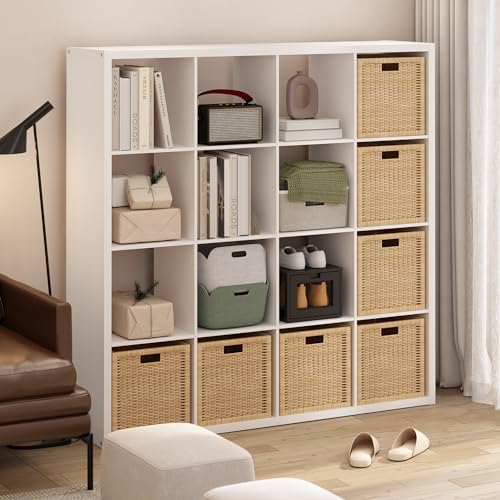 16-Cube Cubicle Reversible Bookshelf |
|
| $173.99 | Check price |
| Best Insert |  Cubicle Cube Insert H-Shelf |
|
| $21.99 | Check price |
| Best Folding Screen |  FDW Room Divider 4 Panel Folding Wooden Screen |
|
| $68.99 | Check price |
16-Cube Cubicle Reversible Bookshelf
Cubicle Cube Insert H-Shelf
FDW Room Divider 4 Panel Folding Wooden Screen
16-Cube Cubicle Reversible Bookshelf — full breakdown
The 16-cube Cubicle Reversible Bookshelf is our pick for nursery use because it solves three problems at once — visual privacy, nursery storage, and ASTM-aligned stability — in a single 58-by-58-inch footprint that fits the geometry most shared bedrooms actually have. The extra-thick frame is the differentiator versus standard Kallax-style cube competitors: the panels are heavier stock than the thin-wall cube units in the same price band, and it is one of the few in the category that ships wall-anchor hardware in the box rather than selling it separately.
The reversible open-back design lets you orient the cube openings toward either the parent or baby side, which matters in shared-bedroom layouts where one side of the divider needs to be storage-forward (the parent zone) and the other side can be aesthetic and clear (the baby zone). Combined with 14.6 inches of cube depth, the divider holds full-size storage baskets, board books, diaper supplies, and a sound machine without overflow.
This is the divider that suits the widest range of shared-room layouts. At 58 inches it sits above a seated adult’s sight line to the crib but below standing height, so a caregiver can still see and hear the baby from their sleep position — which is the whole point of AAP room-sharing guidance, and the reason a taller screen is the wrong choice beside a crib.
Acoustically, what matters is what is in the cubes rather than the divider itself: cubes filled with soft-sided storage baskets absorb sound, while empty cubes leave an open back that lets it straight through. For families using the room divider to buffer adult-side white noise, conversation, or screen audio, filled cubes are the configuration that actually works.
Assembly runs about 90 minutes for one adult by manufacturer and owner accounts, consistent with other 16-cube shelving. The wall-anchor hardware is included in the box, which closes the most common failure mode for any cube-style nursery divider — an unanchored 58-inch storage piece in a child’s environment is a known tip-over risk per ASTM F2057-23, and skipping the anchors is the single biggest install mistake families make.
Cubicle Cube Insert H-Shelf — full breakdown
The Cubicle Cube Insert H-Shelf is the smartest add-on we reviewed for any cube-style room divider. It’s not a standalone nursery divider — it’s a 2-tier H-shelf that drops into any standard 13-inch cube and effectively doubles the usable shelf capacity of the existing bookshelf. For families already using a Kallax, Furinno, or our top-pick Cubicle 16-cube as a room divider, this insert solves a real problem: cube interiors waste vertical space, and an H-shelf cuts the cube into two functional shelves so books, baskets, and supplies stack cleanly.
The H-shelf is built to the 13-inch cube dimension that IKEA Kallax, Furinno, and our top-pick Cubicle bookshelf all share, and the manufacturer lists all three by name as compatible — which makes it the most broadly compatible nursery divider accessory in this roundup. Cube systems do vary slightly between brands, so measure your cube opening before ordering.
The 5-minute tool-free assembly per insert means a parent can upgrade an entire cube bookshelf’s worth of storage in under an hour without a screwdriver. The white finish color-matches every major cube bookshelf line we reviewed against.
The limitation is by design: it’s not a room divider on its own. You need an existing cube bookshelf in place as the base. For families building a nursery divider setup from scratch, buy the Cubicle 16-cube bookshelf first, then add as many H-shelf inserts as you need based on how you’re using each cube. For families with an existing Kallax already in use as a divider, the H-shelf is the cheapest meaningful upgrade you can make — roughly $22 per cube versus $200+ to replace the whole bookshelf with a larger unit.
At ~$22 per insert, the math works out to roughly $176 to double the capacity of a fully-loaded 16-cube divider — significantly less than buying a second bookshelf, and without consuming any additional floor space in the shared bedroom.
FDW Room Divider 4 Panel Folding Wooden Screen — full breakdown
The FDW Room Divider 4 Panel Folding Wooden Screen is the best portable nursery divider we reviewed for renters, studio dwellers, and families who want a temporary room divider that disappears when the baby graduates out of the AAP room-sharing window. At $68.99, it’s the cheapest full-height privacy screen for room-sharing layouts we evaluated — a true 4-panel wooden folding screen that lands under $70, unfolds in seconds, and folds flat for closet storage when not in use. For a one-bedroom apartment where the crib lives in a corner of the parents’ bedroom for the first year, this is the best room divider for nursery use that doesn’t commit permanent floor space.
The 4 panels deliver roughly 5.5 feet of total coverage across the divider line, which is enough to screen a standard crib footprint from the adult side of the bedroom. The wooden frame is meaningfully heavier than the thin fabric folding screens that dominate the under-$50 tier, which translates to better stability when freestanding and a more substantial feel in the room. No wall mounting is required — the FDW screen stands on its own, which is exactly what renters and short-term occupants need.
The FDW folding screen is the pick when you want a divider you can fold away during the day — sibling-sharing rooms and studio apartments, where the floor has to do double duty. The screen blocks adult-side sight lines into the crib zone for full privacy during late-night reading, partner work, or a different sleep schedule — useful when one partner is working on a laptop while the baby sleeps.
For families who rely on audio monitoring (a baby monitor or simple earshot), this works fine; for families who prefer constant visual line-of-sight from the bed, the shorter cube bookshelf is a better geometry choice.
The trade-offs are worth understanding. Color and finish options are limited compared to the wider fabric folding screen category — the FDW is a classic single-finish wooden screen rather than a designer accent piece. The wooden frame, while heavier than fabric, can still topple if knocked, so keep the screen well outside the crib’s reach zone and away from any furniture a climbing toddler or older sibling could use to pull on the panels. And the overall feel is more functional than the premium IKEA Kallax-style shelving room dividers — you’re buying portability and price, not a designer statement piece.
Sound blocking is the weakest of our three picks, because the panels are thin wooden slats with no solid back and very little mass in the sound path. The folding screen is a visual privacy tool first, with noise dampening as a marginal secondary benefit. For families whose primary need is light blocking or visual separation rather than noise, that’s the right trade-off. Pair the FDW folding screen with our best nursery blackout curtains review if light blocking is the primary problem you’re solving — curtains around the crib zone do more for sleep environment than any folding screen alone.
5 things to know before buying a room divider for nursery use
A room divider does not satisfy any AAP safe-sleep requirement
The best room divider for nursery use is a privacy and acoustic tool, not a sleep-safety device. Per AAP 2022 guidance, infants under 12 months should sleep on their own firm, flat surface in the same room as a caregiver — and a room divider does not create a “separate room.” Use the divider for visual privacy and modest noise dampening, but never use it to create distance from the baby that delays caregiver response. Pair this with our complete AAP room-sharing guidelines explainer so your shared bedroom layout meets every safe-sleep recommendation.
Anchor every cube-style nursery divider to the wall — non-negotiable
Per ASTM F2057-23, freestanding storage units taller than 27 inches in a child’s environment must resist a 50-pound lateral force without tipping. A 58-inch cube bookshelf used as a room divider is well above that threshold and absolutely requires wall-anchor straps, especially in a room with a mobile baby, toddler, or older sibling. The Cubicle 16-cube ships with wall-anchor hardware in the box — installing it adds 5 minutes to assembly and eliminates the single biggest failure mode for cube-style nursery dividers. Skipping the anchors is how cube bookshelves end up on incident reports.
Folding screens are visual privacy only — keep them out of reach of climbing kids
Folding wood or fabric room divider screens are freestanding by design and cannot be anchored to a wall. That makes them appropriate as a nursery divider screen only when there’s no mobile baby, climbing toddler, or older sibling who could pull on the panels. Position any folding screen at least 3 feet from the crib and at least 3 feet from any furniture the child might use to reach it. For families with a pre-walking baby and no older siblings, folding screens are a clean temporary solution; for families with toddlers, an anchored cube bookshelf is the safer geometry.
Check GREENGUARD certification for furniture inches from the baby’s sleep surface
A room divider placed within a few feet of the crib is essentially nursery furniture, and the off-gassing profile matters. Look for GREENGUARD or GREENGUARD Gold certification on any engineered-wood cube bookshelf or particle-board folding screen — GREENGUARD Gold caps VOC emissions at levels appropriate for sensitive populations including infants. Not every nursery divider on the market carries certification, but where the manufacturer reports it, that’s a meaningful quality signal for furniture this close to a sleeping baby.
Plan for the post-room-sharing transition before you buy
The AAP room-sharing window is roughly 6–12 months — after that, most families transition the baby to a separate nursery, and the room divider should still earn its place in the home. The Cubicle 16-cube bookshelf converts cleanly into nursery storage in the new room or living-room storage. The H-shelf inserts move with the bookshelf. The folding screen folds flat for closet storage or pivots to use as a playroom divider, photo backdrop, or coat-corner privacy panel. Buy the room divider you’d want even after the room-sharing phase ends.
Best room divider for nursery: frequently asked questions
The best room divider for nursery use depends on your layout and lifestyle. For a permanent shared-bedroom setup with built-in nursery storage value, a 58-inch cube bookshelf like our top-pick 16-cube Cubicle Reversible Bookshelf is the most stable, AAP-aligned room divider option — it blocks seated sight lines, preserves standing-height monitoring, and doubles as nursery storage. For renters or studio dwellers who need a portable nursery divider, a 4-panel folding wood screen is the best room divider for nursery setups that need to disappear when the baby moves to their own room. For families already using a cube bookshelf as a divider, the H-shelf cube insert is the cheapest meaningful capacity upgrade.
No. A room divider does not create a separate room for AAP safe-sleep purposes. Per the AAP 2022 safe-sleep policy, infants under 12 months should sleep on their own firm, flat surface in the same room as a caregiver — and a room divider does not change either requirement. The baby still needs a crib, bassinet, or play yard for sleep, and the caregiver still needs to be in audio and visual range. Use a room divider for visual privacy and noise dampening, not as a safety barrier or as a way to functionally separate the baby into a different room.
For most shared-bedroom setups, the best room divider for nursery use sits between 54 and 60 inches tall. That height blocks seated sight lines from the bed to the crib while preserving standing-height visibility — the exact geometry that lets parents see and hear the baby from their sleep position without the divider creating a false sense of separation. Our top pick Cubicle 16-cube bookshelf is 58 inches, which falls in the sweet spot.
71-inch folding screens block standing sight lines too, which works for adult privacy but means you can’t see the baby from bed without standing up — choose that height only if you rely on audio monitoring rather than visual line-of-sight.
Yes, absolutely. Per ASTM F2057-23 furniture stability standards, any freestanding storage unit taller than 27 inches in a child’s environment must be anchored to resist a 50-pound lateral force without tipping. A 58-inch cube bookshelf used as a nursery divider is well above that threshold. The Cubicle 16-cube ships with wall-anchor hardware in the box, and installation adds about 5 minutes to assembly. Skipping the anchors is the single biggest failure mode for any cube-style room divider in a room with a mobile baby, toddler, or older sibling.
Folding screens are appropriate as a nursery divider only when there’s no mobile baby, climbing toddler, or older sibling who could pull on the panels. Folding screens are freestanding by design and cannot be anchored, so they tip when pulled. Position any folding screen at least 3 feet from the crib and at least 3 feet from any furniture a child could climb to reach it.
For families with a pre-walking infant and no older siblings, a folding screen is a clean temporary nursery divider that folds flat for storage. For families with toddlers, an anchored cube bookshelf is the safer geometry. Either way, the folding screen is a privacy and light-blocking tool — not a safety barrier.
A room divider can help marginally with adult-side light and noise spillover, which can in turn reduce sleep disruptions for the baby. A solid-back cube bookshelf filled with soft-sided storage baskets will take some of the edge off conversation and screen audio from the adult side; a folding fabric screen does very little for sound at all. Neither one is soundproofing, and you should not buy either expecting it to be.
For sleep environment overall, the best room divider for nursery use is one input among several: pair the divider with our best nursery blackout curtains review for light control and a white-noise machine for consistent acoustic masking. The divider alone is a privacy tool, not a sleep solution.
Our #1 best room divider for nursery pick: 16-Cube Cubicle Reversible Bookshelf
The best room divider for nursery use of our three picks: a thicker frame and heavier panels than the usual cube shelves, wall-anchor hardware in the box, a 58-inch height that blocks seated sight lines while preserving standing-height monitoring, and 16 cubes of built-in nursery storage that earn the divider’s footprint twice over. Anchor it to the wall (hardware included), fill the cubes with soft-sided baskets for maximum acoustic dampening, and you have the best room divider for nursery setups under $175.
Safety disclaimer: Not a substitute for AAP safe-sleep guidance. A room divider for nursery use is a privacy and acoustic tool — it does not create a separate room for safe-sleep purposes, and infants under 12 months should always sleep on their own firm, flat surface in the same room as a caregiver. Cube bookshelves used as room dividers must be anchored to the wall per ASTM F2057-23. Folding screens must be positioned out of reach of mobile babies, climbing toddlers, and older siblings. Consult HealthyChildren.org (AAP) for current room-sharing and safe-sleep recommendations.
Prices: Reflect typical Amazon pricing as of May 2026 and may vary. Folding screen SKUs rotate frequently — verify the specific ASIN on the linked product page before ordering. GREENGUARD certification status reflects manufacturer-reported data as of publication.
- Burnett LB. Sudden Infant Death Syndrome (SIDS). Medscape Drugs & Diseases (eMedicine); updated Mar 10, 2026. SIDS (now grouped under Sudden Unexpected Infant Death) is a leading cause of death at 1-12 months, peaking at 1-3 months; a bare, separate back-sleep surface and avoiding soft bedding and overheating are central to risk reduction.