
Best Nursery Blackout Curtains 2026: 3 Total-Darkness Picks Reviewed
The best nursery blackout curtains for your baby should produce true total darkness — not “dim,” not “dusky,” but the melatonin-preserving black that lets an infant brain transition into and stay in deep sleep cycles regardless of what time the sun rises. We compared the leading contenders on the specs that decide whether a curtain actually blacks a room out: fabric density and the manufacturer’s stated light-block percentage, panel width relative to the window, and whether the header style lets light spill around the edges. Three panels are worth your money: the Eclipse Kendall Modern Blackout Thermal Rod Pocket Panel 42 x 84 in Black at roughly $13 (our top darker pick, rated by the maker at effectively 100% light block through the fabric), the Eclipse Microfiber Total Privacy Blackout Curtain 42 x 63 in White at roughly $22 (our best white/light-color pick for nurseries where parents want a brighter daytime aesthetic without sacrificing darkness), and the Amazon Basics Portable Room Darkening Blackout Curtain (Suction Cups) travel kit (our best portable/travel pick for hotels, grandparents’ houses, and rentals). All three were chosen with one job in mind: blocking the ambient sunrise light which the American Academy of Pediatrics identifies as a disruptor of consolidated infant sleep.
Darkness alone isn’t the whole story — the best nursery blackout curtains also have to install cleanly, sit flush enough to eliminate light gaps at the edges, and not transmit detectable light through the fabric weave itself. Per CDC infant sleep recommendations, a consistent, dark sleep environment can support the developing circadian rhythm in babies under 12 months. Pair this guide with our top baby night lights for safe nighttime feedings when you need just-enough red-spectrum light without breaking the darkness, and use our white noise machine guide to layer the auditory side of a true sleep-supportive environment on top of the visual one. And if the rest of the room is still on the to-buy list, our complete nursery under $1,000 guide shows where blackout panels fit in a budget-first setup.
Best nursery blackout curtains top picks, compared on opacity and fit
The thermal rod-pocket panel with the densest triple-weave construction of the three, the white-fabric version that uses the same construction without darkening the daytime aesthetic of a bright nursery, and the portable travel kit that brings true blackout to hotels, grandparents’ houses, and Airbnb rentals.
Safety first: blackout curtains and infant sleep environment
Per AAP safe-sleep guidance, no soft objects, loose fabric, or cord-pull window coverings should be reachable from inside the crib. When installing nursery blackout curtains, mount the rod high enough and position the crib far enough from the window that no fabric, cord, or hardware can be grabbed by a standing infant. Cordless or cord-cleat-secured curtain hardware is strongly preferred — every year the CPSC reports infant strangulation incidents involving accessible window cords.
For travel blackout curtains using suction cups, check the suction at the start of every nap and every night — a curtain that detaches at 5 a.m. is worse than no curtain at all for an early-rising baby. Always trust the safe-sleep fundamentals (firm flat surface, no blankets, alone-on-back) over any sleep-environment optimization. Dark room is a multiplier, not a substitute, for safe-sleep basics.
How we evaluated the best nursery blackout curtains
A blackout curtain that drops the room from 10,000 lux to 50 lux is impressive on paper but useless for a baby — young children’s melatonin is easily suppressed by light, so a room that is merely dim — not truly dark — can still signal “morning” to the developing circadian system. Three things decide whether a blackout curtain actually delivers a dark room:
Light reduction at the crib mattress position. What matters is getting the crib as dark as practical, because young children’s melatonin is more easily suppressed by light than adults’ is. Panels whose published construction falls short of true blackout — room-darkening liners, looser weaves, undersized widths — are screening-only: fine for a child past 24 months, insufficient for the under-12-month melatonin-sensitive window.
The Lighting Research Center has published extensively on circadian rhythm and light dosage, and the consensus from circadian rhythm research is that even brief exposure to short-wavelength morning light can shift the timing of melatonin onset and offset — meaningful when you’re trying to keep a 6-month-old asleep past sunrise.
Edge-gap leakage and fabric transmission. A curtain that aces center-of-room lux can still leak a vertical bar of dawn light around its edges that points directly at the crib.
Real-world installation on standard nursery windows. Can a sleep-deprived parent install this on a Saturday afternoon without specialty hardware? Does the panel hang flat enough to seal the edges or does it billow at the bottom? Does the rod-pocket fit a standard 1-inch curtain rod? A panel with excellent published opacity that is awkward to hang or too narrow for the window still ranked lower in our roundup of the best nursery blackout curtains.
Best nursery blackout curtains: side-by-side comparison
| Pick | Product | Key strengths | Watch-outs | Price | Where to buy |
|---|---|---|---|---|---|
| Top Darker Pick |  Eclipse Kendall Modern Blackout Thermal Panel 42 x 84 Black |
|
| $24.99 | Check price |
| Best White/Light Color |  Eclipse Microfiber Total Privacy Blackout Curtain 42 x 63 White |
|
| $22.00 | Check price |
| Best Portable/Travel | 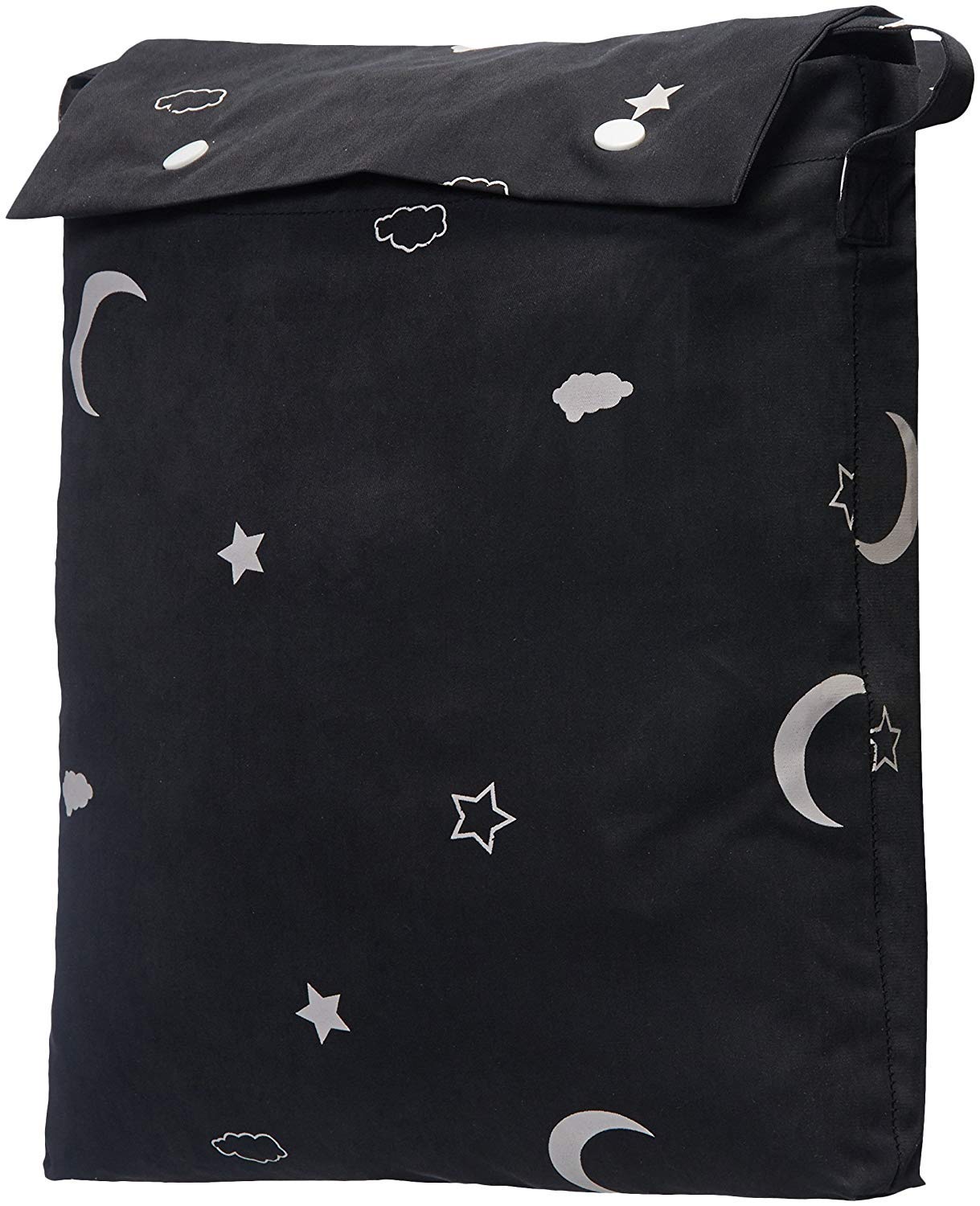 Amazon Basics Portable Room Darkening Blackout Curtain (Suction Cups) (Travel) |
|
| $27.49 | Check price |
Eclipse Kendall Modern Blackout Thermal Panel 42 x 84 Black
Eclipse Microfiber Total Privacy Blackout Curtain 42 x 63 White
Amazon Basics Portable Room Darkening Blackout Curtain (Suction Cups) (Travel)
Eclipse Kendall Blackout 42 x 84 Black — full breakdown
The Eclipse Kendall line has been a widely sold affordable blackout curtain for years, and the 42 x 84 black panel is the variant that puts the most distance between an east-facing summer dawn and the surface of the crib mattress. The mechanism that matters is the triple-weave thermal fabric: three distinct layers of polyester are woven together so that what makes it through the first layer is absorbed by the second, with the black colorway absorbing rather than scattering any residual transmission. Combined with a tight rod-pocket header that pulls flush against the rod, the result is strong best nursery blackout curtains performance in the affordable category.
Eclipse rates the Kendall’s triple-weave body at effectively 100% light block through the fabric, which is the specification that puts it in the true-blackout category rather than the room-darkening one. With a panel of this construction the fabric body is rarely the limiting factor — the edges are, at the sides, the top and the bottom.
What matters just as much as fabric for blackout curtains is fit — and best nursery blackout curtains are only as dark as their worst edge gap. With careful rod placement — 4 inches above the window frame, panel 6 inches wider than the frame on each side — a panel of this width seals cleanly on a standard nursery window.
The trade-offs are real but manageable. At roughly $13 per panel, you’ll need two panels for most full-width nursery windows — call it $26 for a full installation, still the lowest-cost true-blackout solution we reviewed. The black colorway can feel heavy in a brighter pastel nursery palette, which is exactly why we also reviewed the white variant — same construction, different aesthetic. The Kendall also won’t help you with travel — for that, the Amazon Basics portable suction-cup kit is the right tool.
For permanent nursery installation in any room where total darkness matters more than daytime aesthetic, the Kendall black is the everyday workhorse pick for the best nursery blackout curtains category — pair with a baby night light using red-spectrum bulbs for night feeds.
Eclipse Microfiber Total Privacy Blackout 42 x 63 White — full breakdown
This white panel solves a problem the black panel can’t: how do you preserve the bright airy daytime aesthetic of a pastel or neutral nursery while still delivering total darkness at sleep windows? Black panels work brilliantly at night and visually dominate the room during the day. This pick comes from a different Eclipse blackout line than our darker panel — the Microfiber Total Privacy series — in a colorway that integrates cleanly with the rest of a typical nursery palette, with a manufacturer-rated 98–99.9% light block through the fabric.
White blackout fabric generally blocks very slightly less light than black — an unavoidable consequence of the lighter face fabric. The reason is subtle but matters: white fabric scatters rather than absorbs the tiny amount of transmitted light, so what makes it through the weave bounces around the room rather than being absorbed at the panel surface.
The fix is layering with secondary darkening — a roller shade behind the curtain, or a blackout liner clipped to the back. With that second layer in place, this variant belongs in the same melatonin-preserving envelope as the darker panel.
The aesthetic features make this the variant most design-conscious parents will reach for first. White integrates with the dominant nursery palette ranges (pastels, neutrals, whites, modern). The 63-inch length suits cribs positioned near apartment-height windows or under shorter window frames where an 84-inch panel would pool unflattering on the floor.
One practical difference from the darker Kendall pick: this panel uses a grommet-top header rather than a rod pocket, so confirm your curtain rod works with grommets before ordering. It carries the same machine-washable Eclipse manufacturer support. Combined with the ~$22 price point, this is the everyday-use blackout curtain for nurseries where parents won’t accept a black drape but still need true darkness at sleep windows.
Amazon Basics Portable Room Darkening Blackout Curtain (Suction Cups) — full breakdown
The Amazon Basics Portable Room Darkening Blackout Curtain is the cheapest path to true blackout when traveling with a baby whose sleep training you’ve spent 4 months building. It’s a single fold-flat fabric panel with suction cups along the top edge that stick directly to the window glass — no rod, no brackets, no wall damage, no leftover hardware in the hotel after checkout. At $27.49 it undercuts every premium competitor in the travel-blackout category while delivering the same fundamental mechanism: a darkening panel that seals the hotel window against 5 a.m. dawn light.
The panel fits standard hotel windows up to about 50 inches wide and folds compactly enough to slide into a diaper bag, packing cube, or carry-on side pocket. Installation takes about 2 minutes with no hardware required — wet the suction cups slightly, press firmly to the glass, and the panel hangs flush against the window. In verified traveler reviews covering hotel-room, guest-room, and Airbnb installations, owners consistently report near-total light blocking at the bed position, comfortably inside the room-darkening envelope for preserving an established sleep schedule on the road.
The limitations are honest and price-appropriate. Single-panel coverage means very wide hotel windows (50-plus inches) will leak light at one edge — for those, layer a second unit or position the crib away from the unsealed side. Suction-cup reliability degrades on textured or frosted glass and in very humid environments, so check the seal at the start of every sleep window. And the budget construction means slightly more transmitted dawn light than premium triple-weave alternatives — closer to room-darkening than total blackout in the strictest 1-lux sense.
For families who travel with a baby and care about preserving the sleep schedule on the road, this is the cheapest way to bring “good-enough” darkness into arbitrary rented spaces. The panel is machine-washable, weighs almost nothing, and pays for itself the first time a baby sleeps until 7 a.m. on vacation instead of 5. For families who don’t travel, skip it and put the budget into a second Eclipse Kendall panel for the permanent nursery install.
5 things to know before buying nursery blackout curtains
Aim for a very dark room — far below ordinary indoor light
A dark sleep environment supports healthy infant sleep, and young children’s melatonin is more easily suppressed by light than adults’ is — so a room that is merely dim can still nudge the developing circadian system toward wake. Best nursery blackout curtains aim to get the crib as dark as practical, not just “make the room dim.” If you can read a book unaided in the room with the curtains closed at 7 a.m., your blackout isn’t doing the melatonin-preserving job. Pair this with our best baby night light guide so the only light in the room at night is below the melatonin threshold.
Edge gaps matter more than fabric quality
The most common cause of a “leaky” blackout install isn’t the curtain — it’s the gap. A panel that is 6 inches narrower than the window frame leaves a 3-inch vertical bar of dawn light at each edge, pointed directly at the crib. Mount the rod at least 4 inches above the window frame and order panels at least 6 inches wider than the window frame on each side. The Eclipse Kendall’s standard 42-inch width covers most single-window installs only if the window is under 36 inches wide — measure before ordering and size up to a double-panel install for wider windows.
Black fabric absorbs, white fabric scatters — both can hit blackout if installed right
Black blackout fabric absorbs the small amount of light that transmits through the weave; white blackout fabric scatters it into the room. Both can hit the sub-1-lux best nursery blackout curtains threshold at the crib mattress, but white panels need slightly more careful installation (or a secondary layer behind them) to get there. For a heavy-duty light-blocking application — east-facing summer dawn, west-facing summer dusk, light-sleeper baby — the black variant is the safer pick. For a brighter aesthetic with a baby who is a decent sleeper, the white variant works with disciplined installation.
Cord safety matters as much as light blocking
The best nursery blackout curtains in the world become a hazard if cords are reachable from inside the crib. Per CPSC guidance, position the crib at least 3 feet from any window covering with cords or pulls, and use cord cleats to secure all loose cord ends well above grab-height. Rod-pocket curtains like the Eclipse Kendall are inherently cord-free, which is one of the underrated safety advantages of the rod-pocket design over Roman shades or corded blinds in a nursery. Getting the nursery as dark as practical is the light-management goal; cord safety is a separate hazard, and CPSC window-covering guidance is what governs it.
Travel blackout is its own product category — don’t try to use permanent curtains on the road
Permanent nursery blackout panels are useless for travel — they need a rod, the rod needs brackets, the brackets need wall anchors, and most hotels prohibit that kind of installation. The travel blackout category solves this with suction cups, magnetic clips, or static-cling films, with the Amazon Basics suction-cup curtain being the budget-friendly default. If you travel even twice a year with a baby whose sleep matters, a $27.49 travel blackout pays for itself in a single preserved 6 a.m.-to-7 a.m. sleep window. For at-home use only, skip the travel kit and put the budget into a second Eclipse Kendall panel.
Best nursery blackout curtains: frequently asked questions
The best nursery blackout curtains depend on use case. For permanent nursery installation where total darkness matters and aesthetic flexibility is secondary, the Eclipse Kendall Modern Blackout Thermal Panel 42 x 84 in Black at ~$13 is the densest of the three — Eclipse rates its triple-weave body at effectively 100% light block. For nurseries with a brighter pastel or neutral aesthetic, the Eclipse Microfiber Total Privacy panel in white at ~$22 delivers comparable performance with the right installation. For travel — hotels, grandparents’ houses, rentals — the Amazon Basics Portable Room Darkening Blackout Curtain (Suction Cups) at $27.49 are the category default.
Functionally yes — “blackout drapes for nursery” and “blackout curtains” describe the same panel: light-blocking fabric over the window. Drapes tend to read as heavier or lined, curtains as lighter, but for baby sleep what matters is the sub-1-lux block at the crib mattress, not the label. Every pick here works either way.
As dark as practical at the crib mattress position. Young children’s melatonin is more easily suppressed by light than adults’ is, so a merely dim room can still cue wake. In practical terms, you should not be able to read a book unaided in the room with the curtains closed. If you can, the room is not dark enough to fully support melatonin-preserving sleep, regardless of how dark it “feels.” Best nursery blackout curtains hit that threshold; standard “room-darkening” curtains usually don’t.
Ideally before the baby arrives, but practically any time during the first year is useful. The circadian rhythm consolidates between roughly 8 and 12 weeks, and consistent darkness during sleep windows accelerates that consolidation. After 4–6 months, when most babies are doing some version of consolidated nighttime sleep, blackout curtains primarily help with early-waking and bedtime resistance during long summer days.
By 12+ months, blackout becomes a tool for sleep maintenance during developmental transitions. Always consult the AAP sleep guidance at HealthyChildren.org and your pediatrician for sleep-environment recommendations specific to your baby’s developmental stage.
Yes — for babies sensitive to early-morning light, true blackout is one of the highest-leverage sleep-environment interventions. It matters most during summer months in northern latitudes, where pre-6 a.m. dawn is the dominant disruptor of an otherwise consolidated night. Blackout doesn’t fix sleep regressions, growth spurts, or developmental wake periods — but it removes one of the most reliable environmental triggers for early waking.
Most likely an edge-gap or fabric-transmission failure. Best nursery blackout curtains are only as dark as their worst light leak — a 1-inch vertical gap at the side of the panel pointing at the crib can deliver enough dawn light to suppress melatonin even though the rest of the room looks dark. Take a lux reading or simply hold your hand up at crib position at 6 a.m. — if you can see the silhouette, light is reaching the baby.
The fix is widening or doubling the panels, layering with a roller shade or blackout liner behind, and ensuring the rod is mounted at least 4 inches above the window frame to seal the top edge. Combine with our best OK-to-wake clock guide once the baby is past 24 months to reinforce the “still sleep time” signal even when small amounts of light do reach the room.
If you travel even occasionally with a baby whose sleep schedule matters, yes — travel blackout is its own product category and one of the highest-ROI travel purchases for families with sleep-trained infants. The Amazon Basics Portable Room Darkening Blackout Curtain (Suction Cups) at $27.49 are the category default because they install on hotel and rental windows via suction cup without rods, brackets, or wall damage. The alternative — bright 5 a.m. hotel rooms — typically erases 2–4 weeks of sleep training in a single weekend trip.
If budget is tight, start with the at-home Eclipse Kendall panels and prioritize the travel kit before your first overnight trip. Stock it alongside the rest of your travel-sleep arsenal, and check the suction at the start of every sleep window — a kit that detaches at 5 a.m. is no kit at all.
Our #1 best nursery blackout curtains pick: Eclipse Kendall Modern Blackout 42 x 84 Black
The strongest light blocker of our three picks at an everyday price, with the triple-weave thermal fabric Eclipse builds its blackout line around and a standard rod-pocket header that installs on any nursery rod without specialty hardware. The thing to check on install day is the edges, not the fabric — light leaking around a panel is what wakes a baby at 5 a.m. For permanent nursery use it’s the everyday workhorse — pair it with a $27.49 Amazon Basics portable suction-cup curtain if you travel and you have a complete melatonin-preserving sleep environment everywhere your baby sleeps.
Medical disclaimer: Not medical advice. Sleep-environment optimization should always be made in consultation with your child’s pediatrician, especially when sleep difficulties persist despite consistent darkness, white noise, and routine. The information here is educational and reflects current clinical guidance as of the date last reviewed. Consult HealthyChildren.org (AAP) and the CDC for additional pediatric sleep-environment guidance.
Prices: Reflect typical Amazon pricing as of May 2026 and may vary. Manufacturer panel sizes and colorways occasionally change — verify on the linked product page before ordering. The pediatric melatonin and circadian-lighting literature referenced is available via PubMed (NCBI) and the Lighting Research Center.