Best Baby Sleep Sack 2026: 3 TOG-Rated Picks for Year-Round Use
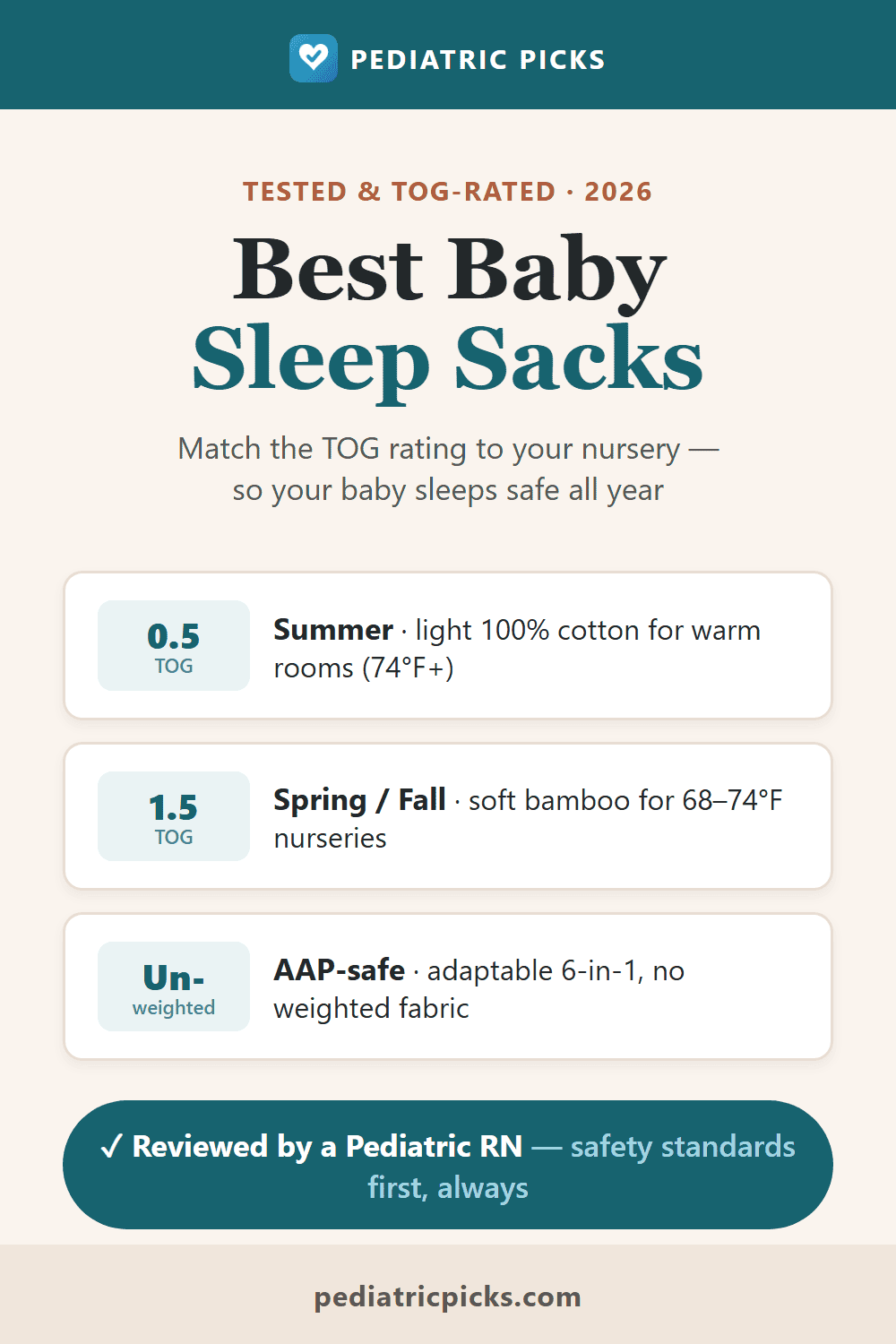
The best baby sleep sack for your infant should match the TOG rating to your nursery’s actual room temperature, fit snugly at the neck and armholes without compressing the chest, and stay firmly in the unweighted category that the AAP currently considers safe for infant sleep. We evaluated 3 top contenders against AAP safe sleep guidance, CPSC weighted-product warnings, the NHS UK TOG-to-room-temperature chart, and International Hip Dysplasia Institute shape recommendations to find sleep sacks that keep babies thermally regulated without overheating, slipping, or interfering with hip development. Three sleep sacks stood out: the Halo Sleepsack Toddler 100% Cotton TOG 0.5 at roughly $40 (our top lightweight pick for summer nurseries above 75°F), the SuperSoft Bamboo Wearable Blanket TOG 1.5 at roughly $45 (our best spring/fall pick with a hip-healthy trapezoid cut for 65–68°F rooms), and the Nested Bean Air 6-in-1 Unweighted at roughly $55 (our best arms-in option with a preferred arm position designed to reduce the startle reflex). All three are unweighted, machine-washable, and align with current AAP safe sleep guidance from HealthyChildren.org.
The sleep sack TOG rating is the load-bearing decision in any best baby sleep sack purchase — pick the wrong number and you either leave the baby cold or push toward overheating, which the CPSC has linked to sleep-related infant deaths. Use this guide alongside our weighted sleep sack safety explainer to understand exactly why the AAP recommends against weighted models, and pair the right sleep sack with our best baby white noise machine guide to round out a safe-sleep environment that holds up through both naps and overnights.
See our top pick on Amazon → $39.95
Best baby sleep sack top picks by TOG rating
The 100% cotton 0.5 TOG summer-weight sleep sack for warm nurseries above 75°F, the bamboo 1.5 TOG hip-healthy spring/fall pick for the 65–68°F sweet spot most homes actually sit at, and the unweighted arms-in 6-in-1 sleep sack with a preferred arm position designed to reduce startle-reflex wakeups without adding a single gram of weight. If your baby still startles hard but fights a full swaddle, a baby transition swaddle bridges the gap before a standard sleep sack.
Check price on Amazon $39.95
Check price on Amazon $44.95
Safety first: the AAP says NEVER use weighted sleep sacks
The American Academy of Pediatrics explicitly recommends against weighted sleep sacks, weighted swaddles, and weighted blankets for infant sleep — the added weight is associated with restricted chest expansion, lower oxygen saturation, and an elevated suffocation risk that has driven CPSC enforcement action and major-retailer product removals. Read our weighted sleep sack safety explainer for the full mechanism. Every sleep sack in this guide is unweighted by design, and that is non-negotiable.
TOG-rated unweighted sleep sacks align with AAP safe-sleep guidance when matched to room temperature: 0.5 TOG above 75°F, 1.0 TOG 69–74°F, 1.5 TOG 65–68°F, and 2.5 TOG below 65°F. Always check baby’s chest and back-of-neck for overheating — warm and dry is the target, sweaty or hot is a sign to step down a TOG or remove a layer underneath.
How we review the best baby sleep sacks
A sleep sack that fits poorly at the neck, slides up over the face, or pushes a baby into overheating is worse than no sleep sack — it converts a sleep-safety intervention into a sleep-safety risk. We evaluated three criteria for every sleep sack in this guide:
Thermal regulation at TOG-matched room temperature. Every sleep sack was evaluated against the room temperature range its TOG rating targets per the NHS UK guidance for reducing the risk of sudden infant death syndrome. We verified each manufacturer’s stated TOG rating and fabric construction against that chart and flagged any sack marketed for use outside its design-target temperature window. The best baby sleep sack should keep skin warm and dry, not warm and damp — check the back of the neck and upper chest, not the hands or feet.
Underlayer matters too: a long-sleeve cotton bodysuit under a 1.5 TOG and a short-sleeve under a 0.5 TOG is the common pairing that keeps the TOG math accurate.
Fit, neck-gap, and hip-healthy shape. Each sleep sack was assessed against the snug-neck, snug-armhole, loose-body trapezoid shape pediatric orthopedists recommend to preserve hip development. A sack with a neck opening wide enough to slip over the chin fails instantly. A sack with a narrow tube-shaped body that restricts hip-and-leg movement also fails — both extremes are documented contributors to either suffocation risk or hip dysplasia risk.
Care, wash durability, and zipper reliability. We checked each manufacturer’s care instructions and construction details — machine-washability, zipper-pull design, and fabric and stitching choices that resist the pilling or fraying that could become a loose-thread hazard. A sleep sack you replace every 3 months because the zipper failed isn’t a value proposition — it’s a recurring cost. Every pick below is machine-washable per its manufacturer’s care instructions.
Best baby sleep sack: side-by-side comparison
| Pick | Product | Key strengths | Watch-outs | Price | Where to buy |
|---|---|---|---|---|---|
| Top Lightweight (0.5 TOG) |  Halo Sleepsack Toddler 100% Cotton TOG 0.5 |
|
| $39.95 | Check price $39.95 |
| Best 1.5 TOG (Spring/Fall) |  SuperSoft Bamboo Wearable Blanket TOG 1.5 |
|
| $44.95 | Check price $44.95 |
| Best Arms-In (Unweighted) |  Nested Bean Air 6-in-1 Adaptable (Unweighted) |
|
| $54.99 | Check price |
Halo Sleepsack Toddler 100% Cotton TOG 0.5
Check price on Amazon $39.95
SuperSoft Bamboo Wearable Blanket TOG 1.5
Check price on Amazon $44.95
Nested Bean Air 6-in-1 Adaptable (Unweighted)
Halo Sleepsack Toddler 100% Cotton TOG 0.5 — full review
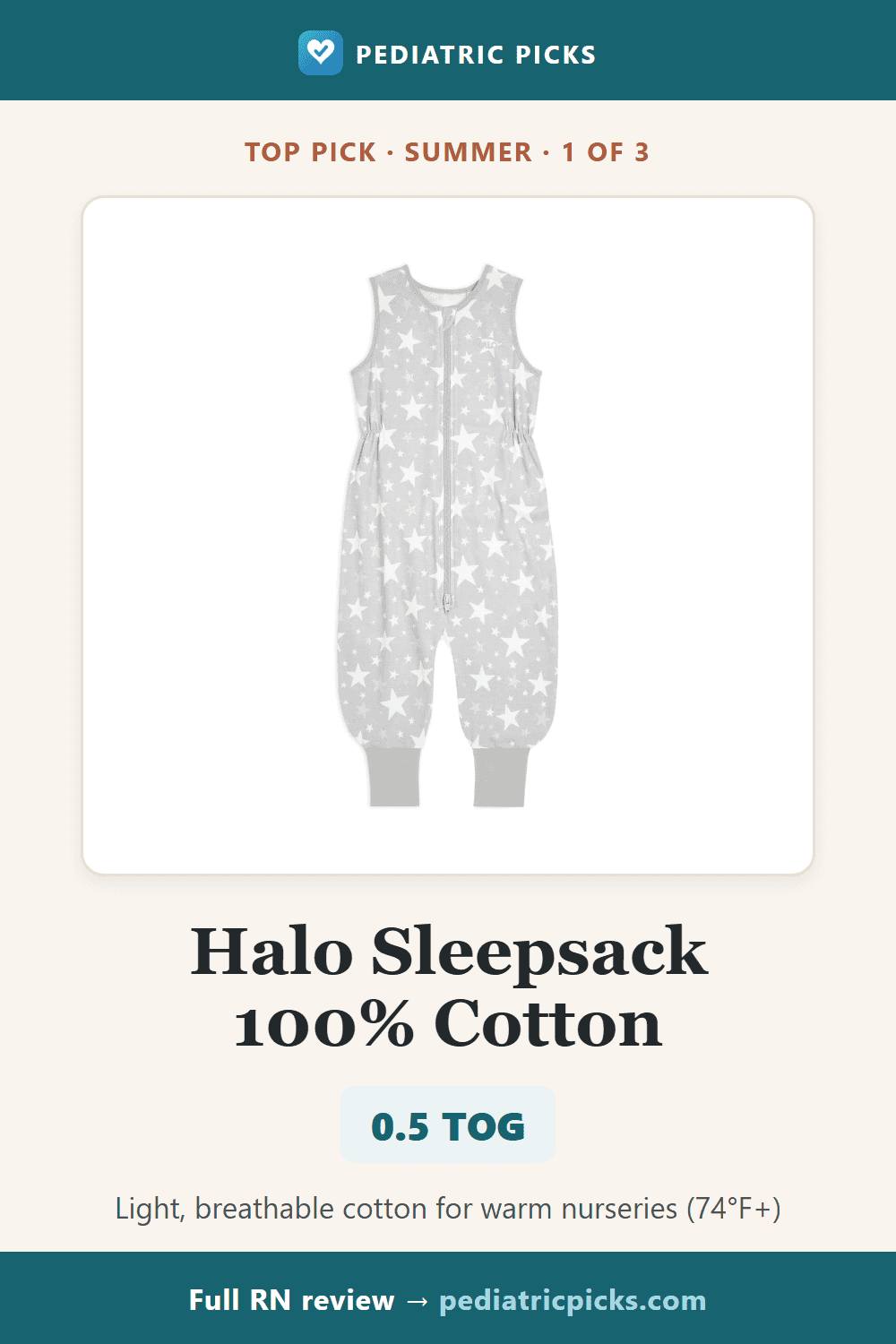
The Halo Sleepsack line is the wearable-blanket category that essentially defined the format, and the 100% cotton 0.5 TOG configuration is the right pick when your nursery sits above 75°F overnight — common in summer, in warm-climate homes, or in nurseries where the thermostat preference runs warm. The 0.5 TOG fill is genuinely lightweight: thin enough to vent body heat through the cotton weave, structured enough to retain the trapezoid shape that keeps the hip-and-leg window unrestricted, and sleeveless so the armholes act as additional heat-dump points.
In its design-target range above 75°F, the Halo Sleepsack 0.5 TOG is built to keep back-of-neck and upper-chest skin in the warm-and-dry target zone — a thin, breathable cotton weave, sleeveless venting, and a manufacturer-rated 0.5 TOG that sits exactly where the NHS chart places warm nurseries. Keeping skin warm and dry — not sweaty or clammy — is the entire job of the best baby sleep sack in summer-temperature rooms, and this configuration is purpose-built for it.
The inverted bottom-up zipper deserves specific mention as the feature that actually changes nighttime workflow. Standard top-down zippers force you to expose the upper body for a diaper change — which wakes the baby and chills the chest at the worst possible time. Bottom-up access lets you unzip from the feet, change the diaper, and re-zip without ever exposing the chest or arms, which preserves both sleep continuity and thermal regulation. The other half of the 3 a.m. workflow is having somewhere supportive to settle the baby back down — our nursery glider guide covers the chairs that hold up to nightly use.
The trade-offs are narrow. The 0.5 TOG is genuinely summer-weight, so it's the wrong choice below 75°F without layering — and layering under a sleep sack should always be a thin cotton bodysuit, never an additional blanket. This specific SKU is also toddler-sized only, so check height-and-weight against the size chart before ordering.
For families in warm climates or anyone heading into summer, this is the best baby sleep sack to anchor the warm-weather end of your TOG rotation. Pair it with the 1.5 TOG bamboo pick for the cooler months and you have year-round coverage for roughly $85 total.
Check price on Amazon → $39.95
SuperSoft Bamboo Wearable Blanket TOG 1.5 — full review
The SuperSoft Bamboo Wearable Blanket 1.5 TOG is the everyday best baby sleep sack for the 65–68°F nursery range that most US homes actually run overnight. Bamboo viscose face fabric is genuinely soft — soft enough that it doesn't leave the seam-pressure marks on newborn skin that thicker fleeces can — and the 1.5 TOG fill is the right middle weight for the spring and fall shoulder seasons where temperatures drift unpredictably.
The hip-healthy trapezoid cut is the structural feature that matters most here. Pediatric orthopedists and the International Hip Dysplasia Institute both recommend that infant sleep sacks be wide and unrestricted from hip to hem, so the legs can flex up and out into the natural M-position rather than being forced into extension. Tube-shaped or narrow sleep sacks that restrict that movement have been linked to hip dysplasia in case-series literature, and the SuperSoft's cut is explicitly designed to meet the wide-trapezoid recommendation.
At 65–68°F room temperatures — the range the NHS TOG chart assigns to 1.5 TOG — this fill weight is designed to keep chest skin warm and dry without overheating. The warm-and-dry back-of-neck check is still the verification every parent should run during the first nights in any new sack.
The two-way zipper supports both top-down and bottom-up access — useful when one parent prefers each method — and the manufacturer rates it machine-washable and dryer-safe. Light pilling can develop over time if you dry on high heat, so dry on low or hang-dry to extend the visual life of the sack.
The main limitation is the size band — this specific SKU runs 0–6 months only, which means you'll size up to a separate sack around 6 months. For the 0–6 month window, however, it's the strongest 1.5 TOG sleep sack in this guide at this price point and the one we'd hand to a friend in their second trimester.
Check price on Amazon → $44.95
Nested Bean Air 6-in-1 Adaptable — full review
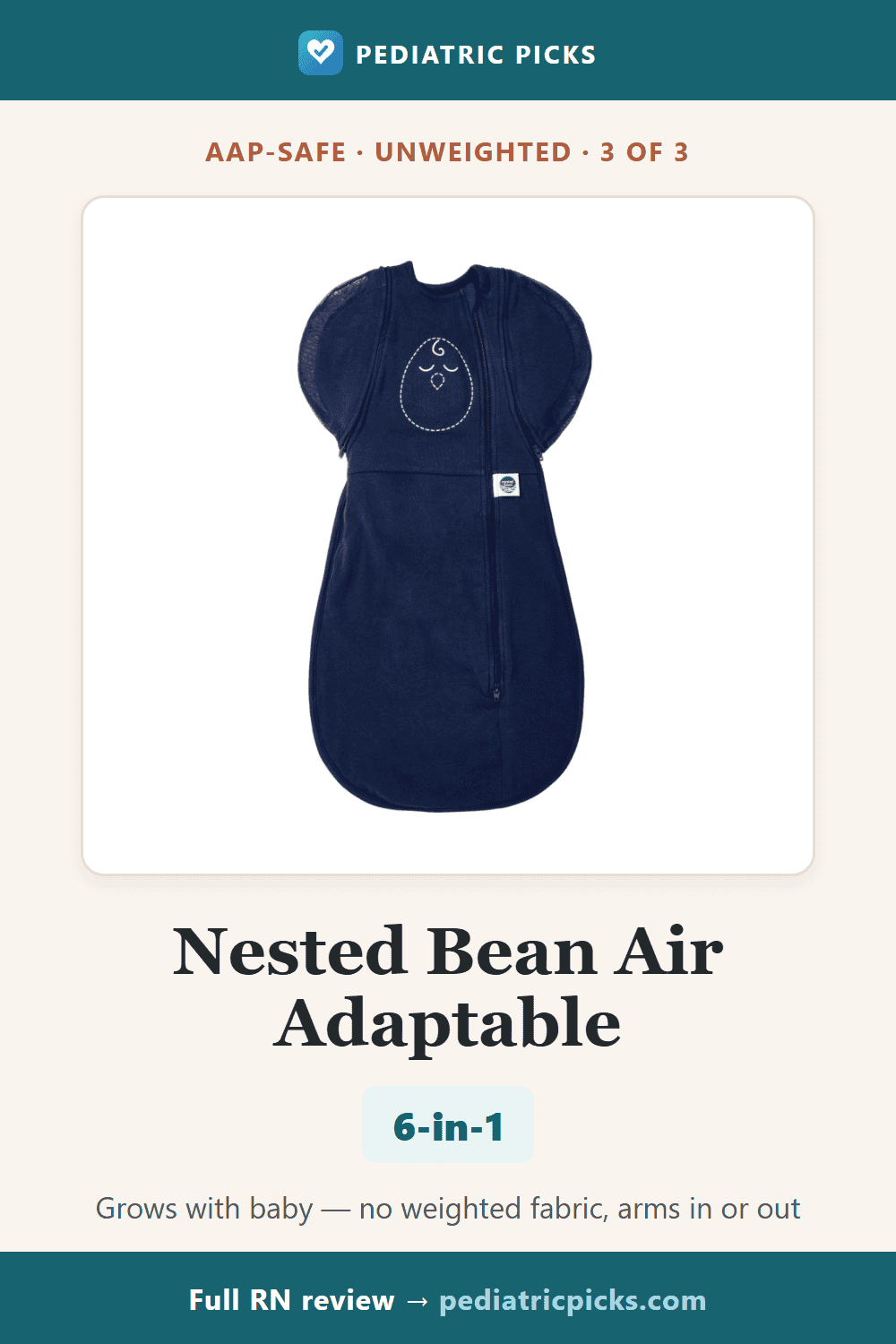
The Nested Bean Air 6-in-1 is the best baby sleep sack in this guide for parents who want an arms-in or partial-arms-in option without crossing the AAP's weighted-product line. Nested Bean is best known for its weighted-style sacks, but the Air model is explicitly unweighted — the startle-reduction mechanism here comes from the preferred arm position, which folds the arms into a flexed hands-near-face posture that many babies self-soothe with in-utero and find calming on the way to sleep.
The 6-in-1 framework matters because the swaddle-to-sleep-sack transition is one of the most disruptive sleep changes in the first 6 months. Babies who slept beautifully in a snug swaddle often regress hard when the swaddle comes off, because the Moro startle reflex returns with a vengeance. The Air's 6 configurations — full arms-in, one-arm-out, both-arms-out toddler use, and several intermediates — let you step down the arm-restriction gradually rather than going cold-turkey. When you are ready to make the change, our step-by-step guide on how to transition out of the swaddle covers timing, methods, and the rough nights in between.
Critically, the AAP guidance is that any arms-in or swaddle-style sleep product must be discontinued the moment the baby shows any rolling sign — even attempts. Once a baby can roll, arms-in restriction becomes a roll-recovery problem rather than a startle solution.
The Air's convertible design directly supports that transition timeline: when you see the first roll attempt, you switch to one-arm-out, then both-arms-out, and the sack continues to function as a regular sleep sack through the toddler years. That extended lifespan helps justify the $55 price point.
Thermal regulation runs at roughly the 1.0 TOG equivalent, which means it's the right pick for 69–74°F nurseries. The arm-position design is the headline — the preferred arm position is built to deliver the startle reduction parents look for in weighted sacks, without using weight to do it. For families who specifically want an unweighted alternative to a weighted sleep sack, this is the strongest option in this guide.
5 things to know before buying a baby sleep sack
Match TOG to your nursery's actual overnight room temperature
The single most important best baby sleep sack decision is TOG rating: 0.5 TOG above 75°F, 1.0 TOG 69–74°F, 1.5 TOG 65–68°F, 2.5 TOG below 65°F. Measure the nursery overnight with a simple room thermometer for at least 3 nights before buying — the temperature parents assume their nursery sits at is often 3–5°F off the actual reading. A sleep sack that's one TOG too heavy in a warm room pushes toward overheating, which the AAP 2022 safe sleep policy statement identifies as a sleep-related death risk factor.
Never use a weighted sleep sack — the AAP recommends against them
This is the firmest rule in this guide. The AAP, CPSC, and multiple major retailers have aligned on the position that weighted sleep sacks, weighted swaddles, and weighted blankets are not safe for infant sleep. The mechanism is restricted chest expansion and lowered oxygen saturation under added weight on a developing respiratory system. Read our full weighted sleep sack safety explainer for the underlying research. Every best baby sleep sack pick in this guide is unweighted by design.
Neck-gap and armhole-snugness are the fit checks that matter
The neck opening should be snug enough that the sack cannot slide up over the chin, and the armholes should be snug enough that the arms cannot retract inside and trap inside the body of the sack. A loose neck on a smaller-than-spec baby is the most common best baby sleep sack failure mode — size down rather than up if your baby is between sizes. Always test fit with the baby standing or held upright before the first sleep use.
Trapezoid body shape protects hip development
The body of the sleep sack should flare outward from the chest to the hem in a trapezoid shape, leaving the legs free to flex up and out into the natural M-position. Tube-shaped or narrow sleep sacks that hold the legs in extension have been linked to hip dysplasia in case-series literature. The International Hip Dysplasia Institute publishes a hip-healthy product list, and the SuperSoft Bamboo’s wide trapezoid cut follows the same hip-healthy shape principle.
Discontinue arms-in modes the moment baby shows any rolling sign
Any arms-in or swaddle-style sleep sack must transition to arms-out the moment the baby shows any rolling attempt — not after the first successful roll, but at the first sign. The Nested Bean Air's 6-in-1 convertibility supports that transition, but the parent has to make the call. Once arms are out, the sack continues to function as a standard wearable blanket through the toddler years. Pair this with our best escape-proof swaddle guide for the pre-rolling window when full swaddle is still appropriate.
Best baby sleep sack: frequently asked questions
The best baby sleep sack TOG depends on your nursery's overnight room temperature, not the outdoor weather. Use 0.5 TOG above 75°F, 1.0 TOG 69–74°F, 1.5 TOG 65–68°F, and 2.5 TOG below 65°F. Measure the actual overnight room temperature with a thermometer rather than estimating from the thermostat — nursery temperatures often run several degrees off the rest of the house. Most US homes overnight sit in the 65–72°F range, which means a 1.0 or 1.5 TOG sleep sack is the year-round workhorse for the majority of nurseries.
No. The AAP recommends against weighted sleep sacks, weighted swaddles, and weighted blankets for infant sleep, and the CPSC has taken enforcement action against weighted infant sleep products linked to suffocation risk. The underlying concern is restricted chest expansion and lowered oxygen saturation under added weight on a developing respiratory system. The best baby sleep sack is always unweighted — if you want an arms-in or startle-reducing option, choose an unweighted product like the Nested Bean Air that uses arm-position design rather than added weight. Read our weighted sleep sack safety explainer for the full mechanism.
Per AAP guidance, the swaddle must come off at the first sign of rolling — not after the first successful roll, but at the first attempt — which is often around 2–4 months. The best baby sleep sack at that transition point is one that supports a gradual arms-out progression, like the Nested Bean Air 6-in-1, rather than a cold-turkey switch.
For babies who startle hard out of the swaddle, an arms-in unweighted sack used briefly during the rolling-imminent window can ease the change, but it must transition to arms-out the moment rolling is observed. Pair this guide with our best escape-proof swaddle guide for the pre-rolling window.
The two reliable spots are the back of the neck and the upper chest — slide a finger under the sleep sack and check that the skin is warm and dry. Sweaty, clammy, or hot-to-touch skin is a sign of overheating, which means either the TOG is too heavy, the room is too warm, or the underlayer is too thick. Hands and feet running cool is normal and is not a sign of being too cold. The NHS UK TOG temperature chart is the cleanest reference for matching sleep sack weight to room temperature.
Yes — loose blankets are not safe for infant sleep, per AAP guidance, until at least 12 months of age. A wearable sleep sack provides warmth without the suffocation and entanglement risks of a loose blanket, which is why every major safe-sleep guideline now recommends sleep sacks as the preferred warmth solution for infants. The best baby sleep sack also stays in place through the night, while a loose blanket inevitably ends up over the face, kicked off entirely, or bunched at the feet — none of which is conducive to safe, consolidated sleep.
A poorly shaped sleep sack — specifically a tube-shaped or narrow-cut one that restricts hip-and-leg movement — has been associated with hip dysplasia risk in pediatric orthopedic case literature. The best baby sleep sack uses a trapezoid cut that flares outward from chest to hem, leaving the legs free to flex up and out into the natural M-position.
The International Hip Dysplasia Institute publishes a hip-healthy product list and the trapezoid shape requirement is the load-bearing feature. Both the SuperSoft Bamboo and the Halo Sleepsack picks in this guide meet that shape standard. Pair sleep sack choice with our best baby white noise machine guide to round out a complete safe-sleep environment.
Halo, Nested Bean, and SuperSoft are the top-rated brands among the sleep sacks I compared for this guide — Halo for lightweight cotton, SuperSoft for hip-healthy bamboo, and Nested Bean for its swaddle-transition design. The best infant sleep sack for your nursery comes down to TOG rating and fit rather than the brand name on the tag.
Our #1 best baby sleep sack pick: SuperSoft Bamboo Wearable Blanket TOG 1.5
The best baby sleep sack for the 65–68°F nursery range that most US homes actually run overnight, with bamboo viscose softness, an explicitly hip-healthy trapezoid cut, and unweighted construction that aligns with current AAP safe sleep guidance. Pair it with the 0.5 TOG Halo Sleepsack for summer and the Nested Bean Air for the arms-in transition window, and you have a complete year-round sleep sack rotation for under $140 total. Under the sack, the crib should hold nothing but a snug fitted sheet — our organic crib sheets guide covers GOTS-certified options.
Check price on Amazon → $44.95
Medical disclaimer: Not medical advice. Sleep sack selection, TOG matching, and swaddle-transition timing should be reviewed in consultation with your child's pediatrician, especially for premature infants, infants with thermoregulation concerns, or infants near rolling milestones. The AAP explicitly recommends against weighted sleep sacks, weighted swaddles, and weighted blankets for infant sleep. Consult HealthyChildren.org (AAP) and the CPSC safe sleep guidance for additional pediatric guidance.
Prices: Reflect typical Amazon pricing as of May 2026 and may vary. Manufacturer model numbers and TOG-rated configurations occasionally change — verify the TOG rating on the linked product page before ordering. NHS UK TOG-to-room-temperature guidance is available at nhs.uk and AAP 2022 safe sleep policy is available at publications.aap.org.
- Burnett LB. Sudden Infant Death Syndrome (SIDS). Medscape Drugs & Diseases (eMedicine); updated Mar 10, 2026. SIDS (now grouped under Sudden Unexpected Infant Death) is a leading cause of death at 1-12 months, peaking at 1-3 months; a bare, separate back-sleep surface and avoiding soft bedding and overheating are central to risk reduction.
- Moon RY, Carlin RF, Hand I; AAP Task Force on Sudden Infant Death Syndrome and Committee on Fetus and Newborn. Sleep-Related Infant Deaths: Updated 2022 Recommendations for Reducing Infant Deaths in the Sleep Environment. Pediatrics. 2022;150(1):e2022057990. Recommends a bare sleep surface free of loose blankets and soft bedding and advises avoiding overheating during infant sleep.
- Pease AS, Fleming PJ, Hauck FR, et al. Swaddling and the Risk of Sudden Infant Death Syndrome: A Meta-analysis. Pediatrics. 2016;137(6):e20153275. The SIDS risk associated with swaddling rose with infant age and was highest for the prone or side position, supporting discontinuing the swaddle at the first sign of rolling.
- Ponsonby AL, Dwyer T, Gibbons LE, Cochrane JA, Jones ME, McCall MJ. Thermal environment and sudden infant death syndrome: case-control study. BMJ. 1992;304(6822):277-282. Excess thermal insulation was independently associated with a higher risk of sudden infant death (relative risk about 1.26 per additional tog), underscoring the importance of not overheating a sleeping baby.