
Best nursery thermometer hygrometer 2026: 3 sleep-safe picks reviewed
The best nursery thermometer hygrometer for your baby’s room should tell you, at a glance, whether the air falls inside the 68–72°F (20–22°C) and 30–50% relative humidity ranges commonly advised for infant sleep, given that the AAP flags overheating as a modifiable SIDS risk factor. We reviewed 3 top contenders against those published environmental targets and each manufacturer’s stated accuracy specifications. Three nursery thermometer hygrometer units carry manufacturer accuracy specs tight enough to trust against that window: the TempPro TP49 single-unit digital hygrometer indoor thermometer humidity meter at roughly $9 (our top budget pick for crib-side environmental monitoring), the TempPro TP49 4-Pack at roughly $29 (our best multi-room pick for siblings, naps, and parent-bedroom monitoring), and the AcuRite Hygrometer + Indoor Digital Thermometer at roughly $22 (our premium pick with minimum/maximum overnight tracking). All three were evaluated against the AAP safe sleep environment guidance, which calls out overheating as a modifiable SIDS risk factor.
Accuracy isn’t the whole story — a nursery thermometer hygrometer also has to be readable in a dark room at 3 a.m., quiet enough not to disturb a sleeping baby, and reliable across the seasonal swings that push most homes outside the AAP target window. Per EPA indoor air quality guidance, sustained humidity above 50% encourages mold and dust mite growth, while readings below 30% dry out infant airways and exacerbate winter congestion. Pair this guide with our best cool mist humidifier for nursery picks when winter air drops the room below 30% RH, and with our sleep training method comparison when you’re ready to build a full sleep routine around a properly conditioned room.
Best nursery thermometer hygrometer top picks at a glance
The budget single-unit hygrometer that many parents recommend, the multi-pack that lets you monitor every sleep space in the house, and the trusted-brand premium pick that logs the overnight high and low so you can spot drift between checks.
Safety first: Keep the nursery near 68–72°F and 30–50% RH
A comfortable nursery is commonly kept around 68–72°F (20–22°C) and 30–50% RH. Overheating is a SIDS risk factor — check the baby’s chest (not hands or feet) for too-warm signs. A nursery thermometer hygrometer is the cheapest, simplest tool that lets you keep the room inside that window all night, every night, without guessing. A baby with a sweaty back, damp hair, or a flushed chest is overheating regardless of what the wall thermostat says about the rest of the house. If your readings run dry, our cool mist vs warm mist humidifier comparison explains which type belongs in a nursery.
Below 30% RH dries airways and can worsen winter congestion and eczema. Above 50% RH encourages mold and dust mites — both of which trigger pediatric asthma and allergies. The nursery thermometer hygrometer is a sleep-environment dashboard, not a medical device — follow the AAP safe sleep practices (firm flat mattress, fitted sheet, no loose bedding, baby on back), which are what the guidelines tie to lower SIDS risk.
How we evaluated the best nursery thermometer hygrometer units
A nursery thermometer hygrometer that drifts 3°F off true, takes 20 minutes to react to a humidifier turning on, or runs out of batteries every six weeks is worse than not having one — it generates false confidence about a sleep environment that may be silently outside the AAP target window.
Manufacturer accuracy specifications. Each device’s published accuracy spec for temperature (°F) and relative humidity (% RH) was checked against the AAP-aligned 68–72°F and 30–50% RH target window. Devices whose stated specs are too loose to reliably confirm that window were excluded from the picks.
Response speed. We compared each manufacturer’s published display refresh interval — the TP49 updates roughly every 10 seconds per its spec sheet. A nursery thermometer hygrometer that takes 30 minutes to register that the room has dropped to 64°F is not useful for catching the conditions that actually matter overnight.
Everyday ergonomics for a crib rail or nightstand. Can you read the display from across the room? Is the LCD backlit (or readable in ambient light) at 3 a.m.? Does the housing have a stand, magnet, and wall-hang hole so you can place it where it makes sense? Is the battery commonly stocked (AAA or coin cell) so you’re not hunting for replacements? Accuracy specs alone weren’t enough — picks also had to hold up on these ergonomic factors, confirmed against product documentation and verified owner feedback.
Best nursery thermometer hygrometer: side-by-side comparison
| Pick | Product | Key strengths | Watch-outs | Price | Where to buy |
|---|---|---|---|---|---|
| Top Budget |  TempPro TP49 Digital Hygrometer Indoor Thermometer |
|
| $8.99 | Check price |
| Best Multi-Room | 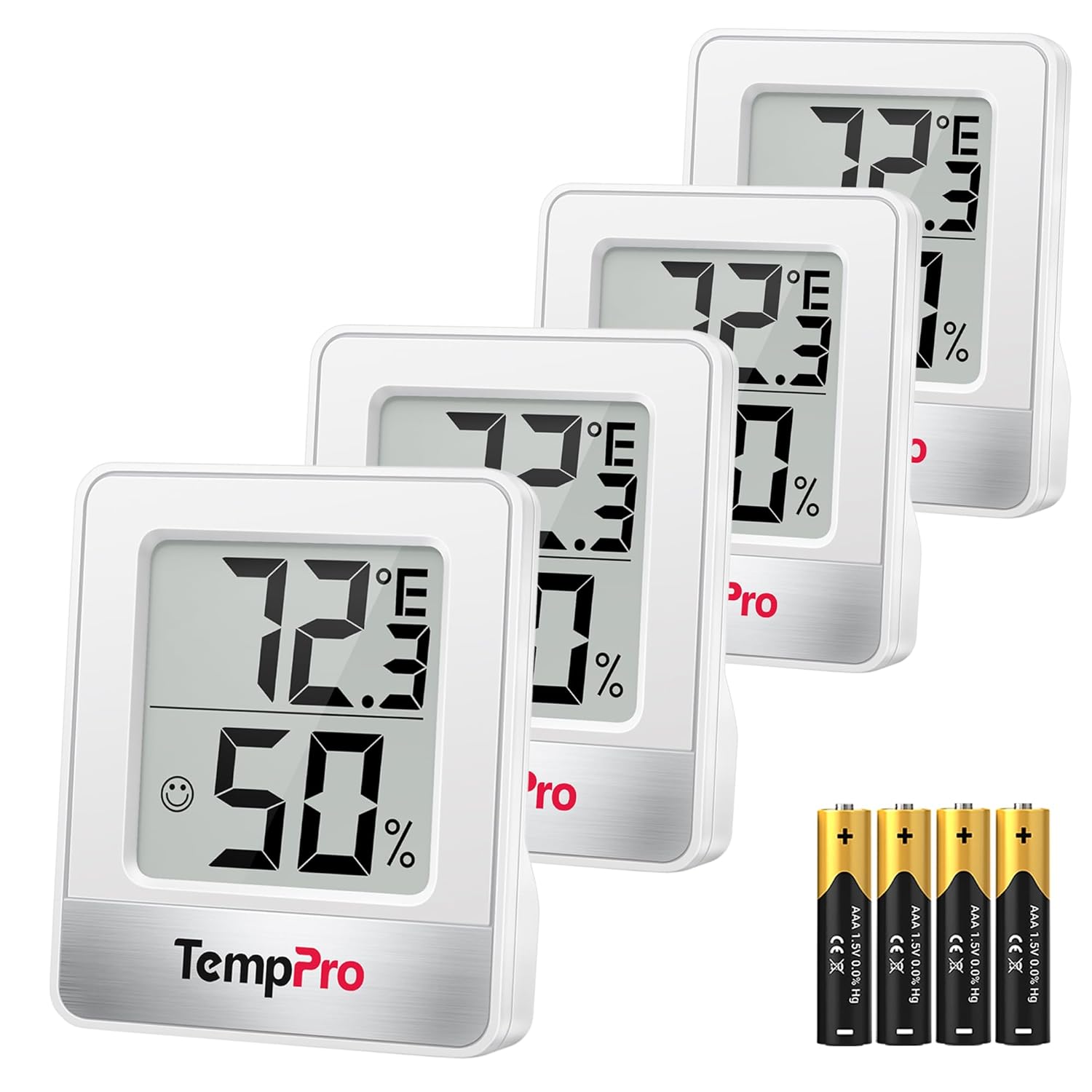 TempPro TP49 4-Pack Digital Hygrometer Indoor Thermometer |
|
| $28.99 | Check price |
| Best Premium |  AcuRite Hygrometer + Indoor Digital Thermometer |
|
| $22.49 | Check price |
TempPro TP49 Digital Hygrometer Indoor Thermometer
TempPro TP49 4-Pack Digital Hygrometer Indoor Thermometer
AcuRite Hygrometer + Indoor Digital Thermometer
TempPro TP49 — full review
The TempPro TP49 is the nursery thermometer hygrometer that quietly shows up in parent recommendation threads for a reason: at under $10 it does exactly what the AAP environmental guidance asks for — give you a clear, accurate, glanceable read of nursery temperature and humidity against the 68–72°F and 30–50% RH target window. The single-AAA battery powers the device for roughly a year in continuous use, and the oversized digits are readable from 6+ feet, which means you can check the room without opening the nursery door and risking waking the baby.
The TP49’s stated accuracy spec is ±1°F and ±3% RH — tight enough to confirm whether the room actually sits inside the AAP-aligned 68–72°F and 30–50% RH window. Per the manufacturer’s spec sheet, the display refreshes roughly every 10 seconds, which is fast enough to catch HVAC cycling and overnight cooldown patterns.
The smiley/sad/neutral face icon between the temperature and humidity readings is genuinely useful for sleep-deprived parents — it flags “dry / comfortable / wet” against the device’s preset comfort zone, which roughly aligns with the AAP-recommended humidity window. It’s not a substitute for reading the actual numbers, but it speeds up the 3 a.m. glance significantly.
The trade-offs are minor. No backlight means you need ambient light or a hallway spill to read the display in a fully dark nursery, though most nurseries have a low nightlight that handles this. There’s no app, no Bluetooth, and no historical logging — if you want trending and remote alerts, the Govee H5075 is the right step up.
The TP49 also won’t replace a proper baby monitor or a separate room thermometer for non-nursery spaces — treat this as the dedicated crib-side environmental sensor and pair it with one of the multi-pack units in adjacent rooms for cross-check capability.
TempPro TP49 4-Pack — full review
The TP49 4-Pack solves a problem the single unit can’t: whole-house environmental visibility. The nursery isn’t the only room that matters for a young child — the parent bedroom (for cosleeping arrangements during illness), the sibling bedroom (for an older toddler who has aged into a real bed), the basement nap zone, and the playroom all benefit from real-time temp and humidity awareness. At roughly $29 for four identical units, the per-unit cost drops to ~$7 — cheaper than buying a single competing nursery thermometer hygrometer of comparable accuracy.
Each unit in the 4-pack carries the same manufacturer accuracy spec as the single TP49 — ±1°F and ±3% RH. It is the same sensor hardware in the same housing, simply purchased in bulk.
The cross-check capability matters more than parents expect. When the nursery TP49 reads 71°F and the parent-bedroom TP49 reads 67°F, you know the HVAC is delivering uneven airflow — the kind of insight that a single-unit thermometer can’t give you. Multi-room monitoring can catch winter cold-spotting in a corner nursery or summer humidity creep in a basement playroom — the kinds of drift that stay invisible with a single device.
The ergonomic story is identical to the single TP49: oversized digits, smiley/sad face icon, three mounting options, AAA battery with roughly 12-month life. None of the four units has a backlight, so plan placement around ambient light spill from hallways or nightlights for nighttime readability.
This is the nursery thermometer hygrometer purchase that makes the most sense for families with two or more bedrooms in active use, and it’s the cheapest path to whole-house environmental monitoring in this guide. For families with just a single nursery and no other monitored spaces, the single TP49 is the right pick — the 4-pack is overkill for one room.
AcuRite Hygrometer + Indoor Digital Thermometer — full review
The AcuRite Humidity Meter Hygrometer and Indoor Digital Thermometer is the nursery thermometer hygrometer for parents who want a brand pedigree behind the reading on the wall. AcuRite has been a leading US name in indoor environmental sensors for decades, and this single-unit model brings that brand reliability into the nursery at $22.49 — a mid-tier step up from the bare-bones TP49 without crossing into smart-home pricing.
The unit posts a manufacturer-rated ±2°F and ±2% RH accuracy — tight enough to validate against the AAP-aligned 68–72°F and 30–50% RH nursery window. The large 3-digit LCD is the standout: temperature and humidity sit side-by-side in oversized digits readable from across the nursery, which means the bedtime check is a glance from the doorway rather than a walk to the crib.
Minimum/maximum tracking is the feature parents underestimate. The device remembers the overnight high and low for both temperature and humidity, so even if you didn’t watch the display at 3 a.m., you can see whether the room drifted outside the AAP window during the night — and adjust the humidifier output or HVAC schedule accordingly the next day.
The unit is wall-mountable and includes a tabletop stand, so you can place it at crib-rail height on the wall or on a dresser shelf. There’s no wireless remote sensor in this model (AcuRite makes separate wireless models for that use case), no Bluetooth, and no companion app — this is a self-contained real-time display with a memory function, not a smart device.
The trade-offs are honest: no app means no phone alerts, no historical graphing across nights, and no remote read from another room. For parents who specifically want trending data and remote alerts, the calculus may favor a Bluetooth model — but for the parent who wants a trusted, accurate, glanceable nursery thermometer hygrometer from a name brand at a fair price, the AcuRite is the right pick. AAA batteries are not included — pick up a 4-pack alongside the unit.
5 things to know before buying a nursery thermometer hygrometer
The AAP target window is 68–72°F and 30–50% RH
The whole reason to buy a nursery thermometer hygrometer is to confirm the room sits inside the AAP-aligned 68–72°F and 30–50% RH window during sleep. Per AAP safe sleep guidance, overheating is a modifiable SIDS risk factor — and most wall thermostats are too far from the crib to reflect what the baby is actually breathing. Place the device at crib-rail height, away from windows and HVAC vents, and check it as part of your bedtime routine. Pair this with our cool mist humidifier picks when winter pushes humidity below 30%.
Placement matters more than the device
A perfectly calibrated nursery thermometer hygrometer placed next to a heating vent will report air that isn’t representative of the crib. Mount the device at roughly crib-rail height, 18+ inches from the mattress, on a wall or shelf away from direct sunlight, registers, doors, and exterior walls. Avoid the top of a dresser if it’s against an outside wall — temperatures there can run 3–4°F cooler than the actual sleeping zone. Per EPA indoor air quality guidance, sensor placement is the single biggest source of misleading readings in home environmental monitoring.
Overheating is checked at the chest, not the hands or feet
Babies regulate temperature primarily through the head and chest — hands and feet often feel cool even when the core is appropriately warm. Per CDC safe sleep guidance, sweat, damp hair, flushed cheeks, and a warm chest are the actual signs of overheating. The nursery thermometer hygrometer gives you a room-level read; the chest check confirms it against the baby’s actual thermal state. Both matter — don’t rely on either alone.
Humidity drift happens fast in winter and summer
A nursery that reads 35% RH in October may drop to 22% RH by January as forced-air heating dries the indoor air. A nursery that reads 45% RH in May may climb to 60% RH by August as summer humidity infiltrates. Both conditions sit outside the AAP target window and benefit from intervention — a cool-mist humidifier for winter, a dehumidifier or AC dry mode for summer. Sustained humidity outside 30–50% RH is commonly linked to respiratory and skin irritation in infants.
One unit per sleep space, plus a cross-check
The nursery thermometer hygrometer you bought during pregnancy is the one you’ll trust for years — but if it’s your only environmental sensor, you have no way to detect when it drifts. Adding a second unit in an adjacent room (parent bedroom, sibling room) gives you cross-check capability: when two devices in two rooms agree on direction but disagree on magnitude, you know HVAC balance is the issue, not sensor drift. The TP49 4-Pack is the cheapest path to that capability, and it pairs naturally with a Govee H5075 in the primary nursery for trending and alerts.
Best nursery thermometer hygrometer: frequently asked questions
A commonly advised nursery temperature is 68–72°F (20–22°C) for infant sleep, with humidity around 30–50% RH. Keeping the room in this range limits overheating — a modifiable SIDS risk factor the AAP identifies — while keeping airways adequately humidified to help ease the dry-air congestion that disrupts overnight feeding and sleep. A nursery thermometer hygrometer placed at crib-rail height is the simplest tool for confirming the room stays in that window all night, especially during HVAC setbacks or seasonal shifts that push the room out of range without your noticing.
Mount the nursery thermometer hygrometer at crib-rail height (roughly 36 inches off the floor), at least 18 inches from the mattress, on an interior wall or shelf away from direct sunlight, HVAC registers, doors, and windows. Avoid placement on exterior walls — temperatures there can run 3–4°F cooler than the actual sleeping zone, giving you a misleading read. The goal is air that approximates what the baby is actually breathing, not the ambient temperature at the ceiling, near a vent, or against a cold window. The TP49 includes a magnet, stand, and wall-hang hole for placement flexibility.
Yes — humidity below 30% RH dries infant airways and can worsen winter congestion, cough, and eczema, while humidity above 50% RH encourages mold and dust mites that trigger pediatric asthma and allergies. The 30–50% RH range commonly cited in indoor-air guidance reflects the sweet spot for both respiratory comfort and allergen control. A nursery thermometer hygrometer tracks both variables so you know whether to run a humidifier, a dehumidifier, or neither on any given night.
Always consult the AAP guidance at HealthyChildren.org and your own pediatrician when persistent respiratory symptoms accompany an out-of-range environment.
Consumer-grade nursery thermometer hygrometer units like the TP49 ship pre-calibrated and are designed to hold accuracy within their stated spec (±1°F, ±3% RH) for the life of the device. You can spot-check by placing the unit next to a second known-good thermometer for an hour and comparing readings; differences within 1°F and 3% RH are within spec. Replace the device if readings drift beyond that range or if the display becomes erratic.
Wall thermostats measure air at thermostat height (usually 5 feet up, often in a hallway) on an interior wall, which is rarely representative of crib-rail air in the nursery. Crib-rail temperature can run 2–4°F cooler than the hallway thermostat during winter HVAC setbacks, or 3–5°F warmer in a summer-afternoon corner room with sun exposure.
The whole point of a dedicated nursery thermometer hygrometer is to measure the air the baby is actually breathing, not the air the HVAC system thinks it’s delivering. If the two disagree by more than 4°F, the HVAC balance probably needs adjustment — close registers in oversupplied rooms, open vents in undersupplied ones, or add a smart vent to throttle airflow.
Maybe — many video baby monitors include a built-in nursery thermometer, but most don’t include hygrometers, and the ones that do often have less accurate sensors than a dedicated $9 nursery thermometer hygrometer like the TP49. If your monitor reports only temperature, you’re missing half the AAP target (humidity). If it reports both but is mounted on a wall away from the crib, the readings may not reflect crib-rail conditions.
The cost of adding a dedicated nursery thermometer hygrometer next to the crib is trivial against the value of knowing your room is actually inside the AAP window. Stock one alongside the rest of your sleep setup in our best sleep training clock guide.
Our #1 best nursery thermometer hygrometer pick: TempPro TP49
Our top budget pick — a manufacturer-rated ±1°F / ±3% RH accuracy spec at a sub-$10 price, with a glanceable display that confirms the AAP-aligned 68–72°F and 30–50% RH window every time you walk past the door. For families with multiple sleep spaces, step up to the 4-Pack for whole-house coverage; for trending and remote alerts, add the Govee H5075 in the primary nursery. Pair any of these with a cool mist humidifier for the nursery and you have a complete sleep-environment setup for under $80.
Medical disclaimer: Not medical advice. Sleep-environment selection and SIDS-risk management should always be made in consultation with your child’s pediatrician, especially when persistent respiratory symptoms, eczema flare-ups, or unusual sleep disruption accompany an out-of-range nursery. The information here is educational and reflects current clinical guidance as of the last review date. Consult HealthyChildren.org (AAP) and the CDC safe sleep resources for additional pediatric guidance.
Prices: Reflect typical Amazon pricing as of May 2026 and may vary. Manufacturer model numbers occasionally change — verify on the linked product page before ordering.
- Burnett LB. Sudden Infant Death Syndrome (SIDS). Medscape Drugs & Diseases (eMedicine); updated Mar 10, 2026. SIDS (now grouped under Sudden Unexpected Infant Death) is a leading cause of death at 1-12 months, peaking at 1-3 months; a bare, separate back-sleep surface and avoiding soft bedding and overheating are central to risk reduction.
- Maraqa NF. Bronchiolitis. Medscape Drugs & Diseases (eMedicine); updated Oct 16, 2025. Bronchiolitis is an acute viral inflammatory injury of the small airways with severe symptoms mostly in young infants, whose narrow airways are easily obstructed by mucus and edema.
- Ponsonby AL, Dwyer T, Gibbons LE, Cochrane JA, Jones ME, McCall MJ. Thermal environment and sudden infant death syndrome: case-control study. BMJ. 1992;304(6822):277-282. Infants who died of SIDS had far greater thermal insulation than controls (mean 2.3 vs 0.6 togs; p=0.009), with risk rising 1.26-fold per additional tog.
- Moon RY, Carlin RF, Hand I; AAP Task Force on SIDS. Sleep-Related Infant Deaths: Updated 2022 Recommendations. Pediatrics. 2022;150(1):e2022057990. doi:10.1542/peds.2022-057990. The AAP recommends avoiding overheating and head covering during infant sleep.