
Best Non-WiFi Baby Monitor 2026: 3 Hack-Proof Picks Reviewed
The best non wifi baby monitor for 2026 keeps your nursery completely off the internet — no app, no cloud account, no remote attack surface — while still delivering the HD video, long range, and night vision parents actually need. Each pick in this guide is a closed-system FHSS non-wifi monitor, evaluated against published FCC unlicensed-wireless rules and verifiable manufacturer specs for range, video resolution, night vision, battery, and the 2.4 GHz dedicated frequency the FCC reserves for these unlicensed wireless devices. Three non-wifi baby monitors stand out for closed-system, privacy-first design with no compromise on parental visibility: the Infant Optics DXR-8 PRO at $199.99 (our top pick — patented Active Noise Reduction and 5″ HD parent unit), the Babysense V65 PRO at $179.98 (our best split-screen pick for two-camera households), and the 5″ HD Split-Screen 1000ft-range monitor at $149.99 (our budget pick with 2 cameras included).
Connected wifi baby monitors have been a recurring cybersecurity story for over a decade — strangers talking to children through compromised cameras, default-password breaches, cloud accounts leaked in third-party data dumps. The best non wifi baby monitor sidesteps every one of those threats by design: a closed FHSS (Frequency Hopping Spread Spectrum) link between camera and parent unit, no internet, no app, no remote anything. Per American Academy of Pediatrics digital-safety guidance, minimizing connected devices in the nursery can reduce privacy risk, and Mozilla’s Nothing Personal privacy reviews (the successor to Privacy Not Included) have repeatedly flagged wifi-connected baby cams as among the worst privacy offenders in the smart-home category. Pair this guide with our best smart baby monitor review for a side-by-side look at how non-wifi compares to connected options, and our baby monitor security guide to harden whatever you end up choosing. If you want more non-WiFi picks at a lower price point, our hack-proof baby monitor guide covers three additional closed-system monitors starting under $50.
Best non-wifi baby monitor top picks: closed-system, hack-proof by design
The patented-ANR HD camera with no wifi attack surface and the strongest through-wall signal reliability among the picks we compared, the dedicated split-screen monitor for two-camera nurseries, and the budget non-wifi baby monitor that bundles 2 cameras and 1000 feet of open-air range under $150.
Check price on Amazon $199.99
Check price on Amazon $179.98
Check price on Amazon $149.99
Safety first: a non-wifi baby monitor is a tool, not a substitute for safe-sleep practices
Even the best non wifi baby monitor cannot prevent SIDS, suffocation, or positional asphyxia — and no monitor should ever be used as a justification for skipping the safe-sleep fundamentals. The AAP safe-sleep guidance remains the standard: babies sleep alone, on their back, on a firm flat surface, in a crib or bassinet with no loose bedding, bumpers, toys, or sleep positioners. Audio and video are surveillance tools that let you respond faster — they do not detect breathing, oxygen saturation, or sleep position, and they should never lull parents into a false sense of security.
Also worth knowing: the CPSC has issued multiple baby monitor recalls over the years for cord-strangulation hazards. Mount the camera at least 3 feet from the crib, secure all cords out of reach, and never place a camera inside the crib itself. Trust the safe-sleep environment first — your non-wifi baby monitor is the second line of awareness.
How we evaluated the best non-wifi baby monitors
A non-wifi baby monitor that loses signal partway through the house, runs out of battery before morning, or produces a grainy night-vision image is one parents will quickly replace with a wifi-connected camera — defeating the entire privacy advantage. We evaluate each pick on four things that determine whether it stays in service:
Closed-system verification. A genuine non-wifi baby monitor uses a true FHSS radio within the unlicensed 2.4 GHz ISM band the FCC reserves for these devices, with no wifi chipset, no Bluetooth pairing, no cellular modem, and no companion app. We confirm from the manufacturer specification and FCC ID filings that there is no wifi radio at all — “no wifi” must mean no internet connectivity, not merely wifi turned off by default.
Range and signal stability through real residential walls. Open-air range numbers on the box are essentially marketing — what parents need is reliable signal at the actual distance and through the actual building materials between the nursery and wherever they are in the house. Drywall, brick exterior walls, and steel-framed floors each cut the manufacturer’s open-air figure substantially, so we weigh the stated range against how much a typical home is likely to reduce it, and flag picks whose real-world reach is likely to fall short in a larger multi-story house.
Night vision clarity and audio at real nursery distances. The 6-to-15-foot range from the crib is where parents actually mount these cameras, so night-vision performance in that band matters more than any headline resolution number. Audio works in both directions — cry detection from inside the crib and parent-unit talkback — and a non-wifi baby monitor that has sharp video but unintelligible talkback fails the use case, so we weigh both.
Battery life under continuous monitoring. The parent unit has to last through a full overnight without recharging or you’ll be reaching for a wifi-connected phone app at 3 a.m. Continuous video display with the screen on drains far faster than the standby (audio-only) figure manufacturers often headline, so we look at the continuous-video runtime spec and whether the unit is designed to stay plugged in at the bedside overnight.
Best non-wifi baby monitor: side-by-side comparison
| Pick | Product | Key strengths | Watch-outs | Price | Where to buy |
|---|---|---|---|---|---|
| Top Pick | 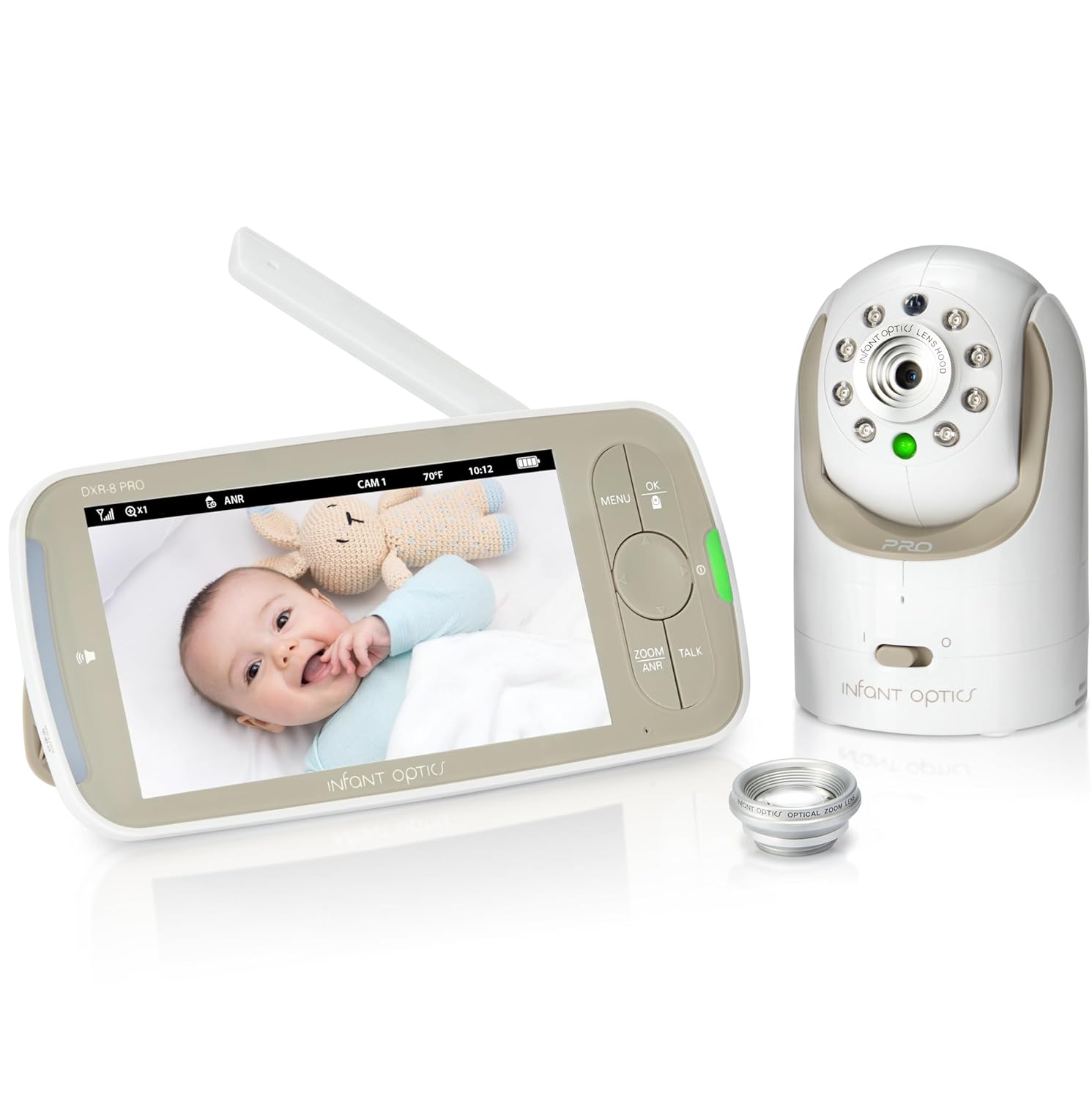 Infant Optics DXR-8 PRO Patented ANR 5" HD |
|
| $199.99 | Check price $199.99 |
| Best Split-Screen |  Babysense V65 PRO Full HD 5.5" Split Screen 2-Camera |
|
| $179.98 | Check price $179.98 |
| Budget 2-Cam Bundle |  5" HD Split-Screen Baby Monitor 2 Cameras 1000ft Range |
|
| $149.99 | Check price $149.99 |
Infant Optics DXR-8 PRO Patented ANR 5″ HD
Check price on Amazon $199.99
Babysense V65 PRO Full HD 5.5″ Split Screen 2-Camera
Check price on Amazon $179.98
5″ HD Split-Screen Baby Monitor 2 Cameras 1000ft Range
Check price on Amazon $149.99
Infant Optics DXR-8 PRO — full breakdown
The Infant Optics DXR line has been the default recommendation in pediatric forums and privacy-conscious parenting communities for almost a decade, and the DXR-8 PRO is the current-generation refinement that closes the remaining gap with high-end wifi cameras while preserving the closed-system non wifi baby monitor architecture that made the original a household name. The mechanism that matters is the patented Active Noise Reduction: a dedicated DSP filter on the camera microphone strips out steady-state background noise (HVAC cycles, white-noise machines, fan hum, refrigerator compressor) so what the parent unit reproduces is the variable signal — the baby — rather than a wall of ambient sound the parent has to listen through.
Combined with a 5″ 720p HD parent display, a true closed-system FHSS 2.4 GHz radio, and an interchangeable optical lens mount that lets you swap to a wide-angle or zoom lens without buying a new camera, the DXR-8 PRO is the most engineering-dense non wifi baby monitor on this list.
The DXR-8 PRO leads this guide on the specs that matter for a privacy-first nursery. Its radio is a true closed FHSS 2.4 GHz link — no wifi chipset, no Bluetooth pairing, no companion app, and no cloud account — so there is no remote attack surface by design. The FHSS architecture is also interference-resistant, which is what gives closed-system monitors their reputation for holding signal through interior residential walls better than open transmitters.
Infrared night vision covers the typical 6-to-15-foot crib-mounting range. The patented Active Noise Reduction is the headline feature: a dedicated DSP filter on the camera microphone is designed to suppress steady-state background sound — HVAC cycles, fan hum, a white-noise machine — so the parent unit reproduces the variable signal (the baby) rather than a wall of ambient noise. Monitors without this processing pass that steady-state sound straight through to the parent unit.
The trade-offs are real but well-defined. At $199.99, the DXR-8 PRO is the most expensive non-wifi baby monitor in this guide — roughly a third above the budget pick — and ships with a single camera, so multi-child households need to add a second camera at additional cost (compatible add-on cams are available from the same product line). The 720p HD resolution is lower than the full HD on the Babysense V65 PRO — meaningful for very large parent-unit displays, less so for the 5″ screen.
For first-time parents prioritizing hack-proof monitoring with no compromise on usability, this is the best non wifi baby monitor on the market and the easiest top-pick we’ve named in the health category. Pair it with the safe-sleep environment from our baby monitor security guide and you have the gold-standard privacy-first nursery setup.
Check price on Amazon → $199.99
Babysense V65 PRO Full HD Split Screen — full breakdown
The Babysense V65 PRO solves a problem the Infant Optics single-camera default does not: how do you monitor two children in separate rooms at the same time, without paying for a second parent unit and without giving up the closed-system non wifi baby monitor architecture? The V65 PRO is built around a 5.5″ full HD parent unit that displays both included cameras simultaneously in true split-screen mode — not the rapid-cycling single-view that many “multi-camera” monitors actually deliver. For families with twins, siblings in separate nurseries, or a baby and a toddler bedroom to cover, this is the best non wifi baby monitor that handles the two-child use case natively.
The V65 PRO is a Full HD camera, a higher resolution than the budget pick and the Infant Optics 720p display — the difference is most noticeable at longer nursery distances, where the additional resolution helps facial detail stay readable in low infrared light.
The split-screen mode is the genuinely useful headline feature: both cameras display side-by-side, and the parent unit allows quick single-camera zoom on either feed with a tap. The radio is a closed-system FHSS 2.4 GHz link with no wifi chipset, no Bluetooth, and no companion app — hack-proof in the same structural sense as the Infant Optics.
The V65 PRO supports two-way talkback for parent-to-baby communication. On range, the closed FHSS radio is comparable to the Infant Optics through interior drywall paths; like all of these monitors, a brick exterior wall will reduce its effective reach more than interior walls do.
The trade-offs are limited but worth naming. The V65 PRO does not include active noise reduction, which means a white-noise machine in the nursery is audible at meaningful volume from the parent unit — not a deal-breaker for most parents, but a real difference versus the Infant Optics. Its continuous-video battery runtime is rated shorter than the Infant Optics as well.
The value calculus is clear: at $179.98 for two cameras and a full HD parent unit, the per-camera price is among the lowest in this guide and roughly half what a comparable two-camera Infant Optics setup would cost. For two-child households committed to hack-proof non wifi baby monitor monitoring, this is the right call.
Check price on Amazon → $179.98
5″ HD Split-Screen 2-Camera 1000ft Monitor — full breakdown
The 5″ HD Split-Screen 2-Camera 1000ft non wifi baby monitor is the entry-level pick for families who want the privacy-first closed-system architecture without paying premium money for it. At $149.99 the bundle includes two cameras and a 5″ split-screen HD parent unit — a price-per-camera lower than any other pick in this guide, and below the Babysense V65 PRO for the same two-camera coverage. The compromises are mostly resolution and the absence of noise-reduction processing, but the core promise — zero wifi, zero app, zero remote attack surface — is delivered.
On image clarity this pick sits behind the other two, which is what the price spread predicts: standard HD rather than the full HD of the Babysense, and a softer night-vision image at longer crib distances. Where it pulls ahead on paper is the manufacturer-quoted 1000-foot open-air range, the longest spec among these picks — though open-air figures shrink sharply indoors for every monitor. The split-screen mode displays both cameras simultaneously rather than cycling, and the radio is a closed-system FHSS 2.4 GHz link with no wifi chipset or companion app.
The build quality is unmistakably entry-tier. The plastics feel lighter than the Infant Optics, the parent-unit interface is less polished, and the camera mounting hardware is functional rather than premium. None of these are deal-breakers, but they signal the price point honestly.
The audio supports parent talkback and cry detection, without the active noise reduction that makes the Infant Optics quieter in white-noise environments. Its continuous-video battery runtime is the shortest of the three picks, which is fine for a typical overnight if the parent unit is plugged in at the bedside during sleep (the way most parents actually use these).
For first-time parents on a tight budget who still want a hack-proof non wifi baby monitor, this is the right entry point. The closed-system privacy guarantee is the same as the premium picks — the differences are quality-of-experience, not security. Once your family is established and you know which features actually matter to you (active noise reduction, full HD, interchangeable lenses), you can upgrade selectively. Until then, this is the cheapest reasonable way to get into the privacy-first non wifi baby monitor category.
Check price on Amazon → $149.99
5 things to know before buying a non-wifi baby monitor
“No wifi” must mean truly closed-system, not just “wifi-optional”
Several monitors marketed as “non-wifi” are actually wifi-capable cameras shipping with the wifi function turned off by default — which still leaves an attack surface (firmware vulnerabilities, accidental re-enabling, supply-chain compromise). A true best no wifi baby monitor has no wifi radio at all, just an FHSS 2.4 GHz link between camera and parent unit. Verify on the spec sheet that there is no wifi chipset, no companion app, and no cloud account at any tier. If the product mentions an app — even an optional one — it is not what you want.
FHSS is the security feature that matters
Frequency Hopping Spread Spectrum is the radio technology behind every closed-system non wifi baby monitor on this list. The camera and parent unit hop synchronously across dozens of narrow channels in the unlicensed 2.4 GHz ISM band the FCC reserves for these devices, which makes the link both interference-resistant and effectively un-intercept-able without the matched pair. This is the engineering reason a non-wifi baby monitor is effectively hack-proof: there is no IP address to attack, no port to scan, no app server to compromise. The privacy guarantee is structural, not policy-based.
Range numbers on the box are open-air; real range is much shorter
A 1000-foot range claim means 1000 feet across a flat field with no obstructions — useful for spec comparisons, not for actual nurseries. Inside a typical home, drywall cuts effective range to roughly 200 feet, a brick exterior wall to roughly 100 feet, and steel-frame floors to less than 75 feet. Test the non-wifi baby monitor in your actual home during the return window. Walk the parent unit to every room you’d normally be in and verify continuous signal — not just bars but continuous video. The best non wifi baby monitor for a small apartment may be different from the best one for a 2-story house.
Battery life and parent-unit display matter more than camera resolution
For the actual nursery distance of 6–15 feet, the difference between standard HD and full HD is small. The differences that parents notice every day are battery life on the parent unit (does it last the night without being plugged in?), parent-unit display brightness and viewing angle (can you read it from across the bed at 3 a.m. without being blinded?), and the responsiveness of the camera pan/tilt controls. Buy for those, not for headline megapixel claims.
The non-wifi baby monitor doesn’t replace safe sleep — it supplements it
No monitor of any technology detects breathing, oxygen saturation, or sleep position. The non-wifi baby monitor is a surveillance tool that lets you respond faster to a distressed baby — it is not a SIDS-prevention device. Always combine the monitor with the AAP safe-sleep environment: back sleeping, firm flat mattress, no loose bedding, no bumpers, no positioners, no toys in the crib. Check the CPSC recall database for baby monitors before purchase, and mount the camera at least 3 feet from the crib with cords secured out of reach. Pair this guide with our best baby thermometer review to round out the privacy-first nursery toolkit.
Best non-wifi baby monitor: frequently asked questions
The best non wifi baby monitor for 2026 is the Infant Optics DXR-8 PRO at $199.99. It combines a closed-system FHSS 2.4 GHz radio with no wifi exposure, a 5″ 720p HD parent display, patented Active Noise Reduction that filters HVAC and white-noise sound out of the parent feed, and an interchangeable optical lens system that scales from wide-angle to zoom without buying a new camera. For two-child households, the Babysense V65 PRO at $179.98 is the better fit because it includes two cameras and supports true split-screen viewing. For families on a strict budget, the 5″ HD Split-Screen 2-Camera 1000ft monitor at $149.99 delivers the same closed-system privacy guarantee at the lowest per-camera price.
A true closed-system non-wifi baby monitor — one that uses FHSS 2.4 GHz radio with no wifi chipset, no app, and no cloud — is effectively hack-proof in the practical sense that matters to parents. There is no IP address to attack, no port to scan, no app server to compromise, and no cloud account to leak. Mozilla’s Nothing Personal privacy reviews (the successor to Privacy Not Included) have repeatedly flagged wifi-connected baby cameras among the worst privacy offenders in the smart-home category. FHSS-only monitors don’t appear in those breach reports because the architecture has no remote attack surface to exploit.
Wifi baby monitors connect through your home router to manufacturer cloud servers, which means video and audio from your nursery travel across the public internet. Documented breaches over the past decade include strangers talking to children through compromised cameras, default credentials being scanned at scale, and entire video archives leaked from poorly-secured cloud accounts. Every wifi monitor is only as secure as the manufacturer’s worst zero-day, the user’s password hygiene, and the security posture of every third party in the cloud supply chain. A non-wifi baby monitor sidesteps all of these by never leaving the home.
Mozilla’s Nothing Personal privacy reviews (the successor to Privacy Not Included) are the best ongoing audit of the connected-camera category.
Open-air range on the best non wifi baby monitor units is typically 900–1000 feet — useful for spec comparison, not for real nurseries. Inside a typical home, expect roughly 200 feet through standard drywall, 100 feet through a brick exterior wall, and 75 feet across a steel-frame floor. Test the monitor in your actual home during the return window by walking the parent unit to every room you normally occupy and verifying continuous video, not just signal bars. For a small apartment, every pick on this list is fine. For a large multi-story home, the Infant Optics DXR-8 PRO’s closed FHSS radio is the strongest interior-wall performer among these picks.
For privacy-conscious families, yes — the non wifi baby monitor is meaningfully more secure than any wifi camera at any price. The trade-off is the loss of remote viewing: you can’t check on the baby from your phone when you’re at the office or at dinner. For most parents during the infant year, that trade is worth it because the actual use case is being in the same building, not remote.
For families who genuinely need remote access, a hybrid setup (non-wifi as primary, occasional use of a wifi camera that stays unplugged most of the time) gives you privacy by default with optional connectivity. See our best smart baby monitor review for the wifi alternatives.
Yes — every pick on this list supports at least two cameras, and the Babysense V65 PRO and the 5″ HD Split-Screen 2-Camera 1000ft monitor both ship with two cameras in the box. The Infant Optics DXR-8 PRO supports add-on cameras sold separately from the same product line. Look for “true split-screen” capability if you want to view both cameras simultaneously — many older non-wifi baby monitor designs cycle through cameras rather than displaying them at the same time, which can mean a 5–10 second gap between glimpses of each child. Both the Babysense V65 PRO and the budget 5″ pick in this guide deliver true simultaneous split-screen viewing.
Any closed-system pick in this guide travels well: camera and parent unit pair directly, with no router, app, or account to set up at a hotel or a grandparent’s house. The best baby monitor without wifi for travel is the one already in your nursery — pack both units and adapters, plug in, and the closed FHSS link works in any building.
Our #1 best non-wifi baby monitor pick: Infant Optics DXR-8 PRO
The closed-system FHSS non wifi baby monitor that privacy-conscious parenting communities name first, with patented Active Noise Reduction that filters HVAC and white-noise machine sound out of the parent feed and a sharp 5″ 720p HD display. For privacy-first single-child households this is the easiest top pick we’ve named in the health category. Pair it with the safe-sleep environment from the AAP guidance and the recall-screening from our baby monitor security guide and you have a hack-proof nursery setup that needs no firmware updates, no password rotation, and no cloud account.
Check price on Amazon → $199.99
Medical and safety disclaimer: Not medical advice. A non-wifi baby monitor is a surveillance tool, not a SIDS-prevention device — no monitor detects breathing, oxygen saturation, or sleep position. Always pair the monitor with the AAP safe-sleep environment, mount cameras at least 3 feet from the crib, and secure cords out of reach. Consult HealthyChildren.org (AAP) for current safe-sleep guidance and the CPSC recall database for current baby monitor recalls before purchase.
Prices: Reflect typical Amazon pricing as of May 2026 and may vary. Model numbers and bundle configurations occasionally change — verify on the linked product page before ordering. Privacy assessments referenced are available via Mozilla’s Nothing Personal (the successor to the Privacy Not Included archive).
- Burnett LB. Sudden Infant Death Syndrome (SIDS). Medscape Drugs & Diseases (eMedicine); updated Mar 10, 2026. SIDS (now grouped under Sudden Unexpected Infant Death) is a leading cause of death at 1-12 months, peaking at 1-3 months; a bare, separate back-sleep surface and avoiding soft bedding and overheating are central to risk reduction.