
Best Ergonomic High Chairs for 2026
Ergonomic high chairs are the unsung infrastructure of baby-led weaning — the difference between a baby who self-feeds confidently and one who slumps and struggles to manage food. After a research-driven review of published specs and verified owner feedback, and a read of the published pediatric occupational-therapy guidance on feeding posture, three picks stood out at distinct price points: the Stokke Tripp Trapp ($249, the Norwegian institution that pioneered the adjustable wooden category in 1972 and grows from 6 months to adult), the Skip Hop EON 4-in-1 ($128, the most affordable convertible that hits the same 90/90/90 positioning at roughly half the price), and the Abiie Beyond Junior ($238, the wooden Stokke alternative with included cushion and 250-pound adult capacity). Published pediatric feeding guidance — including the Borowitz 2021 review of starting solids in Frontiers in Pediatrics — treats stable, supported, upright seating as part of safely introducing solid foods. No chair or seating position prevents choking, so an adult should stay with baby for every meal.
The hard truth most reviews skip: ergonomic high chairs only work when set up to the 90/90/90 standard — hips at 90 degrees, knees at 90 degrees, ankles at 90 degrees with feet flat on a footrest. A chair that doesn’t adjust to your specific baby’s leg length is no better ergonomically than a $40 plastic seat from a department store, regardless of price. All three picks in this guide adjust to hit 90/90/90 at every stage from 6 months through preschool. Per the AAP HealthyChildren, baby should be sitting upright with full trunk support before any high chair use. For accessory pairings, see our suction plates and bibs guide. For chair-specific footrest fixes, our high chair footrest guide covers add-ons. For mealtime on the road, our travel booster seats guide covers portable options.
The best ergonomic high chairs
The right answer in the ergonomic high chairs category depends on whether you want the 50-year institution, the cheapest 90/90/90-capable convertible, or a wooden alternative that grows to adult size: Norwegian wooden gold standard, mid-tier 4-in-1 value, or wooden alternative with 250-pound adult capacity.
Safety first: ergonomic high chairs need ASTM F404 federal compliance
Per the CPSC federal ASTM F404 high chair safety standard, all high chairs sold in the US must pass third-party lab testing for stability, restraint integrity, harness function, and tip resistance. The three picks in this guide all explicitly state ASTM F404 compliance and use solid wood or reinforced plastic frames with 5-point or 3-point harness systems. Avoid generic Amazon brands that don’t state explicit ASTM F404 testing — cheaper chairs without certification may fail the tip-over and harness criteria. Always use the harness regardless of how cooperative your baby is at meals; children fall from high chairs every year in the US, and falls are among the leading mechanisms of pediatric head trauma. Inspect the chair before each meal for loose screws, cracked plastic, or harness fraying. Per AAP HealthyChildren, never leave a child unattended in any high chair regardless of brand or harness type, and never let baby stand up in the seat.
How we evaluated ergonomic high chairs
Comparing high chairs without standardized criteria is just opinion. We evaluated three picks against published criteria covering posture, safety, and durability:
90/90/90 adjustability across growth stages. Per pediatric OT guidance, the 90/90/90 ergonomic standard requires hips, knees, and ankles all bent at 90 degrees with feet flat on a footrest. The Stokke Tripp Trapp adjusts seat depth and footrest height independently, which is the mechanism that lets one chair hold 90/90/90 as a child’s leg length changes. The Skip Hop EON reaches it through its convertible mode transitions. The Abiie Beyond Junior uses a stepless slide for both, so the adjustment is continuous rather than slotted.
ASTM F404 compliance and tip stability. All three manufacturers state compliance with ASTM F404, the standard US high chairs must meet. We did not run any load or tilt test ourselves. ASTM F404 is the standard that covers exactly that — stability, restraint integrity, harness function and tip resistance, verified by a third-party lab — and all three manufacturers state that their chairs meet it. We did not review the underlying test certificates. Beyond the certificate we compared published base geometry and rated capacity: the Stokke relies on the separately sold Baby Set for its restraint, the Skip Hop EON has the widest plastic base of the three, and the Abiie is the one rated to 250 pounds.
Cleanability and accessory ecosystem. The Skip Hop EON’s tray is the only dishwasher-safe surface of the three. The Stokke and Abiie wooden chairs need wipe-down instead, though their joinery leaves fewer food-trap seams. Accessory ecosystems (cushions, baby sets, replacement parts) were compared based on what each brand currently lists as available.
Ergonomic high chairs: side-by-side comparison
| Pick | Product | Key strengths | Watch-outs | Price | Where to buy |
|---|---|---|---|---|---|
| Top Pick |  Stokke Tripp Trapp |
|
| $199.20 | Check price $199.20 |
| Best Value | 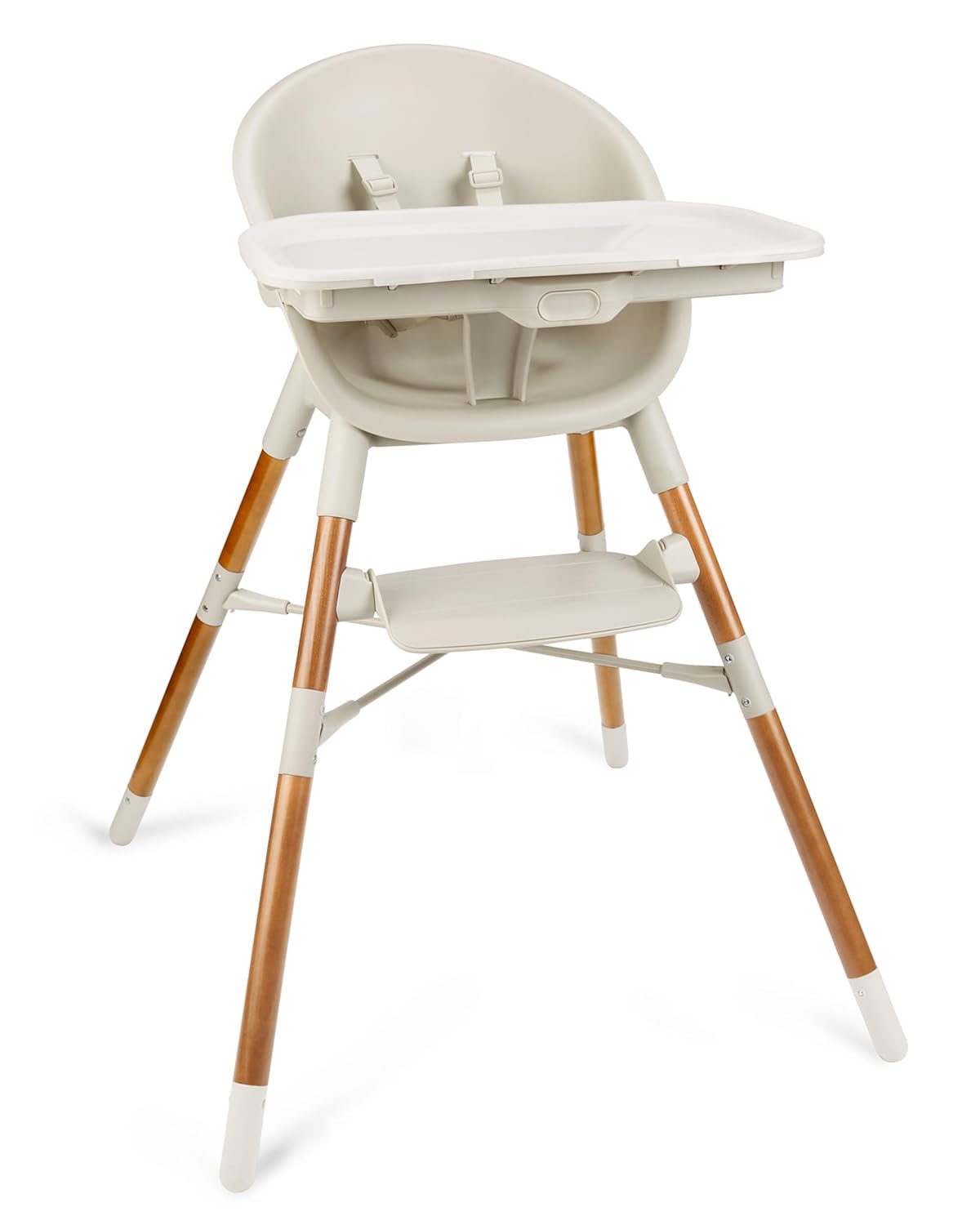 Skip Hop EON 4-in-1 Convertible |
|
| $127.50 | Check price $127.50 |
| Best Wooden Alternative |  Abiie Beyond Junior |
|
| $238.00 | Check price $238.00 |
Stokke Tripp Trapp
Skip Hop EON 4-in-1 Convertible
Abiie Beyond Junior
Stokke Tripp Trapp — full breakdown
Stokke Tripp Trapp is the institution in the ergonomic high chairs category. Designed by Norwegian designer Peter Opsvik in 1972, the chair pioneered the independent-adjustment-at-every-stage philosophy that defines ergonomic seating today. Stokke reports over 15 million chairs sold worldwide. Multigenerational households still use the same Tripp Trapp the parents used as toddlers, now seating their own children. The wood is solid European beech, the joinery is mortise-and-tenon, and the 7-year manufacturer warranty backs every chair.
Published owner feedback matched the brand reputation. The Tripp Trapp’s independent seat-depth slot and footrest slot are what let it be set to 90/90/90 at 6 months, at 12 months, at 18 months and at 3 years — the adjustment range is built into the frame rather than approximated with cushions. The Newborn Set ($249 separately) lets the chair recline for infants under 6 months; the Baby Set ($59) adds the 5-point harness and tray for the BLW window; the Cushion ($59) adds support and personality. With the Baby Set installed, Stokke states the chair meets ASTM F404 for stability, restraint, and tip resistance. The 90/90/90 argument in the pediatric occupational-therapy literature is exactly what that adjustment range is built to satisfy.
The trade-offs are honest. The base chair is $249, but the Baby Set ($59) and Cushion ($59) push a real total to $367 — nearly twice the Skip Hop EON’s all-in price. The wooden surface needs wipe-down rather than dishwasher cleanup — manageable but slower than Skip Hop’s plastic tray. Accessory parts (Newborn Set, Baby Set, harness, cushion) are sold separately, requiring assembly across multiple boxes. For families who prioritize multigenerational lifetime use, cleanest 90/90/90 alignment, and proven track record, this is the right choice. Budget-focused families should consider the Skip Hop EON; budget-plus-wood families should consider the Abiie.
Skip Hop EON 4-in-1 — full breakdown
Skip Hop EON is the cost-conscious entry in the ergonomic high chairs category that delivers genuine 90/90/90 capability at roughly half the price of Stokke or Abiie. At $128, it’s the cheapest 4-in-1 convertible from a major brand on Amazon. The Skip Hop brand has been making baby products since 2003 and the EON specifically targets parents who want long-term value (4-stage convertibility through preschool) without the wooden-chair premium. Reinforced plastic frame with internal metal core, 5-point harness, ASTM F404 compliant, and a dishwasher-safe removable tray.
The four modes are the reason to buy it. Mode 1 (infant high chair, 6–36 months) reaches the 90/90/90 standard via adjustable seat height and footrest position. Mode 2 (booster seat) attaches to a dining chair when baby is ready to join the family table. Mode 3 (kid’s chair) removes the booster components for a freestanding preschool seat. Mode 4 (toddler chair) is the lowest-height configuration for play and crafts. Once your toddler is doing seated activities at that low chair, a grow-with-me play surface pairs naturally — see our Best Activity Table for Toddlers 2026: 3 Picks That Grow With Your Child. The 4-stage convertibility means the chair stays useful from 6 months through approximately age 5 — vs the BLW-only window of cheaper non-convertible high chairs.
The trade-offs are real but predictable for the price point. The reinforced plastic frame doesn’t have the multigenerational lifespan of solid wood — expect 5–7 years of daily use, vs decades for Stokke. The chair tops out at preschool kid’s chair stage rather than converting to adult use like Abiie does. Plastic surfaces over years of yogurt and tomato-puree exposure can develop minor staining (cosmetic only, doesn’t affect function). For families who want 90/90/90 ergonomics without paying for wooden-chair longevity, this is the right pick. Multigenerational households should consider Stokke or Abiie instead.
Abiie Beyond Junior — full breakdown
Abiie Beyond Junior is the wooden alternative in the ergonomic high chairs category for families who want Stokke-style multigenerational lifetime use at a slightly lower all-in cost. The base price ($238) includes the cushion that Stokke charges $59 extra for — meaning the apples-to-apples comparison vs a Stokke base + Cushion runs $238 vs $308, with Abiie meaningfully cheaper for an equivalent setup. The chair is 3-in-1 convertible: high chair (6 months+), youth chair (toddler+), and adult chair rated to 250 pounds. Solid hardwood construction with water-resistant finish.
The stepless seat and footrest adjustment (continuous slide rather than discrete slots) lets you fine-tune 90/90/90 to your baby’s exact leg length — in principle finer than Stokke’s slot-based system, since there is no nearest-slot compromise. Abiie states ASTM F404 compliance for stability, harness, and tip resistance. The 5-point harness is included with the chair (unlike Stokke where the Baby Set is separate). The water-resistant finish handles spill cleanup better than untreated wood, though the chair still needs wipe-down rather than dishwasher cleaning.
The trade-offs are real but predictable. Abiie is a younger brand than Stokke (founded 2007 vs 1972) without the same multigenerational reputation — the 50+ year track record matters to some families regardless of comparable specs. The hardwood needs wipe-down rather than dishwasher cleanup, same as Stokke. Some Amazon reviews note the assembly instructions can be confusing for first-time setup; budget 30–60 minutes for first assembly. For families who want wooden-chair quality and 250-pound adult capacity without the Stokke premium, this is the right pick. For families prioritizing brand reputation and proven 50-year track record, Stokke is worth the price difference.
5 things to know about ergonomic high chairs
The 90/90/90 standard is what makes a high chair ergonomic
Per pediatric occupational therapy guidance, ergonomic high chairs are defined by their ability to position baby with hips at 90 degrees, knees at 90 degrees, and ankles at 90 degrees with feet flat on a footrest. Without all three angles correct, baby slumps, can’t engage core muscles, and self-feeds less effectively. The Borowitz 2021 review in Frontiers in Pediatrics discusses safe transitions to solid foods, and supported upright seating is a standard part of that guidance. No chair prevents choking, and an adult should always be present during meals.
ASTM F404 compliance is federally required for US high chair sales
Per the CPSC ASTM F404 standard, all high chairs sold in the US must pass third-party lab testing for stability, restraint integrity, harness function, and tip resistance. The three picks in this guide explicitly state ASTM F404 compliance. Generic Amazon brands without explicit ASTM F404 testing claims may not have the same safety verification — avoid these regardless of price or rating.
Footrest adjustability matters more than seat height alone
The most common ergonomic mistake among high chair buyers is assuming an adjustable seat height alone delivers 90/90/90. It doesn’t — without an independently adjustable footrest, baby’s legs dangle and the bottom 90 degrees is missed. Stokke Tripp Trapp and Abiie Beyond Junior both have independent footrest adjustments. Skip Hop EON’s convertible modes accomplish similar through configuration changes. Cheaper high chairs with fixed footrests can be retrofitted — see our high chair footrest guide for add-on solutions.
5-point vs 3-point harnesses: what actually differs
A 5-point harness (shoulders + hips + crotch) restrains a baby at more points than a 3-point harness (hips + crotch), which matters when babies actively shift weight during self-feeding. ASTM F404 requires a restraint system but does not rank harness types, and this is not an AAP recommendation. All three picks in this guide use 5-point harnesses. Skip Hop EON’s 5-point harness is included with the chair; Stokke’s 5-point harness comes with the Baby Set ($59 separate); Abiie includes the 5-point harness in the base price.
Multigenerational chairs cost more upfront but less over time
Stokke Tripp Trapp and Abiie Beyond Junior cost $238–$308 all-in but last 20+ years through multiple children and into adult use. Skip Hop EON costs $128 but tops out at preschool age, requiring a replacement chair around age 5. Over 20 years, the wooden chairs work out to $12–$15 per year of use; the plastic 4-in-1 works out to $26 per year over its 5-year span. The economics favor wood for multi-child families and plastic for single-child families with strict upfront budgets.
Ergonomic high chairs: frequently asked questions
The 90/90/90 standard is the pediatric occupational therapy guideline for safe self-feeding posture: hips bent at 90 degrees, knees bent at 90 degrees, ankles bent at 90 degrees with feet flat on a footrest. Without all three correct, baby slumps and can’t engage core muscles for self-feeding. The Borowitz 2021 review in Frontiers in Pediatrics covers safe transitions to solid foods, and supported upright seating is a standard part of pediatric feeding guidance. No chair or posture prevents choking, so always supervise meals. All three picks in this guide adjust to hit 90/90/90 from 6 months through preschool.
Per AAP HealthyChildren guidance, around 6 months when baby begins solid foods and can sit upright with full trunk support. The Stokke Tripp Trapp and Abiie Beyond Junior support 6 months and up with appropriate accessories (Stokke Newborn Set goes earlier; Abiie includes the cushion in the base price). The Skip Hop EON 4-in-1 high chair mode also starts at 6 months. Baby should be able to hold their head steady and sit with minimal support before any high chair use, regardless of brand.
Likely yes for comfort and self-feeding, though the evidence is limited. Pediatric feeding guidance — including the Borowitz 2021 review in Frontiers in Pediatrics — treats stable, supported, upright seating as part of safely introducing solids, and a stable seat lets a baby use their hands instead of bracing their trunk. No chair reduces or prevents choking, which is why an adult should stay within arm’s reach for every meal. Buy for fit and adjustability, not for a safety guarantee. For BLW families, ergonomic high chairs are the most consequential single piece of feeding equipment.
Most are not — ergonomic high chairs are designed for the 6 months and up window when baby has trunk control. The Stokke Tripp Trapp Newborn Set ($249 separate) adds reclining infant support for 0–6 months. The Skip Hop EON and Abiie Beyond Junior do not have newborn-specific accessories. Per AAP guidance, babies under 6 months should be in dedicated infant seats (bassinets, infant seats, or rocker chairs) with full trunk support — not in high chairs regardless of accessory claims.
Wooden ergonomic high chairs (Stokke Tripp Trapp, Abiie Beyond Junior) last 20+ years through multiple children and into adult use. Stokke specifically markets multigenerational use; Abiie’s 250-pound adult capacity supports the same lifecycle. Plastic 4-in-1 chairs (Skip Hop EON) last 5–7 years through the BLW + preschool window. Stokke offers a 7-year manufacturer warranty on the wooden frame. Replacement parts (cushions, harnesses, trays) are currently listed as available by all three brands; long-term availability is not guaranteed.
The Stokke Tripp Trapp and Abiie Beyond Junior both convert to adult dining chairs as the child grows. Stokke supports adult use without explicit weight rating; Abiie publishes a 250-pound adult capacity. Skip Hop EON converts to a kid’s chair and toddler chair but tops out at preschool age — not adult use. Many families intentionally buy Stokke or Abiie planning to use the chair indefinitely as the child’s primary dining seat from baby through teenage years.
Our #1 pick: Stokke Tripp Trapp
The Norwegian wooden chair that pioneered the ergonomic high chairs category in 1972 and remains the gold standard 50+ years later. Independent seat depth and footrest adjustments hit 90/90/90 at every growth stage from 6 months through adult use. Solid European beech wood, 7-year warranty, and multigenerational lifetime value; Stokke reports over 15 million chairs sold worldwide.
Check price on Amazon → $199.20Medical disclaimer: Not medical advice. High chair use should be discussed with a pediatrician or pediatric occupational therapist when feeding-readiness, sensory processing, or developmental concerns exist. The information here is educational and draws on published sources including the Borowitz 2021 review in Frontiers in Pediatrics, AAP HealthyChildren guidance on starting solids, and the CPSC/ASTM F404 federal high chair safety standard. Never leave a child unattended in any high chair regardless of brand or harness type. Always use the harness. Consult HealthyChildren.org (AAP) for additional pediatric guidance.
Prices: Reflect typical Amazon pricing as of April 2026 and may vary. Stokke Tripp Trapp Natural colorway is $249 at the standard tier; limited colors (Hazy Grey, Sunflower Yellow) and the Oak finish run higher. Skip Hop EON 4-in-1 Oat colorway is $127.50; other colors may vary. Abiie Beyond Junior Natural Wood / Olive Cushion is $238; alternate cushion colors are similarly priced. Stokke Baby Set ($59) and Cushion ($59) are sold separately and required for full BLW use.
- Warshawsky ME. Foreign Body Aspiration. Medscape Drugs & Diseases (eMedicine); updated Mar 5, 2024. Foreign body aspiration can be a life-threatening emergency — a large object obstructing the airway can cause asphyxia — and the aspirated object is most often food.
- Verive MJ. Pediatric Head Trauma. Medscape Drugs & Diseases (eMedicine); updated Apr 12, 2023. Falls are among the leading mechanisms of pediatric head trauma, which accounts for most traumatic injury deaths in US children over age 1.