
Best wipe warmers for winter diaper changes (2026)
Cold wipes on warm skin cause an instant startle reflex — and for newborns in the middle of the night, that shock can mean 30 minutes of crying before everyone settles back to sleep. The best wipe warmers solve this by keeping wipes at body temperature, making diaper changes calmer, faster, and less disruptive. We reviewed the top wipe warmers for heat consistency, moisture retention, nightlight quality, and long-term reliability to find the best baby wipe warmer for your nursery — and which ones are actually worth the counter space.
Our top 3 wipe warmers ranked
Short on time? These are the best wipe warmers we reviewed for keeping babies calm during winter diaper changes.
Do you actually need a wipe warmer?
Short answer: no — a wipe warmer is a comfort upgrade, not a safety essential. Your baby will be perfectly healthy with room-temperature wipes, and the American Academy of Pediatrics doesn’t consider warmed wipes a necessity. But after years as a critical-care nurse — and plenty of my own 3 a.m. changes — I think a handful of families get real value from one:
If you decide it’s worth the counter space, the three we reviewed and ranked are at the top of this guide. Still unsure? A warmer is inexpensive and easy to return, so it’s a low-risk thing to try for your first few winter weeks.
Why trust Pediatric Picks?
We verified all three picks have no open recalls on the CPSC recall database.
Whether wipes turn brown, dry out, or develop mold are the three most common wipe-warmer complaints, so we checked each pick’s seal design and manufacturer care guidance against those specific failure points.
Best wipe warmers: side-by-side comparison
| Pick | Product | Key strengths | Watch-outs | Price | Where to buy |
|---|---|---|---|---|---|
| Top Pick | 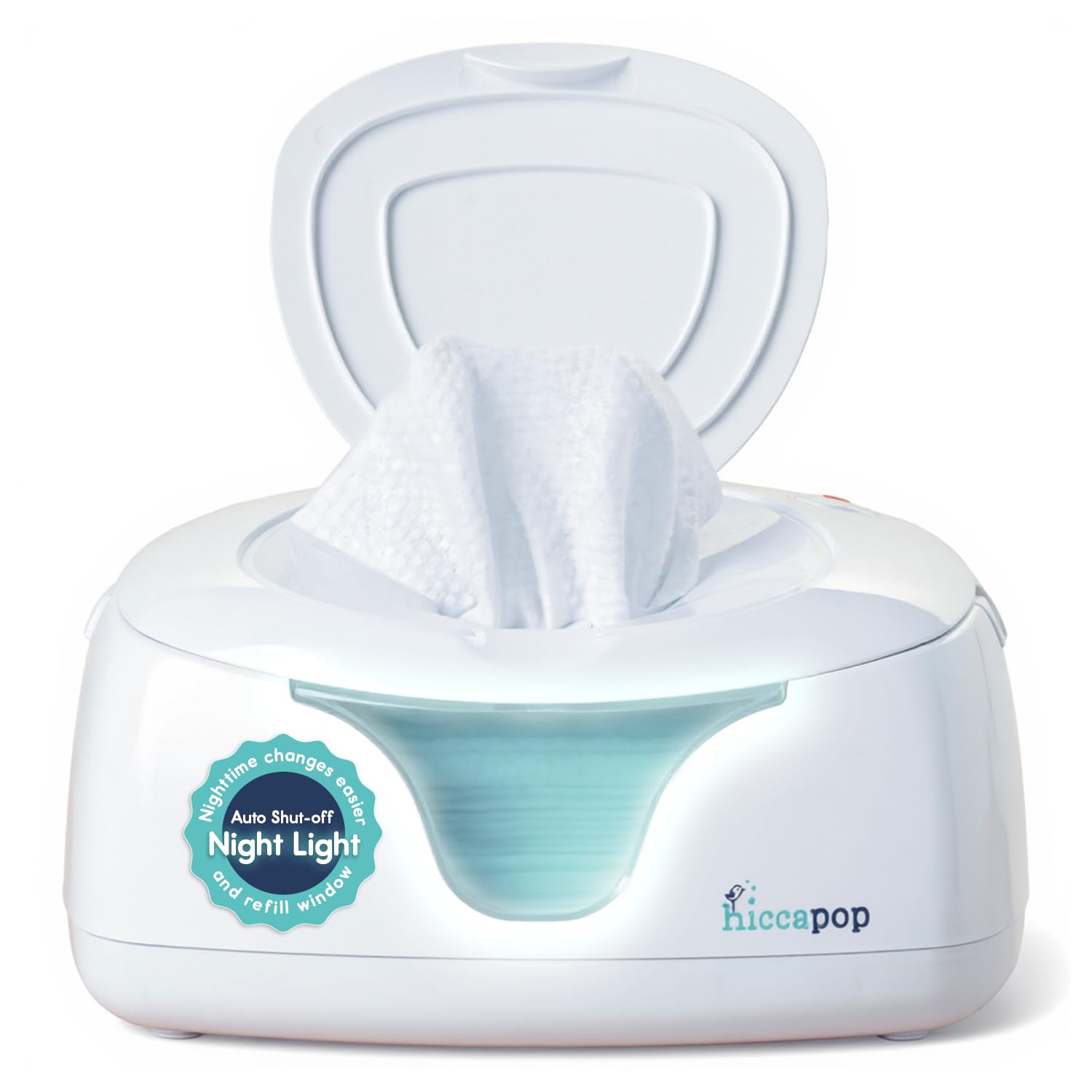 hiccapop Wipe Warmer |
|
| $34.99 | Check price $34.99 |
| Best Portable |  hiccapop Portable Wipe Warmer |
|
| $54.99 | Check price $54.99 |
| Budget Pick |  Munchkin Warm Glow |
|
| $29.97 | Check price $29.97 |
hiccapop Wipe Warmer
hiccapop Portable Wipe Warmer
Munchkin Warm Glow
hiccapop Wipe Warmer review — our full breakdown
The hiccapop Wipe Warmer has earned its #1 best-seller status among wipe warmers through a combination of thoughtful engineering and exceptional customer service. The premium silicone seal is the standout feature — it creates a tight closure that helps limit the moisture evaporation that plagues cheaper warmers. The seal is tight enough that wipes can stay moist and pliable without browning, even after sitting in the warmer for a full week.
The top-heated design is a smart engineering choice for wipe warmers. Rather than heating from the bottom (which can brown the lowest wipes), hiccapop warms from the top down, ensuring the very next wipe you pull is always the warmest. The integrated nightlight activates with the power button and automatically shuts off after 10 minutes — bright enough to see what you’re doing but dim enough to keep the nursery sleep-friendly.
What truly sets hiccapop apart is the lifetime warranty — register the unit online and it’s covered for as long as you own it. For a $35 nursery accessory, that level of backing is virtually unheard of. If you buy one wipe warmer for your winter nursery, make it this one.
hiccapop Portable Wipe Warmer — full review
The hiccapop Portable Wipe Warmer answers the question every parent asks: “Why can’t I just take this to whatever room I’m in?” Diaper changes don’t only happen in the nursery — they happen on the bed, on the living room floor, on the couch at 2 AM. This wipe warmer sits on a power base to heat, and when you need it, you simply lift it off the base and carry it wherever the diaper change is happening.
The insulated design retains warmth for approximately 15 minutes off the base, which is more than enough for a diaper change. The inclusion of two power bases is a practical touch — set one in the nursery and one in the bedroom, and the warmer is always near a dock. Three electronic heat settings let you dial in the perfect temperature: low for summer, high for those frigid winter nights when the nursery thermostat is set to 68°F.
The trade-off is price and physics. At $54.99, this is $20 more than the stationary original. And because there’s no rechargeable battery, the warmer must return to a base to reheat — it won’t stay warm indefinitely while sitting in a diaper bag. For families who change diapers in multiple rooms (which is most families), the portable design is worth every penny. For families who have a dedicated changing station and rarely move, the original hiccapop wipe warmer is the better value.
Munchkin Warm Glow — full review
The Munchkin Warm Glow has been a nursery staple for years, and with 29,000+ Amazon reviews, it has the longest track record of any wipe warmer on the market. The top-down warming system prevents the browning issue that plagued older bottom-heated models, and the flip-top lid makes one-handed operation possible during a squirmy diaper change. The American Academy of Pediatrics does not consider warmed wipes a safety necessity, though in our RN experience a warm wipe can ease nighttime changes for a baby who startles easily.
The standout feature is capacity: the Munchkin holds up to 100 standard wipes, roughly 25 more than the hiccapop. If you hate refilling frequently, this is a meaningful advantage. The clear view window on the front lets you check the wipe supply at a glance without opening the lid (which releases heat and moisture). The low-voltage design is energy-efficient, and the rubber lip lid provides a reasonable seal, though not as airtight as hiccapop’s silicone gasket.
The most common complaint about this warmer is the nightlight. The Munchkin’s green “warm glow” is bright. Too bright for many nurseries. There’s no manual off switch for the light; it runs on an auto-shutoff timer, but the glow in a dark room can be disruptive for light-sensitive babies. If your baby sleeps through anything, this is a non-issue. If your baby is sensitive to light, the hiccapop’s dimmer, button-activated light is a better choice for overnight wipe warmers.
What to look for in the best wipe warmers
Not all wipe warmers are created equal. Here’s what separates the best from the rest:
Top-down vs. bottom-up heating
The best wipe warmers heat from the top down. This ensures the next wipe you grab is always warm, and prevents the browning and drying that occurs when bottom wipes sit on a heating element for days. Bottom-heated models are older designs and should be avoided.
Moisture seal quality
The #1 complaint about wipe warmers is wipes drying out. Look for models with silicone or rubber gasket seals rather than simple snap-close lids. A tight seal is the difference between moist wipes all week and crispy wipes by Wednesday. Adding a few drops of water when refilling also helps.
Nightlight design
A built-in nightlight is essential for winter changes when sunrise is late. But the light should be dim and ideally on a manual switch or short auto-timer. Overly bright wipe warmers can become a nursery nuisance. Red or amber light is better for preserving melatonin than green or white.
Capacity and compatibility
Choose a wipe warmer that holds at least 60–80 wipes (roughly one standard pack) and is compatible with all major wipe brands. Some warmers require you to remove wipes from their original packaging; others accept the entire pack. Check compatibility with your preferred wipe brand before purchasing.
The best wipes to use in a wipe warmer
Your warmer is only as good as the wipes inside it. Thin, budget wipes dry out and brown faster under constant heat — you want a thicker, water-based, unscented wipe that holds moisture. Three stand out for holding moisture under constant heat:
WaterWipes — best overall
99% water and fragrance-free, yet thick enough to resist drying out under heat — a gentle option for newborn and eczema-prone skin. Because they’re preservative-free, use a warmed batch within 3–4 days. Check WaterWipes on Amazon →
Pampers Aqua Pure — best widely available
Water-based with a sturdier weave that stands up to daily warming, and easy to find anywhere. The mild preservatives let a loaded batch last the full 5–7 days. Check Pampers Aqua Pure on Amazon →
Kirkland Signature — best value
Surprisingly thick and moist for the price, and they resist drying better than most budget wipes — the pick if you’re refilling the warmer 8+ times a day. Check Kirkland wipes on Amazon →
Fit tip: most warmers take a standard soft refill pack — pull the wipes out of any hard plastic tub first and drop the soft stack in. Skip scented or alcohol-based wipes: constant heat concentrates the fragrance and can irritate sensitive skin.
How to use a wipe warmer (step by step)
Wipe warmers are simple, but a few habits keep your wipes moist and mold-free:
1. Load the wipes
Pull the whole stack out of its retail pouch, peel the adhesive seal, and drop it in — most warmers are built for a full standard pack. Thread the top wipe up through the lid slot so it’s ready to grab one-handed.
2. Add water only if your model calls for it
Top-heated warmers like the hiccapop stay moist on their own. Some designs include a small sponge or reservoir you dampen. Never pour water directly over the stack — excess moisture is exactly what breeds mold.
3. Leave it plugged in
Wipe warmers are designed to run continuously and draw about as much power as a phone charger — a few cents a month. Unplugging between changes just gives you a cold wipe again.
4. Refill before it runs low
The bottom wipes stay warmest, so top up when you’re down to the last 10–15 to avoid a dried-out or browned stack.
5. Wipe it dry weekly
Once a week, unplug it, empty it, and dry the interior with a paper towel. That one habit prevents the mildew that gives warmers a bad reputation.
Quick answers: Do you add water? Only if your warmer has a reservoir or sponge — otherwise no. Leave it on all the time? Yes. Take the wipes out of the package? Yes — soft stack only, never the hard plastic tub.
Frequently asked questions about wipe warmers
For winter babies, absolutely. The best wipe warmers reduce the cold-wipe startle that disrupts nighttime changes and causes unnecessary crying. A warm wipe keeps most babies calmer through a nighttime change, which in cold climates can mean a faster trip back to sleep for everyone. At $30–$55 for a product you’ll use 6–10 times daily for 2+ years, the cost per use is negligible.
Modern wipe warmers with proper seals and top-down heating are very low risk for mold. The warmth and moisture combination can theoretically promote bacterial growth, but the preservatives in commercial baby wipes help limit this. The key is to finish a loaded batch within 5–7 days and clean the warmer between refills. If you use preservative-free water wipes, use them within 3–4 days when stored in a wipe warmer.
Browning occurs when wipes sit directly on a bottom heating element for extended periods — the sustained heat oxidizes the wipe fibers. The best wipe warmers solve this with top-down heating that warms from above rather than below. If you have an older bottom-heated warmer and notice browning, flip the wipe stack daily or upgrade to a top-heated model.
Yes — most wipe warmers accommodate cloth wipes. Simply dampen the cloth wipes with warm water, fold them, and stack them in the warmer. Some wipe warmers like the Prince Lionheart are specifically designed for cloth wipes with bottom-up heating systems that keep reusable wipes at a safe, even temperature. Use cloth wipes from the warmer within 2–3 days to prevent bacteria growth since cloth wipes contain no preservatives.
A wipe warmer is a comfort upgrade, not a safety essential — the AAP doesn’t consider warmed wipes a necessity. It’s genuinely worth it if you have a cold nursery, a sensitive- or eczema-prone baby, a reflux-prone newborn, or you’re recovering from a C-section; those families consistently report calmer, faster nighttime changes. If your home stays warm and your baby doesn’t react to cold wipes, you can skip it without a second thought.
Only if your model has a sponge or reservoir designed for it. Top-heated warmers stay moist on their own and need no added water. Never pour water directly over the wipe stack — excess moisture is the main cause of mold.
Use a thicker, water-based, unscented wipe that holds moisture under constant heat — WaterWipes, Pampers Aqua Pure, and Kirkland Signature all perform well. Avoid thin budget wipes and anything scented or alcohol-based, since heat dries them out and concentrates fragrance. With preservative-free water wipes, use a warmed batch within 3–4 days.
Our #1 wipe warmer: hiccapop
Silicone seal, top-down heating, dim nightlight, and a lifetime warranty — the wipe warmer families consistently trust.
Check price on Amazon → $34.99Prices and availability: Prices shown reflect typical Amazon pricing as of April 2026 and may vary. Click any product link for the current price.
Medical disclaimer: Content is for informational and educational purposes only. It does not constitute medical advice or replace professional pediatric consultations.
- Zabawski EJ. Irritant Contact Dermatitis. Medscape Drugs & Diseases (eMedicine); updated Aug 11, 2025. Nonallergic skin inflammation caused by direct chemical damage to the epidermis, including cumulative irritation from soaps and repeated exposure.
- Silverberg NB. Pediatric Contact Dermatitis. Medscape Drugs & Diseases (eMedicine); updated Mar 19, 2026. Contact dermatitis affects at least a quarter of children; irritant injury damages the protective upper epidermis, and skin protection with emollients is advised.