
Diaper changes happen thousands of times in a baby’s first couple of years, so the wipe touching that delicate skin is worth a careful look. “Non-toxic” is a marketing phrase with no legal definition, so in this guide it means one specific thing: a short, transparent ingredient list built around purified water, with no added fragrance and none of the ingredients parents most often screen out — parabens, phthalates, and alcohol.
A quick reality check before the picks. No wipe is truly “chemical-free” (water itself is a chemical), and no wipe prevents diaper rash on its own — frequent changes and a barrier cream do the heavy lifting. None of the wipes below are flushable; every label tells you to put used wipes in the trash. And because every baby’s skin is different, patch-test a new wipe on a small area first and stop using it if you see redness or irritation.
I’m Jonathan Wendeln, a critical-care RN, BSN — not a pediatrician — and PediatricPicks does not do first-party lab testing. I researched each product against its verified manufacturer ingredient data and public-health guidance from the American Academy of Pediatrics (AAP), the U.S. Food and Drug Administration (FDA), and the Federal Trade Commission (FTC), and I flag the trade-offs honestly. For a persistent or worsening rash, always see your pediatrician.
Non-toxic baby wipes at a glance
| Pick | Product | Key strengths | Watch-outs | Price | Where to buy |
|---|---|---|---|---|---|
| Best minimal formula | WaterWipes Sensitive+ (720 ct) | Two ingredients, 99.9% water, OEKO-TEX STANDARD 100 | Priciest here; plain-water formula | $44.97 | Check price $44.97 |
| Best plant-based & verified | The Honest Company Multi-Use (288 ct) | Over 99% water, EWG Verified, National Eczema Association seal | More per wipe; compost needs a facility | $19.97 | Check price $19.97 |
| Best mainstream value | Huggies Natural Care Sensitive (768 ct) | 99% purified water, National Eczema Association seal, easy to find | Plant-based 70%+ by weight, not 100% | $24.97 | Check price $24.97 |
| Best budget | Mama Bear 99% Water (432 ct) | 99% water, fragrance-, paraben- & phthalate-free | Basic, thinner feel; stock can vary | $14.82 | Check price $14.82 |
The picks in detail

1. WaterWipes Sensitive+ Newborn & Baby Wipes — best minimal formula
Price: $44.97
Best for: Newborns, preemies, and the most reactive skin — the shortest ingredient list of any wipe here.
Key specs (manufacturer-verified):
- 720 wipes (12 packs of 60)
- Just two ingredients: 99.9% purified water and a drop of fruit extract
- 0% fragrance and 0% alcohol; neutral pH range
- OEKO-TEX STANDARD 100 certified (each component tested against a list of 1,000+ harmful substances)
- Brand states the wipes are dermatologist tested and certified microbiome-friendly
Pros:
- The simplest formula in this guide
- No added fragrance, alcohol, or extra preservatives to react to
- Backed by third-party OEKO-TEX certification
Cons:
- Highest price of the group
- A plain-water wipe can need an extra pass on heavy messes
- No added aloe or soothers that some sensitive skin likes
- Not flushable
Check price on Amazon $44.97
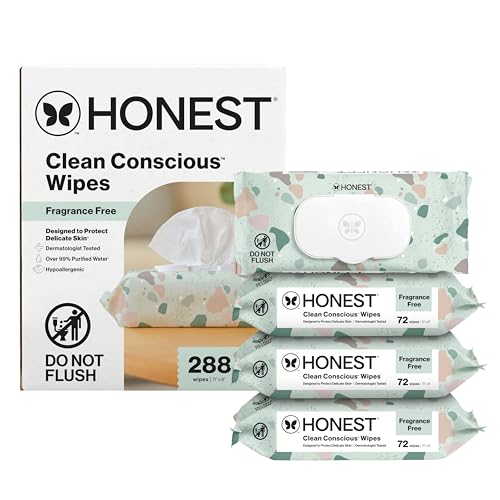
2. The Honest Company Multi-Use Baby Wipes — best plant-based & verified
Price: $19.97
Best for: Parents who want a plant-based wipe with independent, third-party verification.
Key specs (manufacturer-verified):
- 288 wipes with a flip-top dispenser
- Made with over 99% water and only 7 transparent ingredients
- Fragrance-free and hypoallergenic; brand states dermatologist tested
- EWG Verified and carries the National Eczema Association Seal of Acceptance
- Made without fragrances, parabens, alcohol, or chlorine processing; plant-based and compostable
Pros:
- EWG Verified plus National Eczema Association recognition
- Thick, durable multi-use cloth for messes beyond diapers
- Free of added fragrance, parabens, and alcohol
Cons:
- Costs more per wipe than basic store brands
- “Compostable” needs the right facility — not curbside everywhere
- Patterned packaging varies between orders
Check price on Amazon $19.97

3. Huggies Natural Care Sensitive Baby Wipes — best mainstream value
Price: $24.97
Best for: A widely stocked, trusted pick with strong sensitive-skin credentials.
Key specs (manufacturer-verified):
- 768 wipes (12 flip-top packs of 64)
- 99% purified water; fragrance-free and pH balanced
- Hypoallergenic; brand states dermatologist-tested
- Carries the National Eczema Association Seal of Approval
- Free of fragrances, parabens, phenoxyethanol, and alcohol; plant-based (70%+ by weight)
Pros:
- Easy to find in most stores and online
- Free of fragrance, parabens, phenoxyethanol, and alcohol
- National Eczema Association seal
Cons:
- “Plant-based” is 70%+ by weight, not 100%
- Packaging may vary between orders
- Not flushable
Check price on Amazon $24.97

4. Mama Bear 99% Water Baby Wipes — best budget
Price: $14.82
Best for: The value pick — a simple 99%-water wipe at the lowest price in this guide.
Key specs (manufacturer-verified):
- 432 wipes (6 packs of 72)
- Formula made with 99% water
- Fragrance-free; formulated without alcohol, parabens, or phthalates
- FSC-certified fibers; packaging made with at least 25% post-consumer recycled material
- Label instructs: do not flush
Pros:
- Lowest price of the group
- Fragrance-, paraben-, and phthalate-free
- FSC-certified fibers
Cons:
- Amazon-brand stock can fluctuate
- Basic, thinner feel versus premium wipes
- Not flushable
Check price on Amazon $14.82
Baby-wipe safety: what actually matters
“Non-toxic” is not an FDA rating. The FDA regulates cleansing baby wipes as cosmetics, and cosmetics do not require pre-market FDA approval — so a “non-toxic” or “natural” label on the front of the pack is a marketing claim, not a government endorsement. Read the ingredient panel yourself, and compare formulas the same way I did in WaterWipes vs. standard baby wipes.
Fragrance and certain preservatives are the usual irritants. Added fragrance is one of the most common triggers of contact irritation on baby skin, which is why every pick here is fragrance-free. Some parents also avoid the preservatives methylisothiazolinone and methylchloroisothiazolinone (MI/MCI); the American Contact Dermatitis Society has flagged these as frequent skin allergens.
Do not flush them. None of these wipes are flushable. The FTC has challenged “flushable” wipe claims because the wipes did not break down like toilet paper, and non-flushable wipes can clog household plumbing and municipal sewer systems. Put used wipes in the trash — only flush a wipe if its own label specifically says it is flushable.
Wipes support skin care but do not treat rash. Per the American Academy of Pediatrics, most diaper rash clears with frequent changes, gentle cleansing, some air time, and a zinc-oxide barrier cream. Call your pediatrician if a rash is severe, blisters or bleeds, spreads, does not improve within a few days, or comes with a fever — our diaper rash guide walks through the steps. If your baby has broadly reactive skin, it is also worth looking at the diaper itself in hypoallergenic diapers for sensitive skin.
Patch-test first. Skin sensitivity varies from baby to baby, so try a new wipe on a small area before regular use and discontinue it if you notice redness, bumps, or irritation.
Frequently asked questions
What makes a baby wipe ‘non-toxic’?
There is no legal definition of ‘non-toxic,’ so on this page it means a short, transparent ingredient list built around purified water, with no added fragrance and none of the ingredients parents most often want to avoid — parabens, phthalates, and alcohol. Every product here is fragrance-free and lists its exclusions on the label. No wipe is truly ‘chemical-free’ because water is a chemical, so focus on the actual ingredient list rather than the marketing word.
Are WaterWipes really the safest choice?
WaterWipes Sensitive+ use just two ingredients — 99.9% purified water and a drop of fruit extract — and carry OEKO-TEX STANDARD 100 certification, so they are among the simplest formulas you can buy. Simplest is not the same as safest for every baby, though, because some skin does better with a wipe that adds a soothing ingredient like aloe. If your baby has a specific skin condition, ask your pediatrician.
Can these non-toxic baby wipes be flushed?
No. The wipes in this guide are not labeled flushable, and the packaging tells you to throw used wipes in the trash. Even wipes marketed as flushable have been challenged by the Federal Trade Commission for not breaking down like toilet paper, and they can clog home plumbing and municipal sewers. Only flush a wipe if its own label specifically says it is flushable.
Do fragrance-free wipes prevent diaper rash?
They can lower one common trigger, but they do not prevent rash on their own. Added fragrance is a frequent cause of contact irritation, which is why every pick here is fragrance-free. The American Academy of Pediatrics still points to frequent diaper changes, gentle cleansing, and a barrier cream as the core of preventing and treating diaper rash. See your pediatrician if a rash is severe, blisters, or does not improve within a few days.
What ingredients should I avoid in baby wipes?
Parents most often screen out added fragrance, parabens, phthalates, and alcohol; some also avoid the preservatives methylisothiazolinone and methylchloroisothiazolinone (MI/MCI), which the American Contact Dermatitis Society flagged as common skin allergens. Read the ingredient panel rather than the front-of-pack claims, since terms like ‘natural’ and ‘non-toxic’ are not regulated.
Are these wipes unscented and safe for sensitive skin?
Yes to both. All four picks are fragrance-free (unscented) — the change dermatologists recommend first for reactive skin — and three of the four, WaterWipes Sensitive+, The Honest Company Multi-Use, and Huggies Natural Care Sensitive, are specifically positioned for sensitive skin, with two carrying the National Eczema Association Seal. If your baby has diagnosed eczema or very reactive skin, start with the simplest formula here: WaterWipes Sensitive+, at just two ingredients.
Medical references
PediatricPicks is reader-supported. As an Amazon Associate we may earn from qualifying purchases at no extra cost to you. Prices and availability are shown live and can change. This article is educational and is not a substitute for medical advice from your pediatrician.