
Antifungal creams for yeast diaper rash: (2026)
When regular diaper rash cream isn’t working, the culprit is often yeast. Candida thrives in warm, moist diaper environments and causes a distinctive bright red rash with raised satellite bumps that won’t respond to zinc oxide alone. The right antifungal cream can help a confirmed yeast rash improve within a few days, but babies’ rashes are easily mistaken for one another — so have your pediatrician confirm the diagnosis before you start an antifungal, and choosing the wrong product or applying it incorrectly can prolong the problem. We break down exactly which antifungal creams pediatricians recommend, how to use them, and when to call the doctor.
The antifungal cream + barrier cream combo pediatricians recommend
Treating a confirmed yeast diaper rash usually involves two products: an antifungal cream to target the Candida, plus a barrier cream to protect healing skin. Because infant rashes are easily mistaken for one another, have your pediatrician confirm it is yeast before starting an antifungal.
Home remedies for yeast diaper rash: what works and what to skip
Short answer: dryness, air, and frequent changes genuinely speed healing — but no kitchen remedy kills Candida the way clotrimazole 1% does. As an RN, I understand why parents reach for a home fix first, so here is what actually helps versus what can quietly make a yeast rash worse.
1. Diaper-free air time – genuinely helps
Candida needs warmth and trapped moisture. Ten to fifteen minutes of bare-bottom time on a towel after each change starves it of the humidity it depends on. This is the single most effective free thing you can do alongside the antifungal.
2. Change more often and blot dry – helps
Change the moment a diaper is wet or soiled, and pat (never rub) the skin fully dry before the next diaper goes on. A yeast rash sitting in a damp diaper will not clear no matter how good the cream underneath is.
3. Cornstarch – skip it
This is the myth I correct most often. Cornstarch is a carbohydrate, and some laboratory studies suggest it may feed Candida rather than starve it. Paired with the AAP’s warning about powder inhalation, cornstarch has no place on a yeast diaper rash.
4. Coconut oil and breast milk – limited, not a cure
Both show mild antifungal activity in a petri dish, but neither reliably clears a confirmed yeast rash, and an oil layer can trap the very moisture you are trying to eliminate. Use clotrimazole 1% for the infection and save these for ordinary dry skin.
5. Talc baby powder – skip it
Talc does nothing against yeast and carries a real inhalation risk for infants. A thin layer of a zinc oxide barrier like Desitin Daily Defense over the antifungal does the moisture-sealing job far more safely.
Bottom line: home measures support the treatment — they do not replace it. Keep the area dry and aired, layer clotrimazole 1% under a zinc oxide barrier cream, and leave the powders and oils in the cupboard.
Why trust Pediatric Picks?
Our recommendations for antifungal creams for yeast diaper rash are based on clinical guidelines from the American Academy of Pediatrics and the American Academy of Dermatology. We reviewed published research on Candida diaper dermatitis treatment protocols and cross-referenced the EWG Skin Deep safety database for all inactive ingredients in each antifungal cream.
We specifically focused on OTC (over-the-counter) antifungal creams that parents can purchase without a prescription, while noting when prescription options like nystatin may be necessary.
Best antifungal creams for yeast diaper rash: comparison
| Pick | Product | Key strengths | Watch-outs | Price | Where to buy |
|---|---|---|---|---|---|
| Top Antifungal | 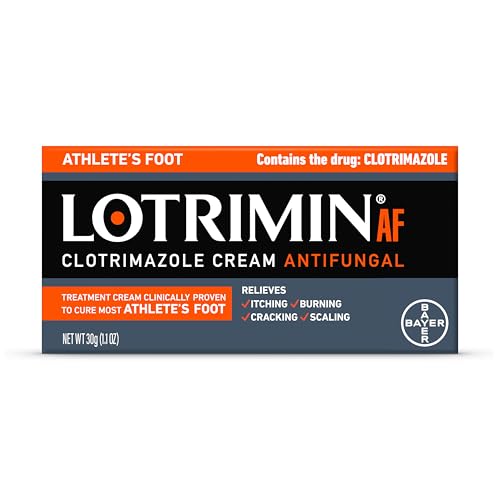 Lotrimin AF (Clotrimazole 1%) |
|
| ~$14.12 | Check price |
| Budget Antifungal | 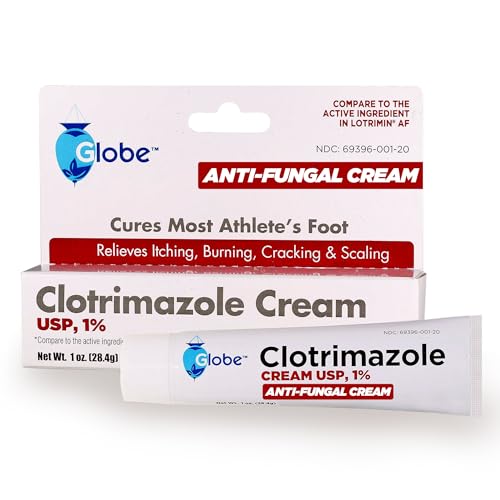 Globe Clotrimazole 1% |
|
| ~$4.85 | Check price |
| Barrier Layer |  Desitin Daily Defense |
|
| ~$15.98 | Check price |
Lotrimin AF (Clotrimazole 1%)
Globe Clotrimazole 1%
Desitin Daily Defense
Lotrimin AF (Clotrimazole 1%) — full review
Lotrimin AF is the antifungal cream most pediatricians recommend as the first-line OTC treatment for yeast diaper rash. The active ingredient, clotrimazole 1%, works by disrupting the cell membranes of Candida albicans — the specific fungus responsible for the vast majority of yeast diaper rashes. Unlike zinc oxide barrier creams that merely block moisture, clotrimazole actively targets the fungal organism causing the infection.
The treatment protocol is straightforward: apply a thin layer of antifungal cream to clean, dry skin twice daily (morning and evening) for 7 to 10 days. The key word is “thin” — you need just enough to cover the affected area. Then layer a zinc oxide barrier cream (like Desitin Daily Defense) on top to seal out moisture. This two-layer approach — antifungal underneath, barrier on top — is the standard pediatric dermatology protocol for treating yeast diaper rash.
An important label note: Lotrimin AF says “not for children under 2 years” on the packaging. Pediatricians do sometimes recommend clotrimazole off-label for infants with a confirmed yeast rash, but that under-2 warning is on the label for a reason, and whether to use it on a baby is a decision for your child’s doctor. Always consult your pediatrician before using any antifungal cream on babies under 2, and let them confirm the diagnosis and decide whether clotrimazole is appropriate for your baby.
Globe Clotrimazole 1% — full review
Globe Clotrimazole 1% contains the exact same active ingredient as Lotrimin AF at roughly one-third the cost. This is a straightforward generic substitution — the clotrimazole molecule is identical regardless of the brand on the tube. Globe is manufactured at audited pharmaceutical facilities in the United States and carries a National Drug Code (NDC) for full regulatory accountability.
For parents treating a yeast diaper rash, the practical difference between Lotrimin AF and Globe Clotrimazole is purely economic. Both contain 1% clotrimazole. Both work by the same mechanism against Candida. Both require the same application protocol (thin layer, twice daily, 7–10 days). The inactive ingredients differ slightly — Globe uses a simpler base formula — but neither contains fragrances or known irritants.
Where the generic option makes the most sense: recurring yeast diaper rashes. If your baby is prone to Candida flare-ups (common during antibiotic courses or teething), having antifungal cream on hand at all times is important. At roughly $5 per tube versus $14 for Lotrimin, stocking up on Globe Clotrimazole for the medicine cabinet is a practical choice that delivers comparable antifungal performance.
Desitin Daily Defense — why you need a barrier cream too
Applying an antifungal cream alone for yeast diaper rash is only half the treatment. The other half is protecting the healing skin from the ongoing moisture, friction, and acidity that created the environment for Candida to thrive in the first place. That’s where a zinc oxide barrier cream like Desitin Daily Defense becomes essential.
The correct layering protocol for antifungal creams for yeast diaper rash: first, clean and thoroughly dry the diaper area. Second, apply a thin layer of clotrimazole antifungal cream directly to the affected skin. Third, apply a thicker layer of Desitin Daily Defense barrier cream on top. The barrier cream seals out moisture while allowing the antifungal to work against the yeast underneath — and the 13% zinc oxide provides additional anti-inflammatory soothing for the irritated, sensitive skin.
Do not reverse the order. Applying barrier cream first and antifungal on top means the clotrimazole can’t reach the skin where the fungus lives. The antifungal must be in direct contact with the infected skin to be effective. Many parents make this mistake and wonder why the antifungal cream for yeast diaper rash isn’t working — it’s almost always an application order issue.
How to identify yeast diaper rash vs. regular diaper rash
Using antifungal creams on regular diaper rash is unnecessary and delays proper treatment. Here’s how to tell the difference:
Yeast diaper rash signs
Bright red (not pink), well-defined borders, raised satellite bumps or pustules surrounding the main rash area, rash in skin folds (not just on flat surfaces), doesn’t improve after 2–3 days of zinc oxide treatment, and often appears during or after antibiotic use.
Regular irritant diaper rash signs
Pink or light red, affects flat surfaces more than folds, no satellite bumps, improves within 2–3 days with zinc oxide barrier cream, and is typically caused by prolonged moisture contact, friction, or reaction to a new product.
When to switch to a yeast rash cream
Start antifungal treatment if the rash has satellite bumps, is bright red in the folds, or has not improved after 3 days of consistent zinc oxide barrier cream use. Apply the antifungal cream for the full 7–10 days even if the rash appears to clear sooner — stopping early allows resistant Candida to regrow.
When to call the pediatrician
See the doctor if the antifungal cream for yeast diaper rash doesn’t show improvement within 3 days, if the rash has open sores or bleeding, if your baby has a fever alongside the rash, or if the rash keeps recurring more than once a month. Your pediatrician may prescribe nystatin (a prescription antifungal) or investigate underlying causes.
Does teething cause yeast diaper rash?
Short answer: teething does not directly cause a yeast infection, but it creates the exact warm, acidic, broken-skin conditions Candida needs to take over. Parents notice the timing constantly, and they are not imagining it.
The teething connection
Teething increases drool and often loosens and acidifies stools. More frequent, more acidic poop irritates the diaper skin and breaks down its protective barrier — and once that barrier is compromised, the Candida already living in the gut and on the skin has an open door.
Why a teething rash can turn into a yeast rash
A teething-related rash usually starts as a plain irritant rash. If it sits under moisture for a few days, or overlaps a cold or a course of antibiotics (both common during teething months), it can convert into a true yeast infection with the classic satellite bumps.
Telling them apart
An irritant teething rash is pink, sits on the flat exposed surfaces, and improves within 2–3 days of a zinc oxide barrier cream. A yeast rash is beefy red, concentrated in the skin folds, ringed by small satellite bumps, and will not budge without clotrimazole 1%.
What to do during a teething stretch
Be proactive: apply a zinc oxide barrier cream at every change to protect the skin, change more often, and add air time. If satellite bumps appear despite that, move to the antifungal-under-barrier routine described above.
Quick answer: teething is a trigger, not the infection itself — prevent it with a barrier cream and dryness, and treat it with an antifungal only if the rash develops satellite bumps in the folds.
Nystatin vs. OTC clotrimazole: when your baby needs a prescription
Short answer: most yeast diaper rashes clear with over-the-counter clotrimazole 1% (Lotrimin AF or generic Globe); nystatin is the prescription backup for rashes that do not respond or keep returning. Here is how I explain the choice to parents.
How the two drugs differ
Clotrimazole is an azole antifungal sold over the counter; nystatin is a polyene antifungal available only by prescription. Both are effective against Candida albicans — the practical difference is access and, occasionally, how a stubborn strain responds to one versus the other.
When OTC clotrimazole is enough
For a first, straightforward yeast diaper rash, clotrimazole 1% applied thinly twice a day for 7–10 days clears the large majority of cases. There is no advantage to a prescription when the OTC cream is doing its job.
When to ask for nystatin
Call your pediatrician for a prescription if there is no improvement after 3 full days of clotrimazole, if the rash keeps recurring, or if your child is a young infant and your pediatrician prefers to confirm and treat candidiasis directly. Nystatin is also the usual choice when oral thrush is present at the same time.
One caution on combination creams
Prescription combos that pair nystatin with a steroid (for example nystatin–triamcinolone) are sometimes handed out for diaper rash. Do not push for a steroid combination on a baby without specific pediatric direction — topical steroids thin delicate infant skin and can mask a worsening infection.
Bottom line: start with OTC clotrimazole 1%, give it a fair trial, and escalate to nystatin only through your pediatrician — especially for infants or thrush that appears at both ends.
Frequently asked questions about antifungal creams for yeast diaper rash
Yes — with your pediatrician’s guidance. Lotrimin AF (clotrimazole 1%) is the most commonly recommended OTC antifungal cream for yeast diaper rash in infants. While the label says “not for children under 2,” pediatricians routinely recommend it for confirmed yeast rashes in babies. Always consult your pediatrician first, especially for infants under 6 months.
No. Barrier creams like Aquaphor and zinc oxide creams do not have antifungal properties — they cannot kill Candida. Using them alone on a yeast rash may actually trap the fungus underneath a moisture barrier, potentially worsening the infection. You need a dedicated antifungal cream to treat yeast diaper rash. Barrier creams should be layered on top of the antifungal, not used as a replacement.
No. Desitin Daily Defense is a zinc oxide barrier cream, not an antifungal — it has no activity against the Candida yeast that causes a yeast diaper rash. It still plays a real role in the two-step protocol described above: sealing out moisture and protecting healing skin. But it only works layered over a true antifungal like clotrimazole 1% (Lotrimin AF or a generic equivalent); using Desitin by itself will not clear a confirmed yeast infection.
With proper antifungal cream treatment, most yeast diaper rashes show visible improvement within 2–3 days and resolve fully within 7–10 days. Continue applying the antifungal cream for the full recommended duration even after the rash looks clear — stopping early is the most common cause of recurrence. If you see no improvement after 3 days of consistent antifungal treatment, contact your pediatrician.
Recurring yeast diaper rash has several common causes: antibiotic use (which kills bacteria that normally keep yeast in check), prolonged time in wet diapers, recent dietary changes that alter stool pH, and teething (which increases drool and can change gut flora). Breastfed babies can also develop yeast if the mother has a breast yeast infection. If your baby gets yeast rashes more than once a month, consult your pediatrician to investigate systemic causes.
Not in the way a cold is. Candida already lives on most skin and in the gut, and a yeast diaper rash flares when the diaper area stays warm and damp — not because your baby “caught” it from another child. With normal handwashing it will not spread across a changing table. The exceptions worth knowing: it can spread between your own baby’s skin folds, and a breastfeeding pair can pass Candida back and forth between baby’s mouth and mother’s nipples, so both may need treating at once.
Sometimes — it depends entirely on the active ingredient. Clotrimazole 1% and miconazole are the same azole antifungals whether the box says “jock itch,” “athlete’s foot,” or “yeast,” so a plain clotrimazole cream like Lotrimin AF is fine for the diaper area. Avoid terbinafine (Lamisil), which targets athlete’s-foot fungi rather than Candida, and avoid anything combined with hydrocortisone or heavy fragrance. Plain clotrimazole 1% is the safest match — and confirm with your pediatrician before using it on a baby under 2.
Not always, but the two are closely linked because both are Candida. A baby with oral thrush — white, hard-to-wipe patches on the tongue and inner cheeks — often develops a matching yeast diaper rash as the fungus travels through the gut and out in the stool. If you see thrush and a diaper rash at the same time, treat both: pediatricians commonly prescribe oral nystatin for the mouth alongside clotrimazole 1% for the bottom. Treating only one end lets the other keep reseeding the infection.
Treat the rash plus a small margin of surrounding skin, including any satellite bumps outside the main patch. Work a thin layer into the folds, then add the barrier cream on top. An antifungal diaper rash cream only needs to cover skin where yeast is active — coating the whole diaper area adds nothing.
Our recommended antifungal cream: Lotrimin AF
Clotrimazole 1% — the OTC antifungal cream pediatricians trust most for yeast diaper rash. Layer with zinc oxide barrier cream for fastest healing.
Check price on Amazon →Prices and availability: Prices shown reflect typical Amazon pricing as of April 2026 and may vary. Click any product link for the current price.
Medical disclaimer: Content is for informational and educational purposes only. It does not constitute medical advice or replace professional pediatric consultations. Always consult your child’s pediatrician before starting any antifungal treatment.
- Kalyoussef S. Pediatric Candidiasis. Medscape Drugs & Diseases (eMedicine); updated Aug 6, 2024. Describes candidal diaper dermatitis with satellite papules and intertriginous-fold involvement, Candida albicans as the usual cause, and antifungal management.
- Agrawal R. Diaper Dermatitis (Diaper Rash). Medscape Drugs & Diseases (eMedicine); updated Jun 30, 2025. Irritant diaper dermatitis from overhydration, maceration and prolonged urine/feces contact; Candida commonly complicates the rash after 48–72 hours and with antibiotic use.
- American Academy of Pediatrics. How to Choose Safer Personal Care Products: Tips for Families. HealthyChildren.org; updated Oct 31, 2024. Advises against baby powder for infants because breathing in large amounts of talc can lead to severe lung disease.
- Semiz S, Balci YI, Ergin S, Candemir M, Polat A. Two cases of Cushing’s syndrome due to overuse of topical steroid in the diaper area. Pediatr Dermatol. 2008;25(5):544-547. Two infants developed iatrogenic Cushing’s syndrome from overuse of a superpotent topical steroid under an occluding diaper, illustrating that steroid creams can be absorbed systemically through diaper-area skin and should be used only as directed by a clinician.