
Best Pikler Triangle 2026: 3 Top Indoor Climbing Sets for Babies
The best pikler triangle for your baby should fold flat for small apartments, hold up to a climbing 4-year-old, and offer enough add-on accessories (arch, ramp, ladder) to stay engaging from the 10-month crawling-up stage all the way to age 5. We compared 3 of the most popular foldable, Montessori-style climbing sets against the original Pikler Institute design principles and each manufacturer’s published load rating, rung spacing and folded dimensions. Three sets met our stability, load-rating, and developmental-engagement criteria: the Tiny Land Pikler Triangle Set 7-in-1 Rainbow at roughly $140 (our top pick for the seven configurations that grow with your child), the Tiny Land 7-in-1 Morandi at roughly $136 (our premium pick for nurseries where aesthetics matter as much as function), and the BlueWood Pikler Triangle Set 7-in-1 at roughly $140 (our value pick that matches the configuration count with a natural-wood finish closest to the original Pikler Institute aesthetic). All three follow the climb-up-then-climb-down philosophy Dr. Emmi Pikler pioneered at the Loczy Institute in Budapest, where children self-regulate their gross motor risk-taking rather than being placed at heights by adults. Read the AMI Montessori philosophy primer for the developmental framework these climbers sit inside.
Foldability matters more than parents expect. A pikler triangle that lives unfolded in the middle of a small living room becomes furniture you trip over by week three; one that folds to roughly 4 inches thick and slides behind the sofa stays in rotation for years. Per the CDC’s 15-month milestone tracker, climbing on furniture is a developmentally normal emergence around 12–15 months — a properly sized pikler triangle redirects that drive onto a purpose-built surface with predictable rung spacing, sanded edges, and a stable footprint. Pair this guide with our weighted baby push walker review for the cruising-stage gross motor work that comes just before climbing, and our sit-in baby walker safety analysis for the developmental milestones the pikler triangle supports that traditional walkers actively undermine.
Best pikler triangle top picks, compared on load rating, rung spacing and configurations
The 7-in-1 rainbow set whose configurations grow with your child for years, the Morandi-toned premium pick whose color palette disappears into modern nurseries, and the value-priced 7-in-1 that delivers the same arch-ramp-ladder versatility at a meaningful discount.
Check price on Amazon $139.99
Check price on Amazon $135.99
Check price on Amazon $139.99
Safety first: pikler triangles require supervision and a soft landing zone
Even the best pikler triangle is a piece of climbing equipment, not a passive toy. Always supervise active climbing, especially during the first month of use while your baby is learning where the rungs are. Place the triangle over a play mat or rug at least 6 inches thick (a standard 1-inch foam mat is not enough) — toddlers fall, and the difference between hardwood and a properly cushioned landing zone is the difference between a startled cry and a hospital trip. The original Pikler Institute methodology in Budapest places climbing structures over thick padded flooring for exactly this reason.
Check fasteners weekly during the first two months and monthly thereafter — wood expands and contracts with humidity, and a screw that was tight at assembly can loosen by the 50th climbing session. Never let a child climb on a folded triangle; the joint geometry that’s stable when fully deployed is not load-rated in transitional positions. Follow the AAP childproofing guidelines for the surrounding play space — sharp furniture corners within 3 feet of the triangle should be padded.
How we evaluated the best pikler triangle sets
A pikler triangle that wobbles under a 30-pound toddler, has rungs spaced too wide for small hands, or folds so awkwardly that it lives unfolded forever is worse than no climbing equipment at all — it generates parent frustration without delivering developmental value. So we judged every set in this guide against four things, using manufacturer load ratings and specs, CPSC guidance for children’s climbing products, and the failure patterns that repeat across owner reviews:
Load rating and stability. We compared published weight limits, rung spacing and locking-hinge design against ASTM F963, the US toy-safety standard. Sets whose stated capacity does not cover the upper end of their own advertised age range were flagged as inadequate.
Rung spacing and grip ergonomics. The original Pikler design specifies rungs at roughly 5–6 inches center-to-center, with rung diameter sized for a toddler’s grip (approximately 1 inch). Spacing wider than 7 inches forces toddlers to over-extend during climb-down, which is the harder half of the climbing skill.
Configuration count and add-on quality. A 7-in-1 set lives in rotation for years; a single-configuration triangle gets ignored once your toddler masters the climb. We compared all advertised configurations on each set and assessed each accessory (arch, ramp, ladder, climbing wall) on how it is built and what it adds developmentally.
Foldability and small-space living. Folded thickness and hinge design decide whether a set stays in rotation or gets stored and forgotten, so both were compared against the published dimensions.
Best pikler triangle sets: side-by-side comparison
| Pick | Product | Key strengths | Watch-outs | Price | Where to buy |
|---|---|---|---|---|---|
| Top Pick |  Tiny Land Pikler Triangle Set 7-in-1 Rainbow |
|
| $139.99 | Check price $139.99 |
| Premium Pick | 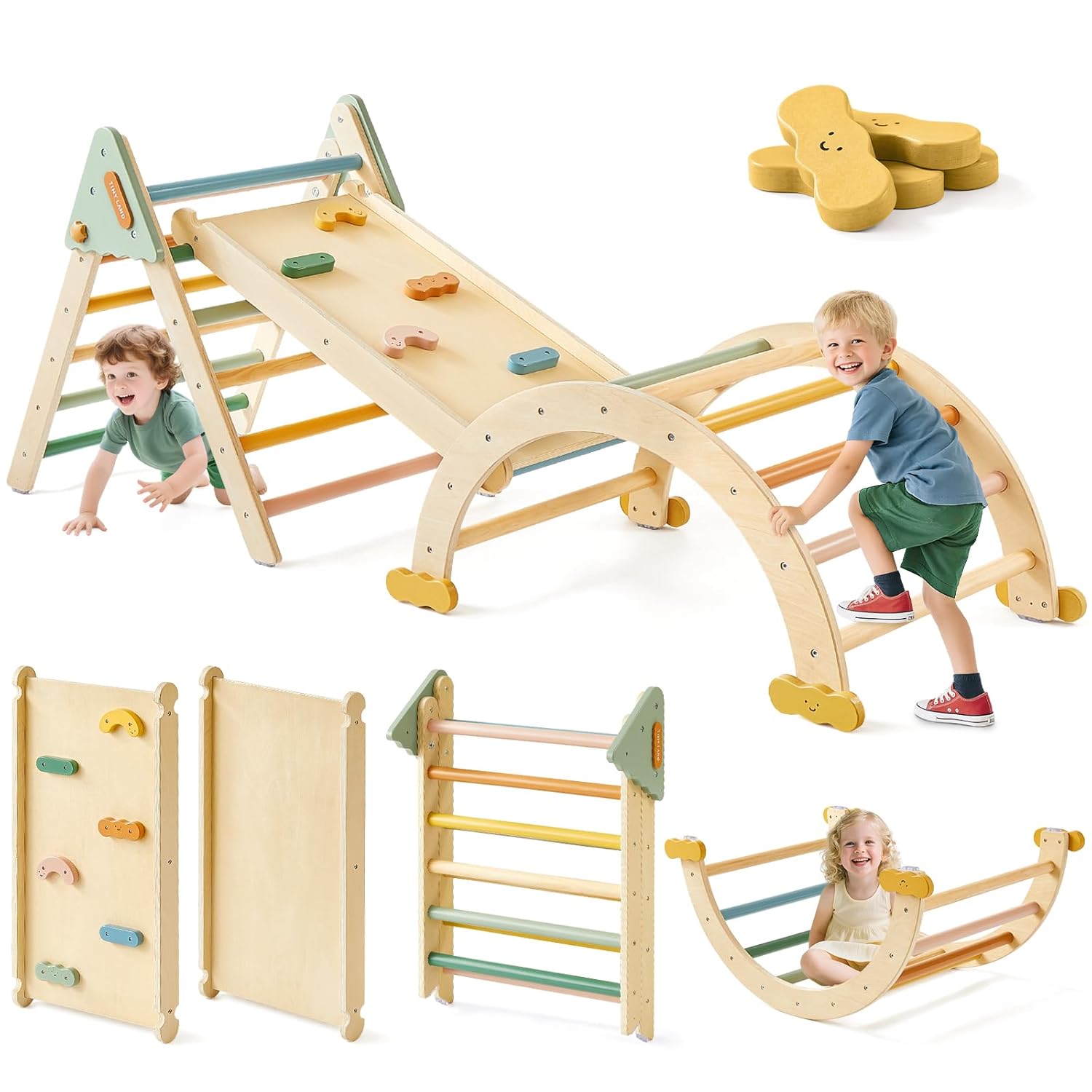 Tiny Land Pikler Triangle Set 7-in-1 Morandi |
|
| $135.99 | Check price $135.99 |
| Value Pick |  BlueWood Pikler Triangle Set 7-in-1 |
|
| $139.99 | Check price $139.99 |
Tiny Land Pikler Triangle Set 7-in-1 Rainbow
Check price on Amazon $139.99
Tiny Land Pikler Triangle Set 7-in-1 Morandi
Check price on Amazon $135.99
BlueWood Pikler Triangle Set 7-in-1
Check price on Amazon $139.99
Tiny Land Pikler Triangle 7-in-1 Rainbow — full breakdown
The Tiny Land 7-in-1 Rainbow is the best pikler triangle for families who want a single piece of climbing equipment to grow with their child from the 10-month crawling-up stage through the climb-it-while-pretending-it-is-a-pirate-ship stage at age 4. The seven configurations — basic triangle, triangle plus arch, triangle plus ramp, triangle plus ladder, arch-and-ramp, ladder-and-ramp, and full obstacle course — give parents a way to reset the play experience every few months as the climber masters a layout. Resetting that novelty cycle is what owner reviews consistently describe as deciding whether indoor gross-motor equipment stays in rotation past the six-month mark — and at seven configurations, the Tiny Land gives you more ways to reset it than anything else in this guide.
Dr. Emmi Pikler’s original methodology, developed at the Loczy Institute in Budapest in the 1940s and 50s, was built on the observation that babies given access to age-appropriate climbing surfaces self-regulate their risk-taking far more accurately than adults predicting “what a baby can handle.” The 7-in-1 supports that philosophy directly: a 12-month-old plays only with the basic triangle and the ramp at its gentlest angle, while a 3-year-old runs the full obstacle course. The equipment doesn’t need adult-imposed difficulty progression — the child sets it.
The Rainbow set is built for daily climbing, and its 1-inch rungs are sized for a baby’s grip rather than a preschooler’s. At the youngest end that means the basic triangle works as a pull-to-stand and crawl-up surface. The arch-and-ramp configuration is the one that tends to hold a 2- to 3-year-old’s attention.
The published static load rating is 160 pounds. The rung spacing of 5.5 inches falls precisely inside the Pikler Institute Budapest design range, with a rung diameter of 1 inch sized for a toddler’s grip.
Trade-offs are minor. Initial assembly takes 30–45 minutes the first time and requires reading the instructions carefully — the hardware kit includes 40+ pieces and the order matters. The painted rainbow rungs do show scuffs and color wear faster than natural wood, especially around the apex where toddler hands grip hardest. Neither is a deal-breaker on a piece of equipment likely to deliver 3–5 years of daily use.
Check price on Amazon → $139.99
Tiny Land Pikler Triangle 7-in-1 Morandi — full breakdown
The Morandi version of the Tiny Land 7-in-1 is the best pikler triangle for families whose climbing equipment will live full-time in the living room rather than in a dedicated playroom. Mechanically and dimensionally identical to the rainbow top pick — same 160-pound static load rating, same 5.5-inch rung spacing, same seven-configuration library — the differentiator is the muted Morandi-palette finish in sage, dusty rose, and oat tones that coordinates with neutral and earth-toned interior design rather than dominating the room with primary-color rungs.
This sounds like a vanity feature; in practice it determines whether the triangle stays deployed or gets folded behind the couch and forgotten. The muted Morandi palette integrates into a living room in a way the primary-color version does not — which matters more than it sounds, because a triangle that stays out and available is a triangle that gets climbed.
Lower-saturation paint shows scuffs and grip wear less obviously than bright rainbow rungs, so the equipment should keep looking new longer through the inevitable nicks and scratches of daily use. For a piece of equipment likely to remain a focal point of your living space for 3–5 years, that finish durability is a meaningful long-term consideration.
The trade-off is engagement at the youngest end of the age range. Infants in the 10–18 month window are generally more drawn to high-contrast, saturated colours than to muted ones, and the Morandi palette is designed for adult aesthetic preferences rather than infant visual stimulation.
If your baby is already past 18 months when you’re buying, this consideration disappears. If you’re buying ahead for a younger infant, the rainbow may genuinely deliver more first-year climbing minutes — and you can always replace it later if the visual treatment grates on you.
Color matching across replacement parts is the one operational caveat. The Morandi palette is manufactured in smaller production runs than the rainbow, and tonal drift between production batches is a known risk with small-run finishes. If exact color matching matters, order any spare parts at the same time as the main set.
Check price on Amazon → $135.99
BlueWood Pikler Triangle 7-in-1 — full breakdown
The BlueWood 7-in-1 is the best pikler triangle for families who want the full 7-in-1 configuration library at the lowest price that still meets the load-rating and rung-spacing criteria. At roughly $140 it’s priced in line with the Tiny Land top pick while delivering the same arch, ramp, and ladder bundle out of the box — and the natural birch finish, unpainted except for a non-toxic protective seal, is the closest aesthetic match to the original Pikler Institute Budapest equipment of any set we reviewed.
The BlueWood’s joinery and rung spacing are built for daily climbing rather than occasional use. It carries the same 160-pound published static load rating as the Tiny Land sets. The manufacturer doesn’t publish beam gauge or a side-by-side stiffness comparison, so we can’t confirm parity beyond the shared weight rating — on any set, the weekly fastener check matters regardless of frame weight.
The rung spacing of 5.75 inches falls inside the Pikler design range (5–6 inches) but at the upper end, which means the very youngest climbers have to reach a little further on climb-down. For parents of newly-cruising 10-month-olds, it is worth noting that the Tiny Land’s tighter 5.5-inch spacing fits the smallest hands marginally better.
Folded thickness is 5 inches versus the Tiny Land’s 4 inches — a small difference that matters only if your storage spot is genuinely tight. The folding mechanism uses the same hinge philosophy as the Tiny Land.
For most families, the BlueWood is a smart buy for the natural-wood aesthetic — it’s priced within a dollar of the Tiny Land top pick, so the decision comes down to finish and rung spacing rather than price. Whichever set you choose, budget separately for a thick rug or 6-inch foam play mat — the mat matters as much as the climber itself for a safe landing zone.
Check price on Amazon → $139.99
5 things to know before buying a pikler triangle
Understand the Pikler philosophy before you buy the equipment
Dr. Emmi Pikler’s child-led gross motor philosophy, developed at the Loczy Institute in Budapest, holds that babies given access to safe climbing surfaces will self-regulate their gross motor risk-taking more accurately than adults can predict. The implication for parents: don’t place your baby on the triangle, don’t move them up the rungs, don’t “help” them climb. Set the triangle on a soft surface, let the baby explore it on their own terms, and intervene only for safety. The vestibular and proprioceptive development the pikler triangle delivers depends on the child generating the motor plan themselves. See the Association Montessori Internationale primer for the full developmental philosophy.
A pikler triangle without a thick play mat is incomplete equipment
Toddlers fall. The pikler triangle is designed around the assumption that those falls happen onto a forgiving surface. A standard 1-inch foam mat or a thin rug over hardwood is not adequate cushioning for a fall from peak triangle height (typically 30–34 inches). Either invest in a 6-inch foam play mat, position the triangle over a deep-pile rug with a thick pad underneath, or place it on carpet over a padded subfloor. The play surface matters as much as the equipment itself — budget for both.
The arch, ramp, and ladder accessories extend useful life by 2–3 years
A standalone triangle becomes uninteresting once a toddler masters climbing it — usually around the 18-month mark. The arch, ramp, and ladder add-ons are what turn the equipment from a 6-month novelty into a 4-year staple. The arch flips upside-down into a rocker for the 12–18 month window, becomes a tunnel at 18–24 months, and a balance beam at 2–3 years. The ramp at gentle angle is a crawl-up surface for 10–14 month-olds and becomes a slide once paired with the triangle’s apex at 18+ months. The ladder is the configuration most parents skip and miss out on — at 2–3 years it becomes the “tall climb” that re-engages a toddler who has plateaued on the basic triangle. Always buy the 7-in-1 set rather than the standalone triangle; the math works out.
Foldability is not optional in apartments or small living rooms
An unfolded pikler triangle occupies a 36-inch by 24-inch footprint in the middle of your living space. In a small apartment that’s the difference between equipment that stays in rotation and equipment that gets disassembled and stored within a month. Every set in this review folds — confirm yours does too if you’re cross-shopping. Test the folding mechanism in the first week and find the storage spot (behind a sofa, in a closet, against a wall) before frustration accumulates.
Check fasteners weekly for the first two months, then monthly
Wood is hygroscopic — it expands and contracts with seasonal humidity, and that movement loosens fasteners over time. A pikler triangle that was rock-solid at assembly can develop a meaningful wobble by the 50th climbing session if you’ve never checked the bolts. Keep an Allen key (the one that came with the kit) in a kitchen drawer and run a 60-second tightening pass weekly through month two, then monthly thereafter. This is the single most-skipped safety practice and the most-cited cause of pikler-triangle structural failure in product reviews. Pair this routine check with the broader weekly babyproofing audit in our weighted push walker guide.
Best pikler triangle: frequently asked questions
The best pikler triangle is appropriate from roughly 10 months — once your baby is reliably pulling to stand and showing interest in climbing onto furniture. At 10–14 months the triangle functions primarily as a pull-to-stand and crawl-up surface; expect your baby to use the lowest one or two rungs only. Active multi-rung climbing typically begins around 14–18 months, and the full triangle apex becomes accessible at 18–24 months. The accessories (arch, ramp, ladder) carry the equipment forward to age 5. Do not place an infant on the triangle — the Pikler philosophy is child-initiated climbing only. For pre-climbing gross motor work in the 9–12 month cruising stage, see our weighted push walker review.
A properly assembled, well-supervised pikler triangle placed on a thick padded surface is safer than the alternative — which is your baby climbing on the sofa, coffee table, or bookshelves with unpredictable load ratings and sharp edges. The Pikler philosophy explicitly redirects the developmentally-normal climbing drive that emerges around 12–15 months (see the CDC’s 15-month milestone tracker) onto a purpose-built surface. The safety practices that matter: always supervise active climbing, always use a thick play mat or rug under the triangle, check fasteners weekly during the first two months, and never let a child climb on a partially folded set.
A pikler triangle is a specific child-led climbing structure developed by Dr. Emmi Pikler at the Loczy Institute in Budapest, designed around the principle that babies self-regulate their gross motor risk-taking more reliably than adults can predict. The design is austere on purpose — no motors, no lights, no instructional overlay. The child climbs because they want to, not because the toy is prompting them. Regular climbing toys often include slides, plastic features, and adult-directed play patterns. The pikler triangle is intentionally minimal so the child’s own motor planning drives the play. The 7-in-1 add-ons (arch, ramp, ladder) extend the configuration space without imposing a play script.
The best pikler triangle delivers three developmental inputs that are difficult to replicate with flat-floor play. First, vestibular system input — climbing up and down at varying heights and angles activates the inner-ear balance system in ways flat-floor crawling does not, supporting the spatial awareness that underlies later coordination. Second, proprioceptive input — gripping rungs and weight-shifting through limbs builds the joint and muscle position-sense that toddlers need for confident gross motor work. Third, motor planning — climbing down (always harder than climbing up) requires the child to sequence and reverse a movement they generated themselves. None of these are deliverable through passive entertainment equipment.
A well-designed foldable pikler triangle is fully load-rated when deployed and is structurally equivalent to a fixed triangle of the same wood gauge — the hinge mechanism locks under load rather than carrying any of the climbing weight itself. The foldable sets here publish a 160-pound static load capacity, which puts them on par with fixed pikler triangles — the folding hinge is not the weak point people assume it is. The catch: never let a child climb on a partially folded triangle. The hinge geometry is stable only in the fully deployed or fully folded states, not in transitional positions.
The 7-in-1 sets cost roughly $30–$50 more than a standalone triangle and deliver 2–3 additional years of useful life. Without the accessories, a pikler triangle typically loses your toddler’s interest around 18–22 months — they’ve mastered the climb-up and climb-down sequence and the standalone structure stops generating new motor challenges. The arch, ramp, and ladder add reconfigurability that maintains novelty: the arch becomes a rocker, then a tunnel, then a balance beam; the ramp becomes a crawl-up, then a slide; the ladder adds a new “tall climb” that re-engages older toddlers. For nearly every family, the math favors the 7-in-1.
Our #1 best pikler triangle pick: Tiny Land 7-in-1 Rainbow
The pikler triangle with the broadest developmental window of our picks — seven configurations that genuinely grow with your child from 10 months to 5 years, a manufacturer-rated 160-pound static load, and a fold-flat form factor that keeps the equipment in rotation rather than buried in a closet. Pair it with a 6-inch foam play mat for a complete, AAP-aligned indoor gross motor setup that supports the climbing drive your toddler is going to express somewhere — on the triangle is far better than on the bookshelf.
Check price on Amazon → $139.99
Safety disclaimer: Not medical advice. Always supervise active climbing on any pikler triangle, place the equipment over a thick play mat or padded rug, and follow manufacturer assembly and weight-limit guidance. Check fasteners weekly during the first two months of use and monthly thereafter. Discontinue use immediately if any structural component shows cracking, splintering, or fastener failure. Consult your pediatrician or a pediatric physical therapist if you have specific questions about your child’s gross motor readiness or any developmental concerns. See HealthyChildren.org childproofing guidance and the CDC milestone tracker for additional context on the developmental window this equipment supports.
Prices: Reflect typical Amazon pricing as of May 2026 and may vary. Manufacturer model numbers and color options occasionally change — verify on the linked product page before ordering. The Pikler Institute Budapest design principles referenced are available via Association Montessori Internationale (montessori-ami.org) and the broader Pikler literature.
- Verive MJ. Pediatric Head Trauma. Medscape Drugs & Diseases (eMedicine); updated Apr 12, 2023. Falls are among the leading mechanisms of pediatric head trauma, which accounts for most traumatic injury deaths in US children over age 1.