
Best Gentle Formulas for 2026
The best gentle formulas can mean the difference between a fussy, gassy, sleep-disrupted infant and a calm, comfortable one when CMPA isn’t the diagnosis but ordinary digestion is the problem. In a research-driven review by a critical-care RN against AAP guidance and FDA infant-formula standards, three picks stood out: Enfamil NeuroPro Gentlease (a partially hydrolyzed pick with brain-supporting DHA), Similac 360 Total Care Sensitive (~$38, the lactose-reduced option with a 5 HMO prebiotic blend), and Dr. Brown’s Gentle Pro ($43 for 32 oz, partially hydrolyzed whey with added probiotics). All three are FDA-regulated and meet the partial hydrolysis or reduced-lactose criteria pediatricians recommend for ordinary fussiness, gas, and spit-up. A 2025 randomized controlled trial in Current Developments in Nutrition found infants on a partially hydrolyzed formula cried significantly less than infants on control formula in the first month, though the trial did not find a significant difference in overall fussiness ratings between formulas — results vary by baby.
Two of these picks are partially hydrolyzed (broken-down whey or whey-casein blend) and one is reduced-lactose with intact protein — the right pick depends on whether your baby’s symptoms point to protein digestion difficulty or mild lactose sensitivity. Per the American Academy of Pediatrics, formulas marketed as “gentle” or “sensitive” are one option to discuss with your pediatrician for ordinary fussiness, gas, and spit-up that doesn’t indicate true CMPA. If your baby has bloody stools, severe eczema, or anaphylactic reactions, see our hypoallergenic formulas guide instead. To pair gentle formulas with the right feeding gear, our anti-colic bottle picks are designed to reduce air swallowing during the transition.
The best gentle formulas after our standards-based review
A partially hydrolyzed pick with brain-supporting DHA, the lactose-reduced option with 5 HMO prebiotics for sensitive-tummy babies, and the partially hydrolyzed whey pick with added probiotics.
Safety first: gentle does not mean hypoallergenic
Gentle formulas are partially hydrolyzed or reduced-lactose — they are NOT hypoallergenic and are NOT safe for confirmed cow milk protein allergy. Partially hydrolyzed proteins are still long enough to trigger immune reactions in roughly 50% of CMPA infants, even though they’re easier on ordinary digestion. If your baby has bloody stools, projectile vomiting, severe eczema, hives, swelling, or breathing difficulty, those are CMPA red flags requiring extensively hydrolyzed or amino acid hypoallergenic formula instead — talk to your pediatrician immediately. Gentle formulas are appropriate for fussiness, gas, mild spit-up, and general digestive discomfort in babies who are otherwise growing well. If your baby’s symptoms persist beyond 2 weeks on a gentle formula, that’s a signal to revisit the diagnosis with your pediatrician rather than switching to another gentle pick. If spit-up is the main event rather than fussiness, start with our reflux management guide — formula switching is only one lever there.
How we evaluated the best gentle formulas
A gentle formula that doesn’t reduce fussiness within 2 weeks, gets refused on taste, or triggers different symptoms than the original fussiness is worse than not switching at all.
Evidence for fussiness reduction. Pediatricians commonly suggest allowing about 7–14 days before judging whether a switch is helping. We favored picks whose formulation type — partially hydrolyzed protein or reduced lactose — matches the categories studied in that clinical research, and whose manufacturer claims are backed by documented clinical studies rather than marketing alone.
Taste acceptance and transition smoothness. Partially hydrolyzed formulas have a slightly bitter aftertaste from the hydrolysis process; reduced-lactose formulas taste closer to standard formula. Pediatricians commonly suggest a gradual 5–7 day transition, so we noted which formulation types tend to be easier for babies to accept.
Sleep, weight, and stool quality considerations. Gentle formulas should improve digestive comfort without disrupting weight gain or causing constipation. We checked each pick’s protein and carbohydrate sources against those trade-offs, and recommend tracking sleep blocks, weight gain against pediatric growth curves, and stool consistency with your pediatrician during any switch.
Best gentle formulas: side-by-side comparison
| Pick | Product | Key strengths | Watch-outs | Price | Where to buy |
|---|---|---|---|---|---|
| Top Pick |  Enfamil NeuroPro Gentlease |
|
| $68.99 | Check price $68.99 |
| Best HMO | 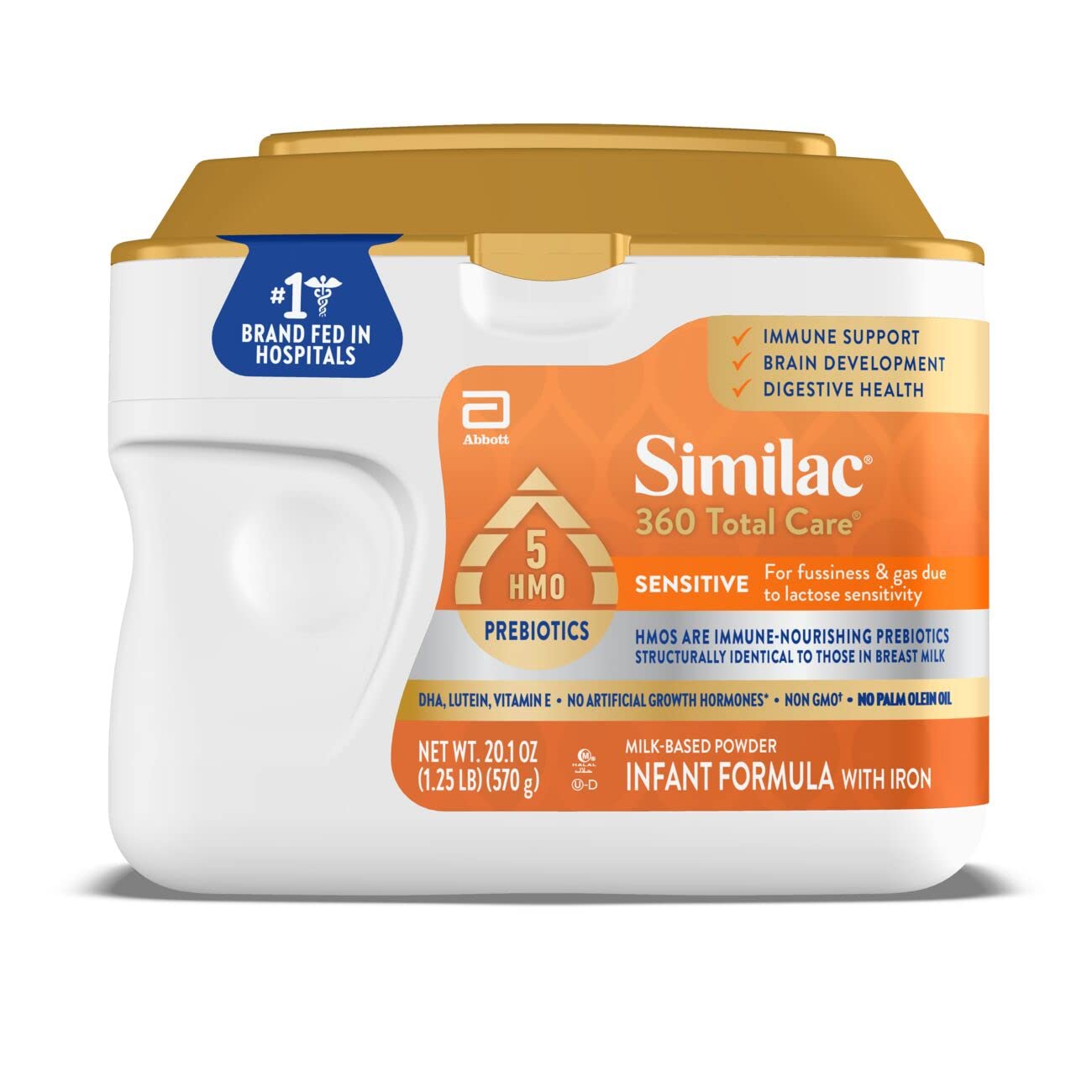 Similac 360 Total Care Sensitive |
|
| $38.49 | Check price $38.49 |
| Probiotic Pick |  Dr. Brown's Gentle Pro |
|
| $39.49 (32 oz) | Check price $39.49 |
Enfamil NeuroPro Gentlease
Similac 360 Total Care Sensitive
Dr. Brown’s Gentle Pro
Enfamil NeuroPro Gentlease — full review
Enfamil NeuroPro Gentlease is a well-established partially hydrolyzed option, and a common first step when ordinary fussiness, gas, and spit-up are the symptoms but CMPA isn’t the diagnosis. Its protein source is partially hydrolyzed whey-casein blend — protein chains broken into smaller pieces that babies can digest with less work, but not broken down enough to address true allergy. The “NeuroPro” addition over standard Gentlease centers on DHA and choline — ingredients the manufacturer includes for brain development support; DHA is required in EU infant formulas. The “fussiness in 24 hours” figure Enfamil markets comes from the company’s own clinical studies of the most obvious discomfort symptoms (post-feed crying, gassy fussiness); independent confirmation is limited, and full pattern improvement more typically takes 7–10 days.
The taste is the trade-off: Gentlease has a slightly bitter aftertaste from the partial hydrolysis, milder than fully extensively hydrolyzed formulas but still noticeable. Babies who switch in the first 2–3 months accept it best; older infants who’ve already tasted standard formula sometimes refuse for 3–5 days before accepting.
Mixing matters with this pick. Always follow the water-to-powder ratio printed on the label and the CDC’s guidance on safely preparing powdered formula — never dilute or stretch a bottle. Within those instructions, Gentlease tends to foam if you over-shake; shake gently for 15–20 seconds, then let the foam settle for about a minute before feeding. This pick now comes as a 35.2 oz can — a larger size that means fewer reorders, though prepared-ounce yield depends on the exact scoop-to-water ratio printed on your label. Availability has tightened: it currently shows a shipping lead time of about 1–3 weeks on Amazon, so confirm live stock and price before buying. Most insurance plans don’t cover gentle formulas (only hypoallergenic), but WIC programs often include partially hydrolyzed picks — check your state’s formula list. Residue also builds up fast in nipples and vents with any powdered formula — our best bottle sterilizers guide covers the steam and UV options that keep daily prep sanitary.
Similac 360 Total Care Sensitive — full review
Similac 360 Total Care Sensitive is the gentle formulas answer for babies whose fussiness comes from mild lactose sensitivity rather than protein digestion difficulty. The protein is intact (not hydrolyzed), but the lactose content is reduced and partially replaced with corn syrup solids and sugar — easier on babies who struggle with lactose specifically. The “360 Total Care” addition is the 5 HMO prebiotic blend — a blend of five prebiotics from a family found naturally in breast milk, intended to support beneficial Bifidobacterium in the gut microbiome. HMOs are the third most abundant solid component in breast milk after lactose and fat, and research into their role in gut and immune development is active and promising — though formula HMOs are not equivalent to breast milk.
The catch is the protein is still intact, which means it doesn’t address protein-digestion fussiness — if your baby’s symptoms come from cow milk protein difficulty rather than lactose, this pick won’t help as much as Enfamil Gentlease or Dr. Brown’s Gentle Pro. The diagnostic challenge is that parents can’t always tell which is the underlying issue, which is why pediatrician input matters.
Cost is reasonable for a US-market pick with a 5 HMO prebiotic blend, and it typically runs below the NeuroPro Gentlease can — though formula prices shift often, so compare the live price before buying. Available at Target, Walmart, CVS, Amazon, and most grocery stores. If your pediatrician suspects lactose sensitivity rather than protein issues, this is the right starting pick. If symptoms don’t resolve in 2 weeks, talk to your pediatrician about trying a partially hydrolyzed pick instead.
Dr. Brown’s Gentle Pro — full review
Dr. Brown’s Gentle Pro (formerly sold as Gerber Good Start GentlePro before the brand transition) is the gentle formulas pick combining partially hydrolyzed whey with added probiotics for layered gut microbiome support. Where Enfamil Gentlease uses a partially hydrolyzed whey-casein blend, Dr. Brown’s uses 100% partially hydrolyzed whey — whey is generally easier to digest than casein, though head-to-head comparisons between the two picks are limited. The added probiotic strain (B. lactis) is one of several probiotics studied for infant digestive comfort; the evidence on probiotics for colic is mixed and strongest for other strains, so treat this as a possible bonus rather than a proven benefit.
Some parents report whey-only formulas are easier to keep down than whey-casein blends, and the milder bitter notes of whey-only hydrolysis can make first-day acceptance easier than Enfamil Gentlease for some babies.
The 32 oz can is a solid value size — larger than the 20.1 oz Similac tub — meaning fewer reorders and lower per-feeding cost when calculated over a month. The larger 32 oz can generally brings the per-ounce cost below the smaller Similac tub, though formula prices shift often — compare the live price before buying. The recent brand transition from Good Start to Dr. Brown’s has caused some retailer stocking inconsistency in 2026 — Amazon availability is the most reliable, with grocery stores still catching up to the new branding. The recipe and manufacturing standards are unchanged from the Good Start era according to the parent company.
5 things to know before switching to a gentle baby formula
Distinguish fussiness from CMPA before switching
Pediatricians distinguish ordinary fussiness from cow milk protein allergy by symptom severity and pattern. Ordinary fussiness includes mild gas, brief post-feed crying, occasional spit-up, and 1–3 hours of evening fussy time — all common and gentle-formula-appropriate. CMPA red flags are bloody stools, projectile vomiting, severe eczema, hives, swelling, or breathing difficulty. Don’t self-diagnose — switch only after your pediatrician confirms ordinary digestion struggles are the issue.
Partially hydrolyzed for protein issues, reduced lactose for lactose issues
The two main gentle formula categories address different problems. Partially hydrolyzed formulas (Enfamil Gentlease, Dr. Brown’s Gentle Pro) help when fussiness comes from cow milk protein digestion difficulty. Reduced-lactose formulas (Similac 360 Total Care Sensitive) help when fussiness comes from mild lactose sensitivity. Talk to your pediatrician about which symptom pattern your baby shows; the wrong category won’t deliver expected relief.
Give it 14 days before judging effectiveness
Partially hydrolyzed formulas are well tolerated in healthy term infants per a 2024 randomized controlled trial in Frontiers in Pediatrics; in practice, pediatricians commonly suggest allowing about 7–14 days before judging whether a switch is helping. Don’t switch again at day 5 because crying hasn’t fully resolved — that’s normal. Track crying minutes per day, gas episodes, sleep blocks, and stool quality during the trial, and bring the log to your pediatrician follow-up at day 14.
Transition gradually over 5–7 days
Sudden formula switches can cause GI upset that mimics intolerance. Prepare each formula separately exactly as its own label directs — never combine powders in one bottle or change the water-to-powder ratio — then offer roughly 25% new for 1–2 days, then 50/50 for 2 days, then 75% new for 1–2 days, then 100% new. This 5–7 day transition gives your baby’s gut microbiome time to adjust and prevents you from confusing transition discomfort with gentle-formula failure.
Pair with anti-colic bottles for compounding benefit
Gentle formulas address what’s in the bottle; anti-colic bottle systems address how the formula reaches the baby. Excess air swallowing during feeds amplifies gas and fussiness even with partially hydrolyzed formula. Vented or paced-flow bottles are designed to reduce how much air a baby swallows during a feed. Combining gentle formulas with vented bottles addresses both the formula and the air-intake side of the problem at once.
Best gentle formulas: frequently asked questions
Partially hydrolyzed gentle formulas may reduce fussiness and crying, but results vary by baby. Pediatricians commonly suggest allowing about 7–14 days before judging whether a switch is helping; reduced-lactose formulas are usually judged on a similar timeline. If your baby is still showing the same fussiness after 2 weeks on a gentle formula, that’s a signal to revisit the diagnosis with your pediatrician — CMPA, reflux, or other underlying issues may need different treatment than gentle formulas can provide.
Yes — many babies outgrow ordinary fussiness by 4–6 months as their digestive systems mature. Ask your pediatrician about trying a switch back to standard intact-protein formula around the 6-month mark, transitioning gradually over 5–7 days. If fussiness returns within a week of switching back, return to the gentle formula. The gentle formula isn’t a permanent commitment; it’s a digestive support during the early developmental period when sensitivity is highest.
Gentle formulas typically run 15–30% more than standard formula. The extra cost is worthwhile when your baby has documented fussiness, gas, or spit-up issues that disrupt feeding, sleep, and family life. For babies with no symptoms, gentle formulas don’t provide measurable benefit over standard formula — the AAP and pediatric guidelines specifically advise against using gentle formulas as preventive measures for healthy non-fussy babies. Match the formula category to your baby’s actual symptoms.
“Gentle” and “sensitive” are largely interchangeable marketing terms for partially hydrolyzed or reduced-lactose formulas designed for ordinary fussiness and digestion struggles. “Hypoallergenic” is a clinical term reserved for extensively hydrolyzed and amino acid formulas that meet AAP requirements for tolerance by 90%+ of CMPA-diagnosed infants. Gentle formulas are NOT hypoallergenic and are NOT safe for confirmed CMPA. If your baby has true allergy, see our hypoallergenic formulas guide for the right category.
European gentle formulas like HiPP Comfort use partially hydrolyzed proteins and reduced lactose similar to US picks, but they’re not FDA-regulated for US sale and importing carries the same risks as importing any European formula — no recall protection, lab oversight gaps, and counterfeit risk. Direct head-to-head comparisons of clinical effectiveness are limited; the regulatory protection is the clear difference. We cover the broader European versus US comparison in our European vs. US formulas guide.
The closest Enfamil equivalent to Similac Sensitive is Enfamil Gentlease. Both ease lactose-related fussiness, but aren’t identical: Similac Sensitive keeps intact protein and only reduces lactose, while Gentlease also partially hydrolyzes it. If lactose is the issue they’re comparable; if protein digestion is, Gentlease wins.
Yes — combo-feeding gentle formula with breast milk works well, particularly during the first 5–7 days when your baby is adjusting to the slightly different taste of partially hydrolyzed protein. Prepare the formula separately according to its label first — never add powder straight into breast milk — then combine roughly 75% breast milk / 25% prepared gentle formula for 2–3 days, then 50/50, then 25/75, then full gentle formula. If your baby is exclusively breastfed and showing fussiness, consider whether dairy in your own diet might be triggering symptoms before switching to formula entirely — talk to your pediatrician about a maternal dairy elimination trial first.
Not much, in practice. Sensitive formulas usually reduce lactose while keeping intact protein; gentle formulas usually partially hydrolyze it. Both target ordinary fussiness, gas, and spit-up rather than true allergy, so the choice comes down to whether your baby struggles with lactose or with protein digestion.
Our #1 pick: Enfamil NeuroPro Gentlease
A well-established partially hydrolyzed gentle formula, and a reasonable starting point for ordinary fussiness, gas, and spit-up that doesn’t indicate true CMPA. Brain-supporting DHA and choline are the main things that set it apart from other US gentle formulas.
Check price on Amazon → $68.99Medical disclaimer: Not medical advice. Gentle formula selection should be made with a pediatrician, especially when fussiness, gas, or spit-up symptoms are persistent or severe. The information here is educational and reflects current clinical guidance as of our last review. Consult HealthyChildren.org (AAP) for additional pediatric guidance.
Prices: Reflect typical Amazon pricing as of April 2026 and may vary. Tub and can sizes change occasionally — verify on the linked product page before ordering. Dr. Brown’s Gentle Pro was previously sold as Gerber Good Start GentlePro before the 2025 brand transition; recipe and manufacturing standards are unchanged.
- Nocerino A. Protein Intolerance. Medscape Drugs & Diseases (eMedicine); updated Dec 5, 2024. Cow’s-milk protein is the most frequent cause of food intolerance/allergy in infancy — the basis for hydrolyzed and hypoallergenic formulas.
- Deshpande PG. Colic. Medscape Drugs & Diseases (eMedicine); updated Dec 13, 2023. Colic is a benign behavioral syndrome of excessive, paroxysmal crying in otherwise healthy infants, typically in the evenings and without an identifiable cause.
- American Academy of Pediatrics, Committee on Nutrition. Hypoallergenic Infant Formulas. Pediatrics. 2000;106(2):346-349. A formula qualifies as “hypoallergenic” only if, with 95% confidence, at least 90% of infants with confirmed cow’s-milk allergy tolerate it — a threshold met by extensively hydrolyzed and amino-acid formulas, not partially hydrolyzed (“gentle”) ones.
- Kipfer S, Goldman RD. Formula choices in infants with cow’s milk allergy. Can Fam Physician. 2021;67(3):180-182. Partially hydrolyzed cow’s-milk formula should not be used to treat cow’s-milk allergy, because cross-reactivity has been demonstrated in roughly 50% of infants with the allergy.
- Greer FR, Sicherer SH, Burks AW; AAP Committee on Nutrition and Section on Allergy and Immunology. The Effects of Early Nutritional Interventions on the Development of Atopic Disease in Infants and Children. Pediatrics. 2019;143(4):e20190281. There is no convincing evidence that partially or extensively hydrolyzed formula prevents atopic disease, so hydrolyzed (“gentle”) formula is not recommended as a preventive measure.
- Bode L. Human milk oligosaccharides: every baby needs a sugar mama. Glycobiology. 2012;22(9):1147-1162. Human milk oligosaccharides are the third most abundant solid component of human milk, after lactose and lipids, and act as prebiotics that help shape the infant gut microbiome.