
Best Audiobooks for New Parents: An RN’s 2 A.M. Listening List for 2026
I worked years of hospital night shift as a critical-care RN, and here’s what the newborn months have in common with any night shift: they run on the same clock. Same 3 a.m. clock, same fluorescent-fog brain, same loneliness of being the only person awake in the building. The difference is that at home with a cluster-feeding six-week-old, your hands and eyes are completely occupied for hours — but your ears are completely free. That mismatch is exactly what the best audiobooks for new parents are built for.
This isn’t a typical product roundup — you can’t bench-test a memoir. It’s the listening list I wish every family got tucked into their hospital discharge folder: which audiobooks survive being interrupted every twenty minutes, which to save for the long contact nap versus the 2 a.m. feed, and the few books still worth owning in print. The cheapest way to work through it is Audible’s free trial, which includes a full credit — enough to test the whole idea against your real 2 a.m. before paying anything. Pair the habit with a comfortable feeding setup from our nursery glider guide, and those night feeds stop feeling like lost hours.
Best audiobooks for new parents: where to start
Start with the free trial so your first listen costs nothing, lead with Emily Oster’s data-driven and blessedly re-listenable Cribsheet, and keep one book — the breastfeeding reference — in print, because latch photos don’t work in audio. When it is baby’s turn for stories, our when to start reading to baby guide covers how early shared reading pays off.

Check price on Amazon $10.13

Check price on Amazon $24.98
Safety first: one earbud, low volume, and stay awake for contact naps
Two non-negotiables from the RN side. First: one earbud when you’re on duty, at a volume that still lets you hear breathing changes, congestion, or a spit-up. You are the monitor; the audiobook rides shotgun. Second: contact naps are only safe when the adult is fully awake. The AAP’s safe-sleep guidance is blunt — an adult falling asleep with a baby on their chest, especially on a couch or armchair, is a serious suffocation risk. If sleep is coming, the baby goes into the crib or bassinet, mid-chapter or not. Used this way, an audiobook is actually a safety tool: far better at keeping a drowsy parent alert than staring at a dark wall.
What makes a great audiobook for new parents
The newborn window creates a very specific listener: interrupted constantly, awake at strange hours, emotionally raw, hungry for both information and escape. The books below were chosen against that reality.
Interruption tolerance. A thriller with a plot to track is the wrong tool at 3 a.m. — miss ten minutes to a diaper change and you’re lost. Essay collections, chapter-per-topic parenting books, and comfort re-reads all resume gracefully; books were sorted by exactly that.
Information versus escape, in the right ratio. All-parenting listening backfires — it turns every feed into homework and feeds the anxiety loop. This list deliberately mixes evidence-based titles with pure escape, because the parents who keep listening are the ones who alternate.
Evidence alignment. Every parenting book here was checked against current AAP positions on safe sleep, feeding, and development. Where an author summarizes research rather than issuing guidance — Oster is the clearest example — we flag that these are decision-making frameworks, not medical advice, and your pediatrician outranks any audiobook.
The starter shelf: three picks at a glance
Audible Free Trial
Cribsheet: A Data-Driven Guide to Better, More Relaxed Parenting, from Birth to Preschool (The ParentData Series)
Check price on Amazon $10.13
The Womanly Art of Breastfeeding: Completely Revised and Updated 8th Edition
Check price on Amazon $24.98
Short chapters, warm voices, zero plot-tracking required
The overnight feed is the hardest listening slot of the day: you’re at your cognitive lowest and the session might last 20 minutes or 60. What works here is material with no memory burden.
Cribsheet (Emily Oster, paperback around $10 $10.13) is the anchor pick — each chapter stands alone, and hearing the actual evidence on night wakings while you’re living one is strangely calming. The Wonder Weeks (around $9 in paperback $10.65, also available in audio) fits the same slot: cue up just the “leap” your baby is currently in. One clinical note — its precise leap timeline is more schedule than settled science, so treat it as a reassuring map of common fussy phases, not a diagnostic calendar. The message underneath earns the slot: fussy weeks are normal, developmental, and temporary.
Cribsheet: A Data-Driven Guide to Better, More Relaxed Parenting, from Birth to Preschool (The ParentData Series)
Check price on Amazon $10.13

The Wonder Weeks: A Stress-Free Guide to Your Baby’s Behavior
Check price on Amazon $10.65
For the escape half of the ratio, this is the slot for comfort re-listens — a book you already love, where losing ten minutes costs nothing.
The 90-minute deep-dive window
A daytime contact nap is the best listening real estate you’ll get: you’re awake (and must stay awake — that’s the rule), the baby is settled, and you have an uninterrupted hour. This is where the meatier books go.
Expecting Better (Emily Oster, around $9 in paperback $11.01) is technically the pregnancy book, but worth a postpartum listen if another baby is on the horizon. The Whole-Brain Child (Siegel & Bryson, around $11 in paperback $10.48) is the pick that pays off later — its strategies aim at toddlers, but hearing the framework early, while your baby is still immobile and quiet, means you’ll have it loaded when the tantrums arrive. And Bringing Up Bébé (Pamela Druckerman, around $11 in paperback $8.90) is the genre’s best crossover — half memoir, half parenting observation, genuinely funny, paced like the escape read your brain is craving. Take its French-parenting prescriptions as anthropology rather than instruction, and it’s a joy.

Expecting Better: Why the Conventional Pregnancy Wisdom Is Wrong–and What You Really Need to Know (The ParentData Series)
Check price on Amazon $11.01

The Whole-Brain Child: 12 Revolutionary Strategies to Nurture Your Child’s Developing Mind
Check price on Amazon $10.48

Bringing Up Bébé: One American Mother Discovers the Wisdom of French Parenting
Check price on Amazon $8.90
Hands busy, brain free
Walks, dishes, bottle-washing, laundry: the motion slots. You’re more alert than at 3 a.m., so reference-style listening lands best here. What to Expect When You’re Expecting (around $9 in paperback $9.43) remains the standard month-by-month reference, and its section-based structure suits skip-around listening — cue up the month you’re actually in and ignore the rest. This is also the natural slot for pure escape: memoirs, comedy, light fiction. The parents who burn out on listening are the ones who treat every free ear-hour as a parenting seminar, so guard at least half your walk time for books that have nothing to do with babies. That’s not indulgence; on the night-shift wards we called it staying human.
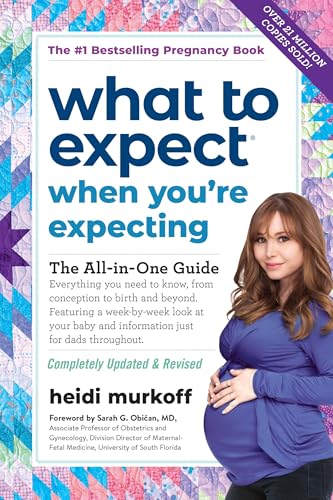
What to Expect When You’re Expecting: (Updated in 2026)
Check price on Amazon $9.43
Your voice is your baby’s favorite audiobook
One thing audio can’t outsource: the AAP recommends reading aloud to your baby starting in infancy, because early shared reading builds language, bonding, and later literacy. The source material costs less than a latte. Goodnight Moon (around $7 board book $6.91) and The Very Hungry Caterpillar (around $6 $5.74) are the canonical starters; Brown Bear, Brown Bear (around $6 $5.97) adds the high-repetition rhythm young babies lock onto; and the rip-proof, drool-proof Indestructibles: Baby Animals (around $4 $3.64) covers the grab-and-chew phase. For a full developmental-stage breakdown, see our board books by stage guide.

Goodnight Moon Milestone Edition: A Beloved Bedtime Classic Featuring a Bunny Saying Goodnight
Check price on Amazon $6.91


Lift-the-Tab: Brown Bear, Brown Bear, What Do You See?: Classic Novelty Lift-the-Tab (Brown Bear and Friends)
Check price on Amazon $5.97

Indestructibles (The Original): Baby Animals: Chew Proof · Rip Proof · Nontoxic · 100% Washable (Book for Babies, Newborn Books, Safe to Chew)
Check price on Amazon $3.64
5 rules for audiobook listening with a newborn
One earbud is the uniform
Keep one ear open whenever you’re the caregiver on duty, at a volume a change in your baby’s breathing would cut through. Single-earbud modes and bone-conduction headphones exist for exactly this; over-ear noise-cancelling headphones don’t belong in the nursery.
The audiobook never overrides safe sleep
Mid-chapter is not a reason to keep a sleeping baby on your chest when drowsiness hits. Per AAP guidance, babies sleep safest alone, on their backs, in a bare crib or bassinet — adult sleep with a baby on a couch or armchair is one of the highest-risk arrangements there is. Pause button first, every time. Our sleep training guide covers the longer game of independent sleep.
Slow the narration down, not up
Productivity culture says 1.5x. Sleep deprivation says otherwise: on broken sleep, 0.9–1.0x is where retention actually lives. The newborn-era audiobook isn’t about throughput — it’s about keeping your mind fed through hours that would otherwise be empty and long.
Alternate information and escape
A parenting book, then a novel or memoir. The pattern that lasts is alternating; turning listening into a second job of self-improvement is the fastest way to quit. Balance is the dosing schedule.
Know when print wins
Anything you’ll use as a mid-crisis reference — breastfeeding troubleshooting, first-aid steps, dosing charts — belongs on paper you can flip to one-handed. That’s why The Womanly Art of Breastfeeding sits in our print column, and why the pediatrician’s dosing sheet goes on the fridge, not in your ears.
Audiobooks for new parents: frequently asked questions
Start with one evidence-based parenting title and one pure-escape book, and alternate. Our first-listen pick is Emily Oster’s Cribsheet — short, self-contained chapters that survive constant interruption, and a data-driven message that lowers anxiety. Claim it with the credit in Audible’s free trial so your first listen costs nothing, then add The Whole-Brain Child or Bringing Up Bébé for longer contact-nap sessions.
With the right setup, yes. One earbud only, at a volume that still lets you hear breathing, congestion, or fussing — you remain the monitor. Skip noise-cancelling over-ear headphones while on duty, and never let an audiobook keep you on the couch past the point of drowsiness with a baby on your chest: if sleep is coming, the baby goes into the bassinet first, per AAP safe-sleep guidance.
No — a parent quietly listening to a book while feeding is still holding, feeding, and responding to their baby. What matters is the mix across the day: plenty of face-to-face talking, singing, and reading aloud in the awake windows, which the AAP encourages from infancy. Let the audiobook cover the silent 3 a.m. feed, and let your own voice cover story time.
For most reading, yes, purely on logistics: your hands and eyes are occupied for hours a day, and audio is the only format that fits a contact nap or a 40-minute feed. The exceptions are visual references — breastfeeding guides with latch photos, first-aid manuals — which belong in print. Most parents land on a hybrid: audio for narrative and theory, print for look-it-up references and board books for the baby.
Yes — the trial includes a full credit good for any premium audiobook, and if you cancel before it ends you pay nothing and keep the title you claimed. If you don’t cancel, it converts to a paid monthly membership, so set a phone reminder a few days out and decide then whether the habit has stuck.
Both — deliberately alternated. All-parenting listening turns every feed into a seminar and feeds the anxiety loop; all-escape listening wastes a good window for frameworks you’ll want later, like The Whole-Brain Child. A sustainable mix is roughly half information, half escape, with the densest material saved for daytime contact naps when the brain is least foggy.
Format follows the moment. For narrative and theory — Cribsheet, The Whole-Brain Child, Bringing Up Bébé — audio wins, because your hands stay full through feeds and contact naps. Keep visual references like breastfeeding guides in print. Most parents settle on a hybrid: audio for the long night hours, print on the nightstand.
The real recommendation: reclaim the night shift
You will spend hundreds of hours this year with your hands full, your eyes on a dozing baby, and your ears doing nothing. That time can feel like it’s disappearing — or it can be the year you read forty books. Start the free trial, claim Cribsheet with the included credit, keep one earbud open, and let the 3 a.m. shift give something back.
Medical disclaimer: Not medical advice. Parenting books — in any format — are educational resources, not clinical guidance. Decisions about feeding, sleep, and your baby’s health should be made with your pediatrician. For safe-sleep and early-literacy guidance, consult HealthyChildren.org (AAP).
Prices: Reflect typical Amazon pricing as of July 2026 and may vary. Audible trial terms (length, included credits, and included-catalog access) are set by Audible and may change — verify current terms on the sign-up page.
- Burnett LB. Sudden Infant Death Syndrome (SIDS). Medscape Drugs & Diseases (eMedicine); updated Mar 10, 2026. SIDS (now grouped under Sudden Unexpected Infant Death) is a leading cause of death at 1-12 months, peaking at 1-3 months; a bare, separate back-sleep surface and avoiding soft bedding and overheating are central to risk reduction.