
Best Rear-Facing Camera Monitors for 2026
The best rear-facing camera monitors let you check on your baby without twisting around. Based on published safety guidance and manufacturer specifications, three stood out. The Itomoro ($25.99) pairs a 149° wide lens with the highest install base on Amazon, the DoHonest ($29.98) features a matte anti-glare display, and the LUCKVIEW BM2A ($49.98) is the only pick here with real optical 3× zoom and a 5.2″ IPS display. The American Academy of Pediatrics urges keeping babies rear-facing as long as possible — but that leaves parents driving blind. Per NHTSA distracted-driving research, glancing away from the road for just five seconds at highway speed equals a football field driven blind. For installation basics see our infant car seats guide, and compare mirror alternatives in our backseat mirrors roundup.
The best rear-facing camera monitors for safe, quick-glance checks
Best anti-glare clarity for daytime drives, best wide-lens value at under $30, and best premium pick with real optical zoom and the largest display.
Driver-distraction warning: treat it like a rearview mirror
Mounting any screen in your dashboard carries real risk. Per NHTSA distracted-driving research, a glance longer than two seconds doubles crash risk at highway speed. Treat your rear-facing camera monitor like a rearview mirror — quick glances only, never sustained viewing. Mount the display where it doesn’t obstruct your forward view or the airbag deployment path. Never adjust camera angles or menu settings while moving. If your baby cries or needs attention, pull over safely before responding — the camera’s job is reassurance, not intervention.
How we review the best rear-facing camera monitors
A rear-facing camera monitor that washes out in summer sun, drops the image on rough roads, or is slow to boot is worse than no monitor at all — it teaches you to stop trusting it. We evaluate three things against published safety guidance and manufacturer specifications:
Install and stability. We look at the mounting design — supplied headrest straps, 12V/USB power, cable-routing complexity, and how securely the camera anchors to a headrest. A design that resists re-aiming through everyday bumps matters more than any single feature.
Visibility across light conditions. We weigh the specs that drive real-world readability: anti-glare display coating, IR night-vision type, field of view across a rear bench, display size and resolution, and zoom where present. Matte anti-glare and larger displays are easier to read at a quick glance in bright sun.
Safe, quick-glance use. We consider boot behavior at engine start and how each design supports rearview-mirror-style glances rather than sustained viewing — the only safe way to use any in-cabin screen while driving, per NHTSA distracted-driving guidance.
Best rear-facing camera monitors: side-by-side comparison
| Pick | Product | Key strengths | Watch-outs | Price | Where to buy |
|---|---|---|---|---|---|
| Top Pick |  DoHonest Baby Car Camera |
|
| ~$29.98 | Check price |
| Best Value |  Itomoro Baby Car Mirror |
|
| ~$25.99 | Check price |
| Best Premium | 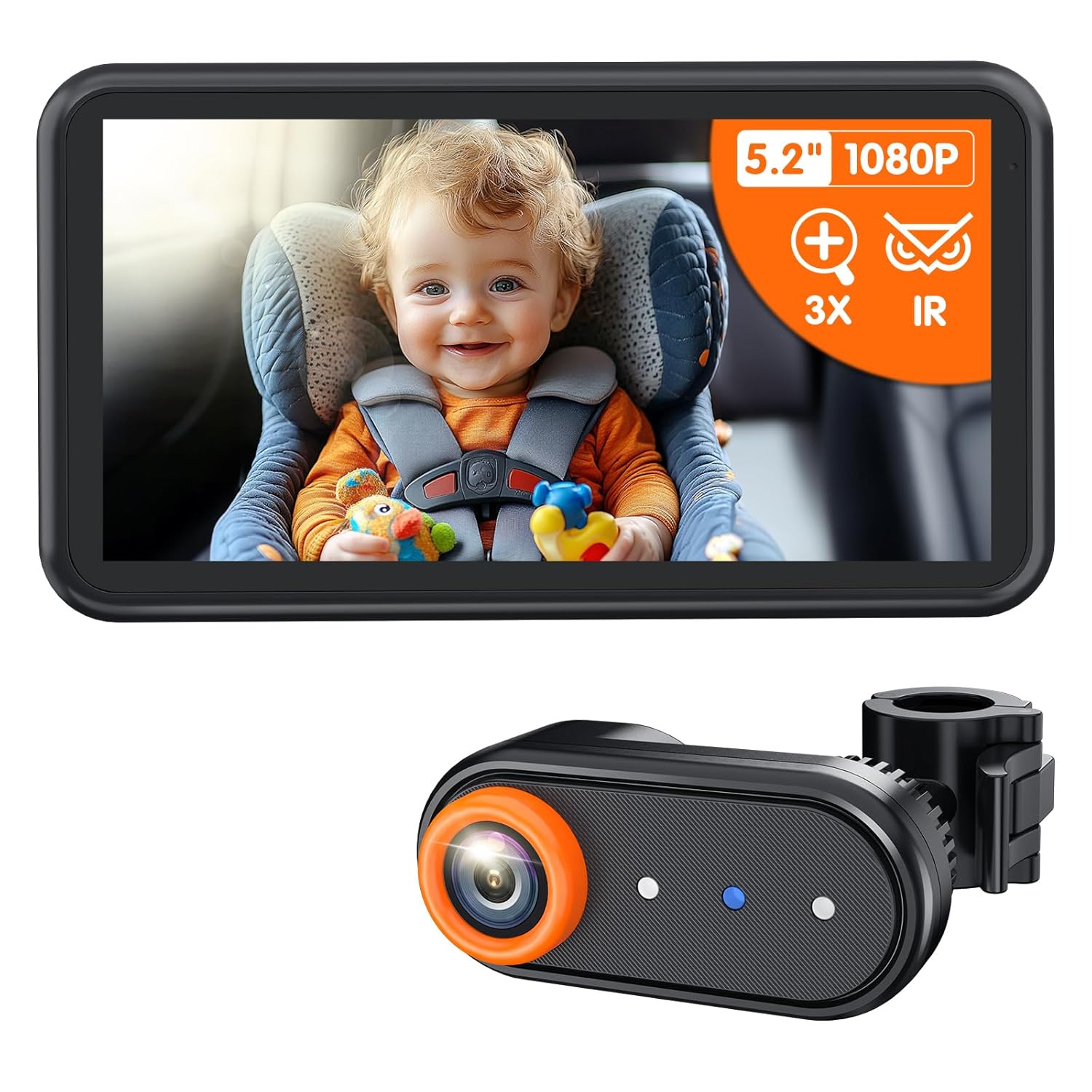 LUCKVIEW BM2A |
|
| ~$49.98 | Check price |
DoHonest Baby Car Camera
Itomoro Baby Car Mirror
LUCKVIEW BM2A
DoHonest Baby Car Camera — the details
The DoHonest earns Top Pick on one specific feature: its matte anti-glare screen coating. Glossy displays wash out toward unreadable white in midday sun through a windshield, which defeats the purpose of a screen you’ll glance at while driving. A matte anti-glare finish is designed to keep the image usable in that bright-sun scenario — the single biggest differentiator for this kind of device.
Install is straightforward: plug the USB power lead into a front 12V accessory port, route the cable under the passenger-side trim, strap the camera to the rear headrest, and aim. The adjustable ball-joint camera mount lets you set the angle precisely and hold it. As a USB plug-and-play unit, it powers up when the accessory circuit goes live, so the feed is ready shortly after ignition.
The one thing to flag: the 4.3″ display is physically smaller than the LUCKVIEW’s 5.2″ panel. If your eyesight is imperfect or your dashboard is deep, consider the bigger screen. But for anti-glare clarity per dollar among rear-facing camera monitors, the DoHonest stands out.
Itomoro Baby Car Mirror — the details
The Itomoro is the value story: the lowest-priced pick here and the most-installed rear-facing camera on Amazon, with years of high-volume reviews behind it. The 149° lens frames two rear-facing car seats across a bench without squashing faces toward the edges — genuinely useful if you have a newborn and a toddler sharing the backseat. At $25.99 it undercuts the DoHonest by $4 and the LUCKVIEW by $24.
Install mirrors the DoHonest’s process — USB plug into a 12V-to-USB adapter, run the cable along the trim, strap the camera to the rear headrest. The 360° rotating camera head is the Itomoro’s signature feature: you can aim the lens almost anywhere, which matters more than you’d think when you switch the rear-facing seat from center to passenger-side.
The trade-off: its display doesn’t have the DoHonest’s dedicated matte anti-glare coating, so it’s more prone to washout in direct sun. If you commute into a low sun at 5pm in summer, that matters. If you mostly drive morning and evening runs, it’s a non-issue. Either way, this is the rear-facing camera monitor to buy if the budget is tight — or if you already know you want two (one per vehicle).
LUCKVIEW BM2A — the details
The LUCKVIEW is the rear-facing camera monitor for parents who want premium picture quality. The 5.2″ IPS display is physically larger than the other two picks (nearly 1.5× the screen area), and the optical 3× zoom is the only real zoom among these picks. That zoom is the standout feature: it lets you look closely enough to tell whether a pacifier is actually in your baby’s mouth or just resting on the chin — something a fixed-focus monitor can’t do.
Auto IR night vision switches from color daylight to grayscale IR automatically — a detail that matters on early-morning and winter drives. The built-in sun-shade bezel around the display is a small but thoughtful touch that reduces glare a different way than the DoHonest’s matte screen coating does.
Trade-off: price. At $49.98 you’re paying nearly double the Itomoro. The mount footprint is also larger — on a compact sedan dashboard, it may eat visibility you didn’t expect to lose. But for parents who want the largest, sharpest rear-facing camera monitor display here, the LUCKVIEW justifies the spend.
Safe-install rules for the best rear-facing camera monitors
Don’t block airbag deployment
Never mount the display where it could launch into the passenger compartment during airbag deployment. Keep displays low on the dash or in the center console area, well clear of the passenger-side airbag zone. The CPSC flags loose dashboard accessories as a real injury risk in frontal crashes — a heavy display becomes a projectile when an airbag fires.
Keep cable runs clean and out of reach
Route cables along existing trim seams and under the passenger-side door threshold. Never let a cable dangle where a child can grab it, and keep cables clear of seat-track slide paths and the footwell floor. Zip-ties on existing harnesses keep things tidy for years and prevent rattles on rough roads.
Strap the camera firmly to the headrest
A loose rear camera shifts every bump, and a moving camera ruins the whole system. Cinch the headrest strap tight enough that you can’t move the camera with hand pressure. Re-check after the first week of driving — straps bed in and need one adjustment before they hold permanently. Note that a rear-facing camera and its headrest mount are aftermarket add-ons — they are not part of your car seat and are not crash-tested to FMVSS 213 by any independent authority. Per NHTSA, accessories not sold with the seat can become projectiles or interfere in a crash, so keep the camera clear of your child’s head and secure the strap so a unit that loosens can’t come free.
Aim once, then leave it alone
Aim the camera with the car seat installed at the seating position you’ll use daily. Don’t adjust aim on the fly. If you switch the rear-facing seat to a different bench position, pull over and re-aim — never reach behind you while the vehicle is moving.
Treat the screen like a rearview mirror
Quick glances only, never sustained viewing. If your baby needs attention beyond a quick look, pull over. The purpose of rear-facing camera monitors is reassurance — not remote intervention while driving. Consult AAP injury-prevention guidance for more on safe in-vehicle behavior with infants.
Best rear-facing camera monitors: frequently asked questions
In most real-world situations, yes — but with caveats. Rear-facing camera monitors put the image where your eyes are already looking (dashboard level), which reduces the focus-shift distance compared to glancing at a rearview mirror reflection of a backseat mirror. That shorter focus shift means a faster return to the road. The caveat: cameras can become a sustained-viewing distraction if parents stare at them. A mirror gets a glance; a screen can pull attention. Used correctly (quick glances only), the best rear-facing camera monitors beat mirrors for visibility and safety.
No — every USB-powered pick in this guide only draws power while the vehicle’s accessory circuit is live (i.e., when the key is in the “ON” position or the engine is running). Turn the car off and the monitor powers down, so there’s no parasitic drain on your battery while parked.
Yes, easily. The USB plug-and-play designs mean you can swap the whole system between a primary car and a second vehicle in a few minutes. Just unthread the cable, unstrap the camera from the headrest, and reinstall. There’s no pairing or calibration step, so moving a unit between vehicles is simply an unplug-and-reinstall.
With a long enough cable run, yes. All three picks use a single cable from display to camera; the Itomoro and LUCKVIEW ship with roughly 15 feet of cable, which is long enough for most SUV and minivan third-row installs. The DoHonest’s cable is shorter — measure your run before buying if you’re installing in a Honda Odyssey, Toyota Sienna, or similar.
None of the picks in this guide record. They’re live-feed only — camera to display, no storage. If you want DVR-style recording, you’re looking at a different category (dash cams with interior-facing channels). For rear-facing infant monitoring specifically, live-only is usually preferable — no privacy storage to worry about and no files to manage.
Generally, no. Wireless baby car cameras are prone to signal dropouts — more metal in an SUV structure can weaken the link — and wireless transmission can introduce noticeable lag between camera and display. A wired connection avoids both by design. Cable management is a one-time install job — not worth trading connection reliability for.
For most checks, yes — and that’s the point. You can see if your baby is sleeping, if the pacifier fell, or if a toy is out of reach, all without shifting your body or eyes off the road. What it can’t do is reach back to hand something over or reposition a head that’s slumped forward. For those, pull over safely — the camera is reassurance, not intervention.
The best baby car camera for a rear-facing seat comes down to a matte anti-glare display readable in bright sun, a wide lens (around 149–150°) that frames the whole rear bench, and a mount that straps firmly to the headrest so the image doesn’t drift on bumps. Treat whichever you pick like a rearview mirror — quick glances only.
Our #1 pick: DoHonest Baby Car Camera
Best anti-glare display of our three picks, USB plug-and-play install, boots at ignition. A matte-coated screen built to stay readable in bright sun, for $29.98.
Check price on Amazon →Safety disclaimer: Pediatric Picks is not a substitute for manufacturer installation guidance or professional advice. Always follow your vehicle’s owner manual and the monitor’s installation instructions. Per NHTSA distracted-driving guidance, never adjust cameras or screens while the vehicle is moving. Mount displays clear of airbag deployment paths.
Prices: Reflect typical Amazon pricing as of April 2026 and may vary.