
Best Infant CPR Training Kit 2026: 3 Manikin and Mask Picks Reviewed
The best infant CPR training kit for at-home practice should help a parent or caregiver build the muscle memory that turns a panicked freeze into a usable response — a confident hand position, a 30:2 compression-to-breath cadence, and a properly seated mask seal. We reviewed 3 contenders against the American Heart Association’s current infant CPR algorithm and the chest-compression depth and rate the AHA recommends for under-1-year patients, evaluating each on published safety standards and verifiable manufacturer specifications. Three picks stand out for clinically appropriate practice: the MCR Medical Infant CPR Training Manikin with Rate Monitor at roughly $172 (our top pick for hands-on technique practice with chest-compression feedback), a $9.95 Adult and Infant CPR Mask Combo Kit with 2 one-way valve masks (our best budget mask pick for emergency kits and go-bags), and a $14.25 Adult/Child/Infant CPR Mask with O2 Inlet in a Red Cross branded soft case (our top mask pick for families who want a single mask covering every age). All three were evaluated against the published AHA infant CPR guidelines, which remain the operational standard for lay-rescuer pediatric resuscitation in the United States.
Equipment alone isn’t enough — a manikin practices technique, but it does NOT replace in-person AHA or American Red Cross Infant/Child CPR certification. We strongly recommend every parent and caregiver take a Red Cross or AHA-affiliated course in person, because the rate feedback and mask-seal practice we describe here are most useful as reinforcement between certifications, not as a substitute. Pair this guide with our best choking rescue device review for the airway-obstruction half of pediatric emergencies, and use our complete baby first aid kit guide to make sure a CPR mask is stocked alongside the rest of your emergency essentials.
Best infant CPR training kit top picks for at-home practice
The rate-monitor manikin that delivers real-time compression feedback during practice, the budget 2-mask combo kit that belongs in every diaper bag and emergency go-bag, and the premium universal-fit Red Cross branded mask with O2 inlet for families who want one mask covering every age.
Safety first: a manikin practices technique but does NOT replace in-person certification
A best infant CPR training kit is a practice tool, not a credential. A manikin lets you rehearse the hand position and compression cadence between courses, and a mask lets you practice the seal before you ever need to use one — but neither replaces the in-person, instructor-led training the AHA and Red Cross require for genuine skill acquisition. We strongly recommend every parent, grandparent, nanny, and regular caregiver complete the American Red Cross Infant and Child CPR course or the equivalent AHA Heartsaver Pediatric First Aid CPR AED course in person, and recertify on the 2-year cycle those programs recommend.
If your infant is unresponsive and not breathing normally, call 911 first (or have someone else call while you begin compressions), start CPR immediately, and continue until emergency services arrive. Always trust your trained instincts over what a practice device tells you, and always defer to live emergency dispatchers in an actual emergency.
How we evaluated the best infant CPR training kit options
A practice tool that lets you reinforce wrong technique is worse than no practice tool — it builds muscle memory in the wrong direction. We reviewed each device against published AHA guidance and manufacturer specifications on three dimensions:
Tactile realism and compression feedback. The AHA target for infant CPR is 100–120 compressions per minute at roughly 1.5 inches of chest depth — about one-third the chest’s anterior-posterior diameter. A manikin that allows over-compression without resistance, or that doesn’t recoil between strokes, lets a learner build bad habits. We looked for chest recoil and compression resistance consistent with the published AHA pediatric basic life support guidelines describing what high-quality lay-rescuer compressions require in real arrest cases.
Mask seal quality and one-way valve function. A CPR mask only works if a non-clinician can get a usable seal on the first try, with one hand, in an environment where the rescuer is panicked and the infant is unresponsive. We reviewed each mask’s seal contour and sizing for an infant face, one-way valve design, and whether the device is documented for the age range it claims to cover.
Real-world ergonomics for a panicking caregiver. Can you open the case one-handed? Does the mask fit a 6-week-old as well as a 9-month-old? Does the manikin store cleanly between practice sessions, or does it gather dust on a top shelf where it never gets used? A kit whose documented feedback features look strong on paper but whose case, mask sizing, or storage design makes it unlikely to be picked up and used lost points in our final ranking.
Best infant CPR training kit: side-by-side comparison
| Pick | Product | Key strengths | Watch-outs | Price | Where to buy |
|---|---|---|---|---|---|
| Top Pick | 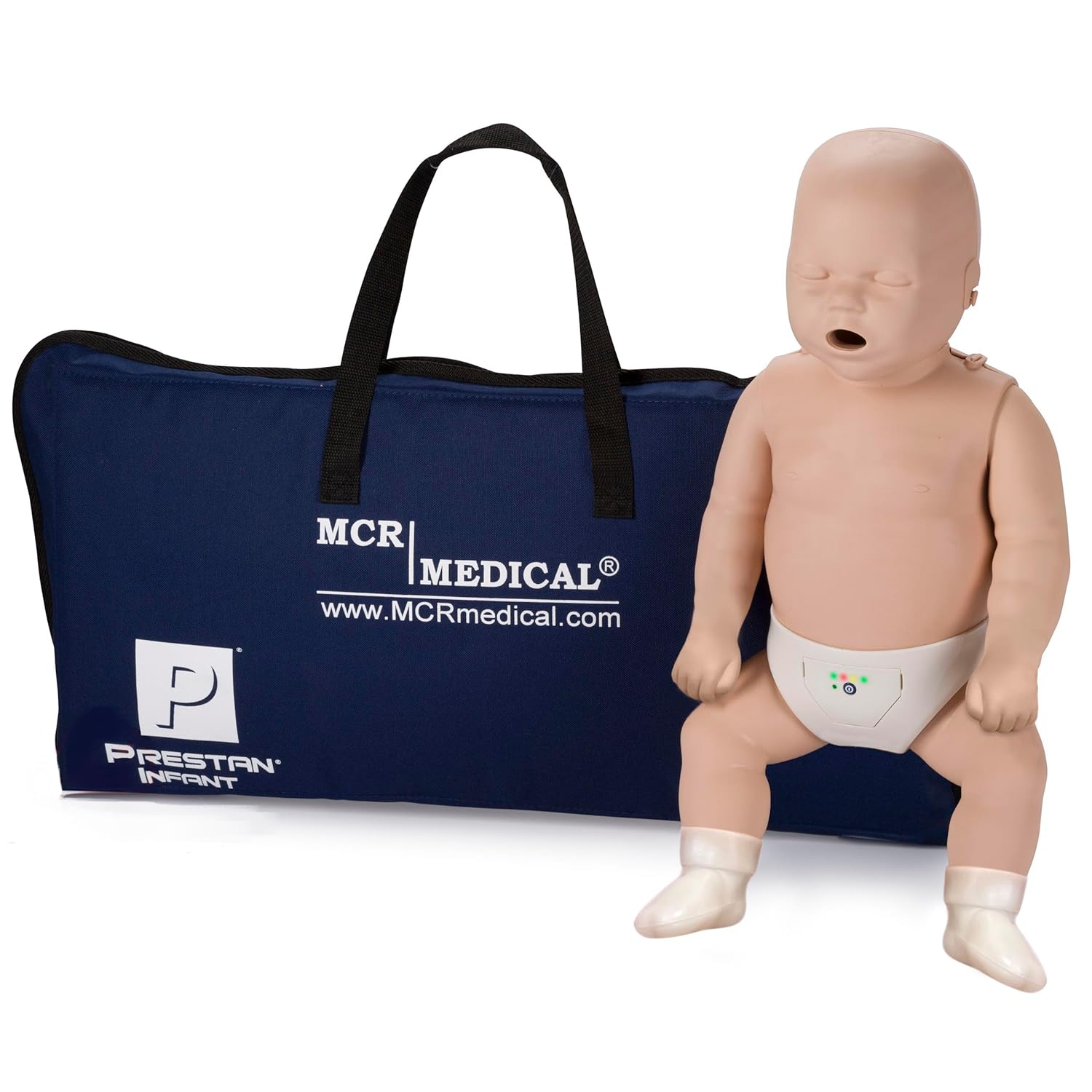 MCR Medical Infant CPR Training Manikin with Rate Monitor |
|
| $172.00 | Check price |
| Budget Alternative |  Adult and Infant CPR Mask Combo Kit |
|
| $9.95 | Check price |
| Top Mask Pick |  Red Cross Branded Adult/Child/Infant CPR Mask with O2 Inlet |
|
| $14.25 | Check price |
MCR Medical Infant CPR Training Manikin with Rate Monitor
Adult and Infant CPR Mask Combo Kit
Red Cross Branded Adult/Child/Infant CPR Mask with O2 Inlet
MCR Medical Infant CPR Training Manikin with Rate Monitor — full breakdown
The MCR Medical infant manikin is the kind of practice tool that sits in the gap between the cheap inflatable trainers daycares use for compliance check-the-box exercises and the $1,200 instrumented manikins AHA instructors run in formal courses. It’s the best infant CPR training kit for parents who want to actually rehearse technique between certifications, not just look at a diagram. The integrated rate monitor is the single feature that separates it from the rest of the at-home market: a small electronic indicator on the chest reports compressions per minute in real time, which means you find out in the first 15 seconds whether you’re drifting outside the AHA’s 100–120/min target window — and you find out before you’ve practiced 2,000 wrong-cadence compressions and built the wrong reflex.
The MCR manikin is closer to a clinical-grade practice experience than most at-home infant CPR training kits, largely because of its integrated rate monitor. That real-time feedback is the feature that separates it from passive trainers: it signals cadence drift immediately, so even a trained adult gets the corrective cue that a static manikin can’t provide.
The anatomical landmarks support both the two-finger technique (single rescuer) and the two-thumb encircling-hands technique (two rescuers) that the AHA teaches for infant compressions, which matters because the right hand position depends on who’s available when the emergency happens.
The trade-offs are real. At roughly $172, the MCR is the priciest infant CPR training kit on our list — defensible if you’re a parent expecting multiple children, a grandparent with regular caregiving duties, or a nanny who watches multiple families’ kids, harder to justify for a one-time refresher between courses.
The device also won’t teach you the rescue-breath half of CPR by itself — you’ll want to pair it with one of our recommended masks to practice the 30:2 compression-to-breath cycle the AHA prescribes. And critically, this manikin reinforces technique but does NOT replace the in-person Red Cross or AHA certification you should hold as a parent — treat it as homework between courses, never as a substitute for them.
Adult and Infant CPR Mask Combo Kit — full breakdown
The 2-mask combo kit solves the most common gap in family emergency-preparedness setups: most parents don’t own a CPR mask at all, and the ones who do typically own a single adult mask that doesn’t seat correctly on an infant face. The dedicated infant mask included in this combo is the feature that earned it our best budget mask slot — it’s sized for an under-1-year face, with a seal contour that actually fits over a newborn’s nose and mouth without overlapping the eyes or chin. At $9.95 for the pair plus one-way valves, gloves, alcohol pads, and a soft carrying pouch, it’s also the only infant CPR training kit on our list cheap enough to stock in every place your baby goes: home, car, grandparents’ house, daycare bag, vacation luggage.
The dedicated infant mask’s seal contour is sized for an under-1-year face, which is what lets a non-clinician seat it correctly — the most common failure point with oversized generic masks. The included one-way valve is the feature that makes it appropriate for real rescue-breath use, protecting the rescuer while allowing chest rise.
The nitrile gloves are a small but genuinely useful inclusion: in a real pediatric emergency, you may be working on a baby who has vomited, bled, or had a bowel movement, and the gloves let you focus on technique instead of contamination. The alcohol pads are appropriate for wiping the mask before or after a practice session.
The carrying pouch’s Velcro handle attaches to a diaper bag or backpack strap without adding bulk — though like any soft pouch, it won’t protect the silicone as well as a rigid case if it gets crushed at the bottom of a bag, so give it its own pocket when you can.
The limitations are appropriate for the price point. The silicone is thinner than premium options, and we’d recommend replacing the kit every 3 to 4 years even if unused — material drift over time degrades seal integrity. There’s no O2 inlet, which makes this an emergency-only kit rather than a clinical or EMS-grade device. For most families those trade-offs are immaterial: this is the infant CPR training kit you actually keep stocked because it was cheap enough to buy without overthinking it. Stock it alongside everything in our best baby emergency go-bag guide so the whole kit travels together.
Red Cross Branded Adult/Child/Infant CPR Mask with O2 Inlet — full breakdown
The Red Cross branded universal-fit mask is the best infant CPR training kit accessory for families who want a single device covering every age in the household. The seal contour adapts across adult, child, and infant faces, the O2 inlet allows EMS to attach supplemental oxygen on arrival without removing the mask mid-resuscitation, and the soft Red Cross branded case fits in a backpack, diaper bag, or kitchen drawer, with a nylon shell that holds its shape a bit better than the budget combo’s simple carrying pouch. At $14.25 it sits between the budget combo and a dedicated EMS-grade mask — the right price point for families who want quality silicone and clinical compatibility without buying a separate mask for every age.
The universal-fit seal contour is designed to adapt across adult, child, and infant faces. That flexibility is the expected trade-off of universal-fit design — a purpose-built infant mask like the one in our budget combo kit seats slightly more cleanly on a small face, while the universal mask is documented to cover every age in one device.
The O2 inlet is the feature that genuinely separates this from the budget pick: in a real pediatric emergency, EMS will arrive with supplemental oxygen, and a mask with an O2 inlet allows them to continue ventilation without breaking the seal you’ve already established. That handoff matters in the first 60 seconds of EMS arrival, when transitioning ventilation poorly can interrupt the compressions-and-breaths cycle the AHA emphasizes.
The Red Cross branded packaging is more than cosmetic: caregivers who completed Red Cross courses recognize the branding and the included instruction card, which reinforces correct technique alignment with what they were taught in person. The quick-reference card visible inside the case shows the 30:2 compression-to-breath ratio and the hand-position diagrams in the same visual language used in AAP HealthyChildren.org first aid for parents resources.
For households with a single child, the budget combo kit is probably enough. For households with multiple kids of different ages, or for grandparents who watch grandchildren of varied ages, the universal-fit mask is the more practical pick. Take a Red Cross course in person and keep this mask stocked alongside our baby first aid kit guide — that combination covers the prepared-caregiver baseline almost any pediatric professional would recommend.
5 things to know before buying a best infant CPR training kit
A manikin is reinforcement, not certification
Every major pediatric organization — AHA, Red Cross, AAP — emphasizes that hands-on instructor-led training is the only way to acquire CPR skills that work under stress. A best infant CPR training kit at home lets you practice between certification renewals so that the skill doesn’t decay (and skill decay is real — a published AHA scientific statement on resuscitation education documents meaningful skill drop-off within months of a course). Take a Red Cross Infant and Child CPR course in person, then use a manikin to keep the muscle memory fresh.
Infant compression cadence and depth are different from adult CPR
The AHA target for infant CPR is 100–120 compressions per minute at approximately 1.5 inches of chest depth — roughly one-third the anterior-posterior diameter of an infant chest. That’s shallower than adult compression depth and uses different hand positioning (two fingers for single rescuer, two thumbs encircling for two rescuers). A best infant CPR training kit that doesn’t specifically support those parameters trains you on adult CPR with a smaller manikin, which is not the same skill.
Mask sizing matters more than rescuers expect
A CPR mask that’s too large for an infant face won’t seal — the rescue breath escapes around the edges and the baby gets no usable ventilation. Adult-only masks are common in workplace first-aid kits and are not appropriate for infant use. The best infant CPR training kit for your family includes either a dedicated infant mask or a universal-fit mask explicitly rated for infant use. Verify on the packaging before you trust a generic mask in a real emergency.
One-way valves are non-negotiable in 2026
A CPR mask without a one-way valve exposes the rescuer to whatever is in the patient’s airway — vomit, blood, respiratory secretions, infectious agents. Every CPR mask we recommended in this guide includes a one-way valve. If you inherit an older mask without a valve, replace it. The cost of a new mask is trivial against the disease-transmission risk a rescuer faces during an unprotected rescue breath.
Storage and replacement matter more than parents expect
The best infant CPR training kit you bought 8 years ago is probably no longer the kit you should reach for. Silicone drift, valve degradation, and packaging compromise are real over multi-year storage. Replace masks every 3–4 years even if unused. Store masks in a hard case to prevent compression deformation. Manikins should be wiped down with alcohol between uses, especially if multiple family members or co-caregivers practice on them, to prevent skin or respiratory contamination across users.
Best infant CPR training kit: frequently asked questions
No — a best infant CPR training kit reinforces technique but does not replace in-person instruction. The AHA and Red Cross both require hands-on, instructor-led training for genuine skill acquisition, and the published lay-rescuer outcomes data supports that requirement. Use a home manikin to practice between certifications, but always start with an in-person Red Cross Infant and Child CPR course or AHA Heartsaver Pediatric First Aid CPR AED course. The combination of a course plus at-home reinforcement is the best predictor of skill retention at the 6-month and 12-month marks.
Infant CPR (under 12 months) uses two fingers (single rescuer) or two thumbs encircling (two rescuers) at the center of the chest just below the nipple line, compressing about 1.5 inches at 100–120 per minute, with 30:2 compressions-to-breaths for lay rescuers. Child CPR (1 year to puberty) uses one or two hands at the lower half of the breastbone, compressing about 2 inches. Adult CPR uses two stacked hands compressing about 2 inches at 100–120 per minute. The best infant CPR training kit specifically supports the infant parameters — generic CPR equipment doesn’t necessarily.
Call 911 immediately and begin CPR if your infant is unresponsive AND not breathing normally (or only gasping). Always defer to live 911 dispatchers, who can provide telephonic CPR instructions while EMS is en route. The published AHA pediatric chain-of-survival emphasizes immediate recognition, immediate 911 activation, immediate compressions, and rapid EMS handoff.
This guide and any best infant CPR training kit are preparation tools — in a real emergency, your training and the dispatcher’s instructions, not a product review, are what guide your actions. Consult AAP HealthyChildren.org first aid for parents for additional pediatric emergency guidance.
Published skill-retention data suggests meaningful technique decay within 6 months of an initial certification course. A best infant CPR training kit at home lets you run a 5-minute refresher every 2 to 4 weeks — long enough to recall the cadence, hand position, and 30:2 ratio without becoming a chore. Pair quarterly home practice with the every-2-year recertification cycle the Red Cross and AHA recommend, and your skill retention will track meaningfully better than the typical lay-rescuer baseline. The MCR Medical rate monitor is particularly useful here because it tells you immediately whether your unsupervised practice is on-cadence.
Yes — for two reasons. First, infection control: a one-way valve mask protects the rescuer from airway contaminants during rescue breaths, which is non-trivial when the patient is a sick infant who may have vomited or have respiratory infection.
Second, seal quality: a properly sized infant mask can deliver a more effective rescue breath than mouth-to-mouth-and-nose on a panicked rescuer, with cleaner chest rise and more reproducible technique. Every best infant CPR training kit we recommend includes a one-way valve mask, and we’d stock at least one in every place your baby spends time — home, car, grandparents’ house, daycare bag.
The two largest providers in the United States are the American Red Cross (Infant and Child CPR/AED course) and the American Heart Association (Heartsaver Pediatric First Aid CPR AED course). Both are typically offered through local hospitals, community centers, and Red Cross or AHA training partners; both run roughly 4 to 6 hours including the AED component and cost roughly $80 to $130 depending on region. We strongly recommend the in-person option — blended courses are available, but the hands-on portion is the part that builds the muscle memory a best infant CPR training kit then helps you maintain.
Our #1 best infant CPR training kit pick: MCR Medical Infant CPR Training Manikin
The most realistic at-home infant manikin we reviewed, with an integrated rate monitor that catches cadence drift before it becomes muscle memory. Pair it with the $9.95 Adult and Infant CPR Mask Combo Kit for go-bag and emergency-stash use (or step up to the Red Cross Branded Adult/Child/Infant CPR Mask with O2 Inlet, our top mask pick), take a Red Cross or AHA Infant/Child CPR course in person, and you have the prepared-caregiver baseline almost any pediatrician would recommend for under $185 total.
Medical disclaimer: Not medical advice. A best infant CPR training kit is a practice tool only and does NOT replace in-person AHA or American Red Cross CPR certification. We strongly recommend every parent and caregiver complete an in-person Red Cross Infant and Child CPR course (or AHA Heartsaver Pediatric First Aid CPR AED course) and recertify on the 2-year cycle those programs recommend. In a real emergency, call 911 immediately, follow dispatcher instructions, and begin CPR according to your in-person training. Consult HealthyChildren.org (AAP) and AHA CPR resources for additional pediatric guidance.
Prices: Reflect typical Amazon pricing as of May 2026 and may vary. Manufacturer model numbers occasionally change — verify on the linked product page before ordering. The pediatric resuscitation outcomes literature referenced is available via PubMed (NCBI).
- Auerbach M. Pediatric Resuscitation. Medscape Drugs & Diseases (eMedicine); updated Jun 14, 2021. Structured pediatric basic and advanced life support (AHA/AAP) underlies the response to pediatric cardiopulmonary arrest.
- Topjian AA, Raymond TT, Atkins D, Duff JP, et al. Part 4: Pediatric Basic and Advanced Life Support: 2020 American Heart Association Guidelines for Cardiopulmonary Resuscitation and Emergency Cardiovascular Care. Circulation. 2020;142(16_suppl_2):S469-S523. Defines infant CPR quality: a compression rate of 100-120 per minute, a depth of about 4 cm (1.5 in, one-third of the chest’s anterior-posterior diameter), full chest recoil, two-finger (single-rescuer) or two-thumb encircling (two-rescuer) hand placement, and a 30:2 compression-to-ventilation ratio for a lone lay rescuer.
- Cheng A, Nadkarni VM, Mancini MB, et al. Resuscitation Education Science: Educational Strategies to Improve Outcomes From Cardiac Arrest – A Scientific Statement From the American Heart Association. Circulation. 2018;138(6):e82-e122. Resuscitation psychomotor skills decay within months of training, so brief, frequent refresher practice is recommended to sustain CPR competence between courses.